

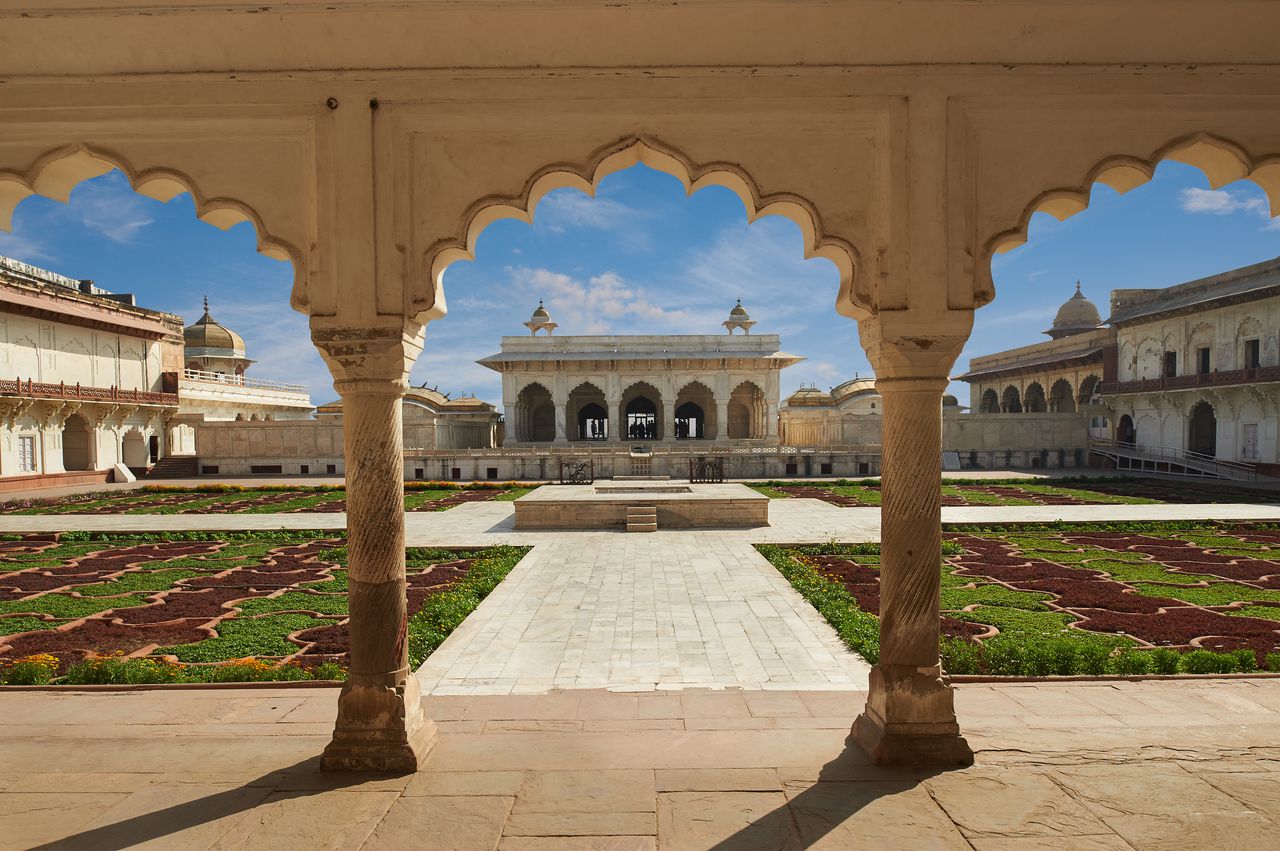
The Red Fort of Agra – A Vision in Stone
Diwan-i-Aam and the Grand Courtyard
The Macchi Bhavan and the Diwan-i-Khas
Jahangiri Mahal
The Agra Fort stands as a breathtaking testament to India’s medieval grandeur — a place where marble dreams and red-sandstone walls whisper the brilliance of the Mughal empire. Its palaces, mosques, and elegant pavilions showcase an unmatched artistic sensibility, reflecting the royal life, culture, and refined tastes of the mighty emperors who once lived within these walls.
Every historic fort in the world holds stories etched into its stones, but Agra Fort carries a legacy that feels almost alive. Walk through its colossal gateways, trace your fingers along the ancient walls, and you can sense centuries of triumphs, intrigues, romances, and battles preserved in silence.
To truly appreciate its architectural beauty, you must first travel back in time. Long before it became the jewel of Mughal artistry, the Agra Fort was known by another name entirely. Over a thousand years ago, it was attacked and seized in 1080 by Mahmud Shah, the ruling governor of Hind — a moment recorded in the writings of 11th-century poet Salman.
From that early, turbulent past, the fort evolved into a commanding symbol of power and sophistication under the Mughals. Today, it stands proudly on the banks of the Yamuna, reminding every visitor of the empires it has witnessed and the masterpieces it inspired.
Agra Fort isn’t just architecture — it is history carved into stone, still standing strong after a millennium of stories.
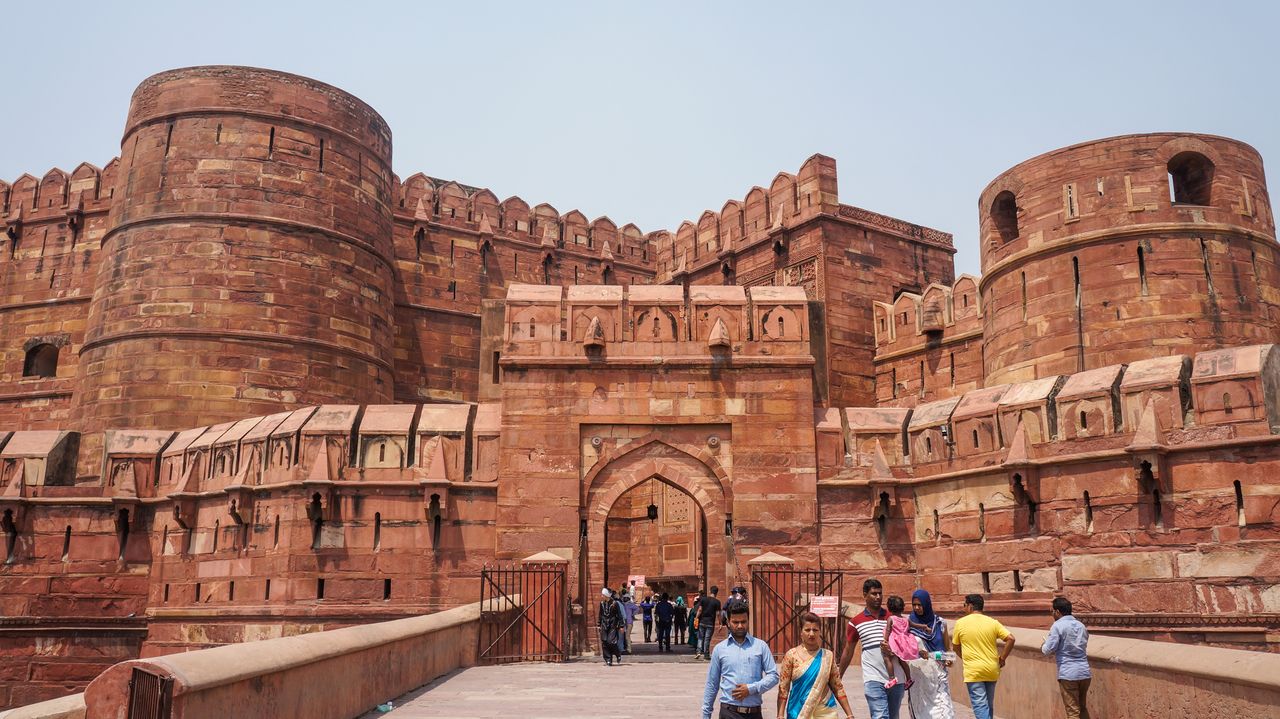
The majestic front face of Agra’s Red Fort looms into view, its colossal red-sandstone walls once bristling with cannons, archers, and absolute authority. Today, this grand entrance still radiates the power of an empire. © isaray / Shutterstock
Time swept forward, and Agra’s destiny began to shift dramatically. Between 1487 and 1517, the Sultans of Delhi chose Agra as their capital, transforming it into a thriving center of culture, scholarship, and influence. During this era of growth, Raja Badal Singh commissioned the construction of Badalgarh Fort, a project that took eight long years and stood boldly on the very grounds where the Agra Fort exists today.
History turned another page when Sikandar Lodi died in 1517. His son, Ibrahim Lodi, ascended the throne and ruled for nine turbulent years. In that time, he expanded the site further by adding a grand palace between 1518 and 1526, setting the stage for what would soon become one of India’s most contested strongholds.
But the year the palace was completed, everything changed. Babur, the founder of the Mughal Empire, marched into India and defeated Ibrahim Lodi at the Battle of Panipat. His foreign forces stormed Agra, seized the fort, killed the Raja of Gwalior, and imprisoned his family. Within the fortified walls, Babur’s son Humayun stepped into power and discovered treasures beyond imagination — including the legendary Koh-i-Noor diamond, glimmering among a trove of rare gems.
In 1527, Babur ordered the construction of a three-story stepwell (baoli), a marvel of Mughal engineering that still survives today, offering visitors a glimpse into the fort’s earliest Mughal chapter.
Yet Agra Fort’s story was far from settled. In 1540, the Sur dynasty’s formidable leader Sher Shah Suri defeated Humayun at Bilgram and took control of the fort. But his hold, too, was brief. Within just five years, Agra Fort would once again fall under siege — proving that this magnificent stronghold has always been at the center of India’s most dramatic power struggles.
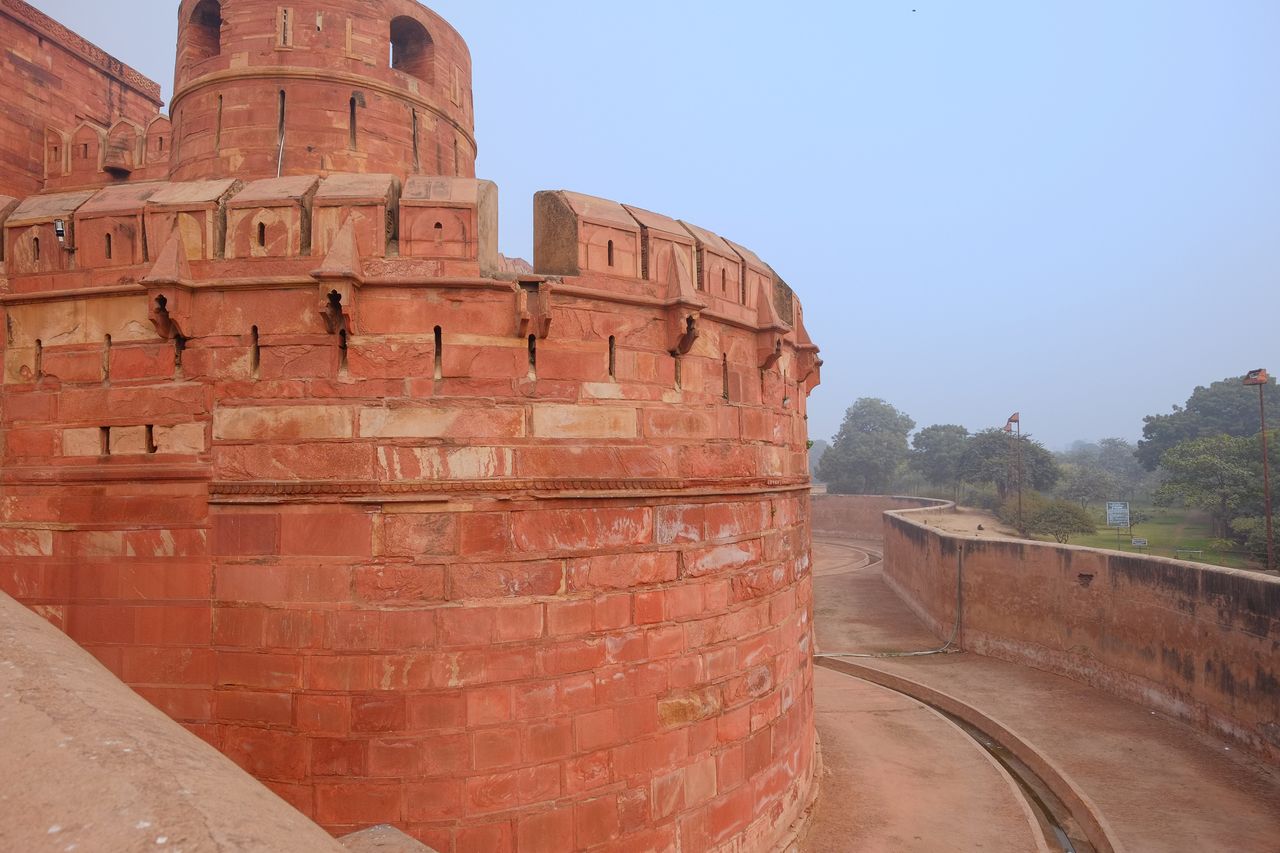
For over two centuries, a massive 2 km-long moat wrapped protectively around Agra Fort—an impenetrable water barrier that kept invading armies at bay. © Julian52000 / Shutterstock
In 1556, the Mughal army returned to Agra for yet another decisive chapter in its turbulent history. Iskandar Khan managed to hold the fort for a while, but everything changed in 1558, when the young and ambitious Akbar arrived. With his victory, the fort passed fully into Mughal hands — and Akbar envisioned far more than a military outpost.
He transformed the conquered stronghold into the beating heart of the Mughal Empire. Agra became the Dar’ul Khilafat, the seat of imperial power, and in a bold declaration of authority, he renamed the city Akbarabad. For nearly a century, this new capital knew peace rather than battle. It blossomed into a prosperous, influential center — a place where ideas, culture, art, and power met in magnificent harmony.
But its long, war-torn past had left visible scars on the old structures. Akbar decided the old Badalgarh Fort needed to be reborn. In 1565, he ordered it to be torn down completely. The emperor entrusted Muhammad Qasim Khan, his chief overseer of buildings, with designing a new fort worthy of a grand empire. Master architects and artisans arrived from distant regions such as Gujarat and Bengal.
For eight tireless years, nearly 3,000 masons, laborers, and craftsmen worked day and night. Together they built an entirely new fortress city: palaces, royal residences, mosques, hammams (bathhouses), gardens, and exquisite pavilions — all rising within its towering walls. They chose dressed red sandstone, a bold and unprecedented material for a project of such monumental scale. What emerged was nothing short of a masterpiece — a shining jewel of Mughal architecture.
Akbar wanted power to be seen in stone — an unshakeable citadel that proclaimed the might of his empire. Yet he also had a deep appreciation for beauty. So the fort blended strength with stunning artistry: massive battlements and embrasures were softened by delicate Islamic geometry, elegant calligraphy, and motifs inspired by Hindu traditions — flowers, birds, and mythical creatures woven into carvings and patterns. The result was a magnificent fusion of cultures, something only the Mughal imagination could have realized.
The completed Agra Fort stood surrounded by a nearly impregnable double wall of red sandstone, stretching 2.4 km (1.5 miles) in a grand semicircle along the Yamuna River. The inner wall towered above the outer, and both were crowned with crenelated battlements. Massive round bastions reinforced the ramparts, perfectly aligned for military defense. Rising 21 meters (69 ft) high, these walls were breached only once — by the British during the Indian Rebellion of 1857. Below them, a wide 10-meter-deep moat wrapped around the fort, once filled with water and designed to halt invaders in their tracks.
What Akbar built was not just a fort — it was a statement of power, a celebration of artistic brilliance, and the very foundation of Mughal glory. Even today, as visitors walk through its gates, they can feel the echo of that legacy in every stone.
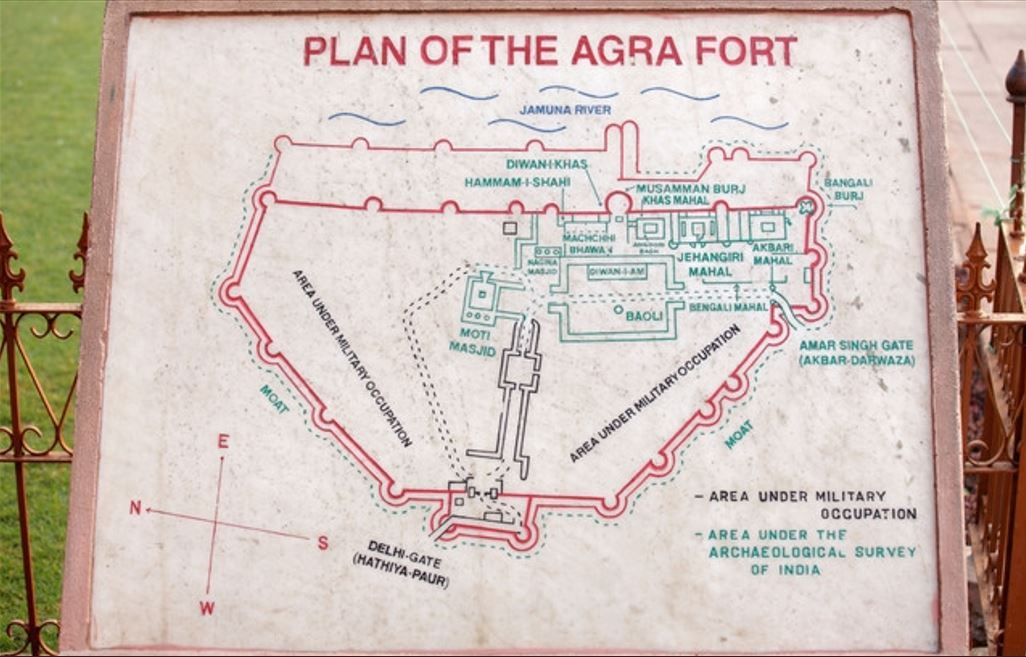
A detailed architectural plan of Agra Fort reveals its distinctive crescent shape—an ingenious design blending beauty, strategy, and Mughal engineering mastery.
Akbar’s own court historian, Abu’l Fazl, recorded in the Ain-i-Akbari that the emperor commissioned over 500 red-sandstone structures within the mighty Agra Fort. Imagine the sheer grandeur of that architectural city-within-a-city — palaces, pavilions, halls, and gardens glowing in the warm hue of imperial red.
Sadly, time has not been kind to all of them. Only a small portion of those magnificent creations survives today. Yet even in their reduced number, the remaining buildings still capture the breathtaking vision and audacity of Akbar’s architectural genius. Each surviving structure feels like a fragment of a once-larger world — a reminder of the fort’s unmatched splendor at the height of the Mughal Empire.
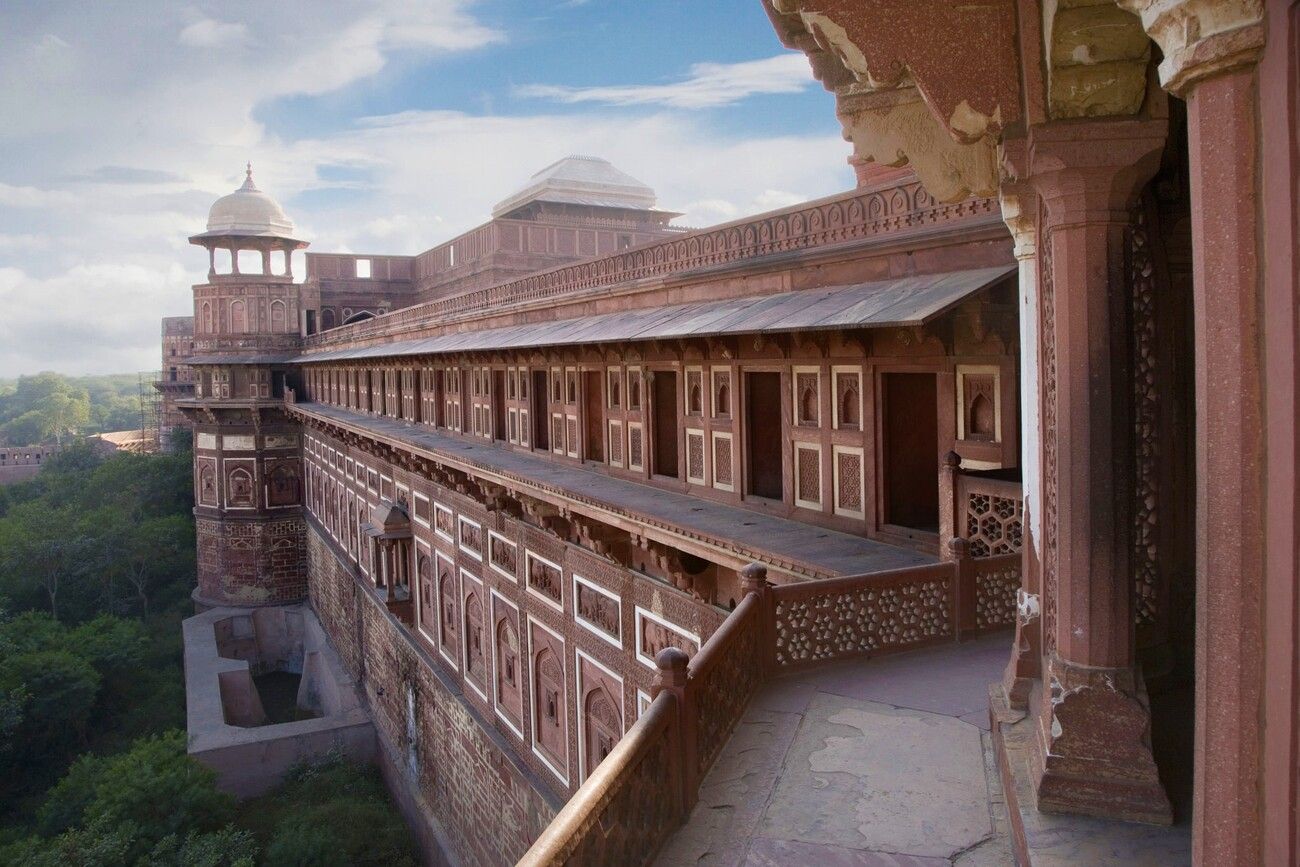
Agra Fort’s eastern wall stretches almost perfectly straight along the Yamuna River, which once acted as a natural defense line guarding the fort’s vulnerable flank. © Don Mammoser / Shutterstock
Four grand gateways once guarded the powerful Red Fort of Agra — each strategically placed and brilliantly engineered. To the south stood the Amar Singh Gate, to the west the formidable Delhi Gate, to the east the Jal Darwaza facing the Yamuna River, and to the north the commanding Darshani Gate. Today, it is this northern gate that welcomes visitors into the heart of the fort.
Among the structures that still stand proudly from Akbar’s era are the Akbari Mahal, the Jahangiri Mahal, the former Bengal Mahal (built between 1568–1569), the southern Amar Singh Gate, and the west-facing Delhi Gate, all constructed during the late 1560s. These surviving masterpieces offer a glimpse into Akbar’s extraordinary architectural ambition — where aesthetics, engineering, and imperial grandeur blended seamlessly.
Both the Amar Singh and Delhi Gates were fortified with ingenious defensive features: raised battlements, massive bastions, hidden traps, and crooked, winding passages designed to confuse and slow down intruders. These clever additions also provided extra protection for Mughal soldiers positioned above, allowing them to fire safely at enemies caught in the maze below.
Thanks to its almost impregnable defences, the Mughals felt confident enough to store their most precious treasures in the fort’s underground vaults. Deep beneath the red sandstone walls, jewels, riches, and priceless artifacts rested securely — protected by one of the most formidable strongholds in medieval India.
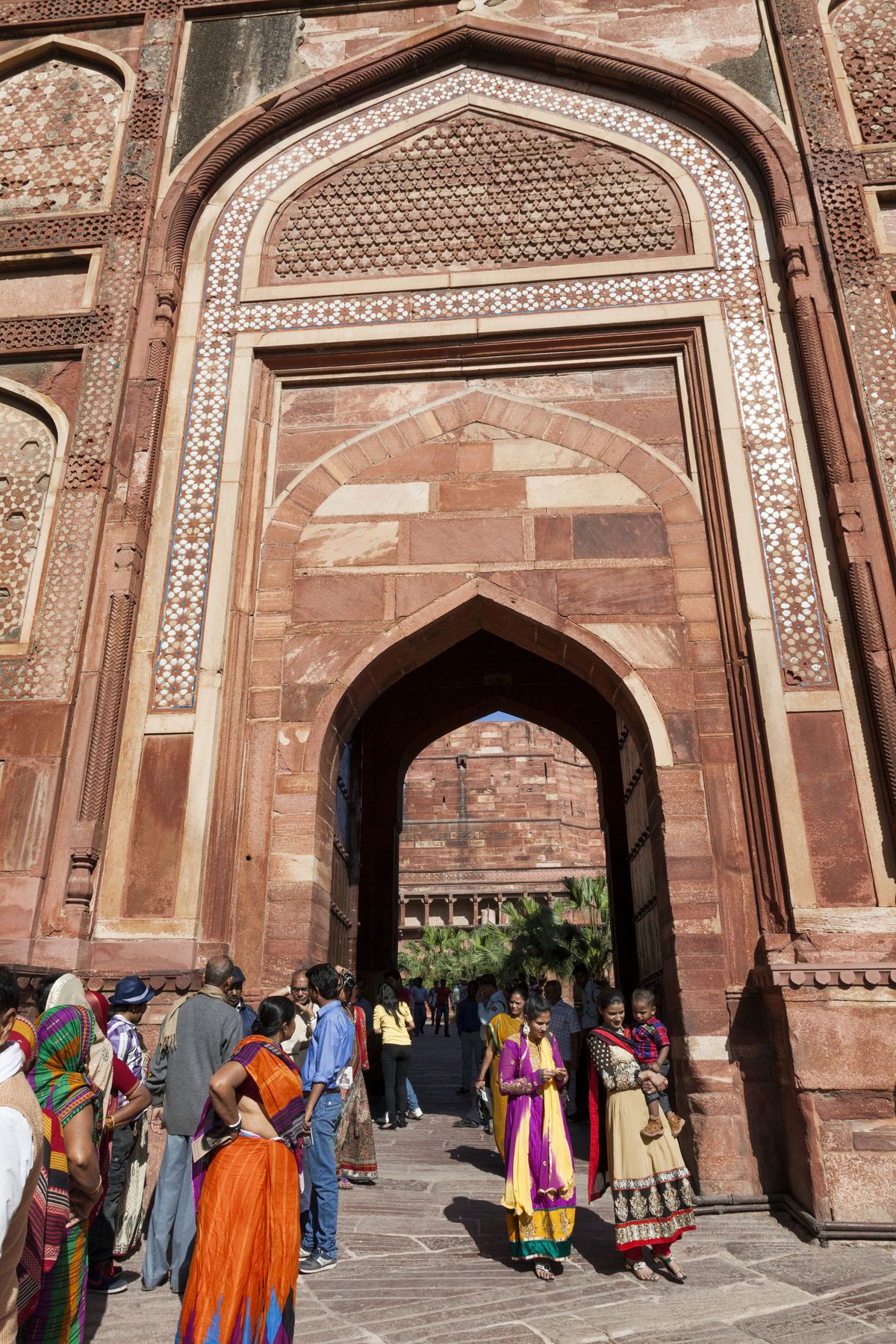
The fort’s second grand gateway showcases a stunning fusion of glowing red sandstone and delicate white marble—Mughal artistry at its best. © powerofforeever
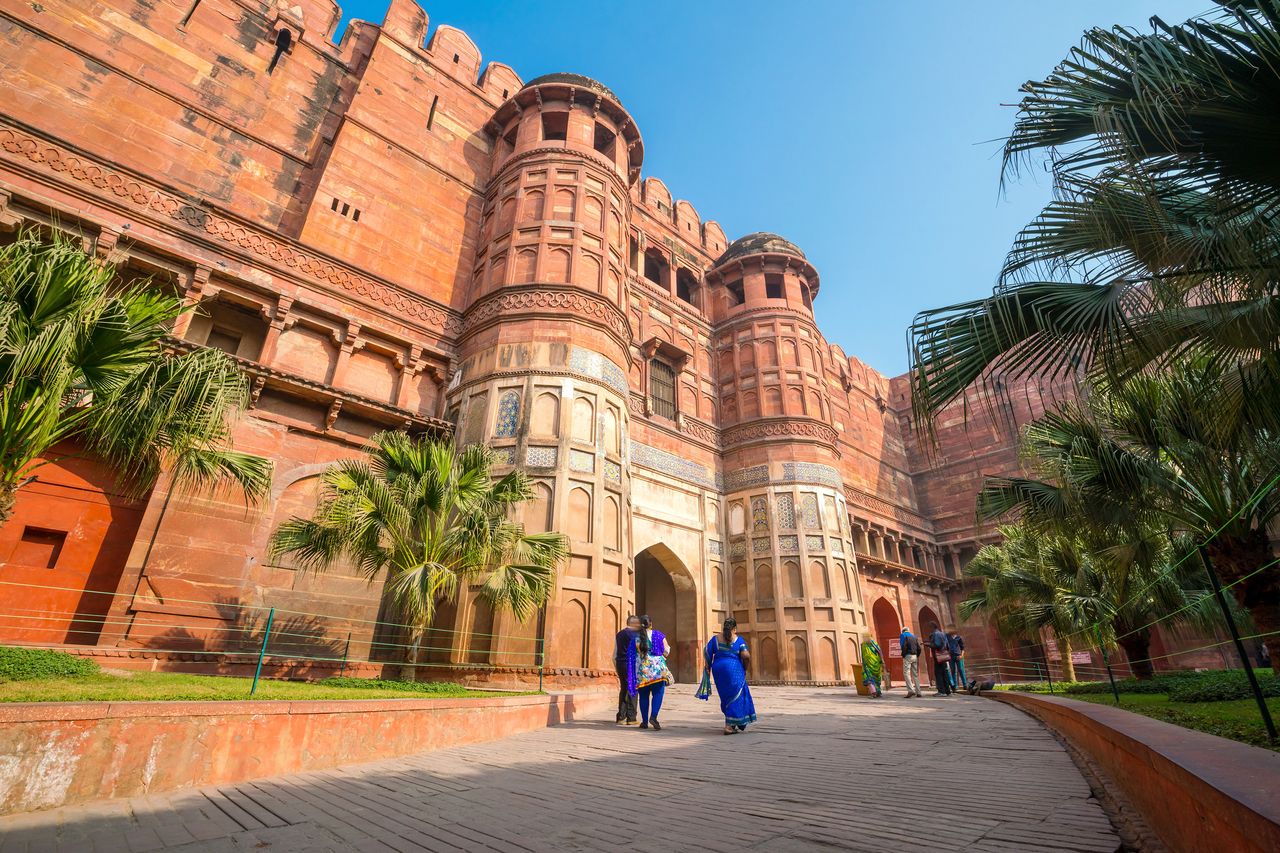
Another mighty entrance rises ahead—one of the three impressive gateways leading visitors deeper into the labyrinthine Red Fort of Agra. © f11photo / Shutterstock
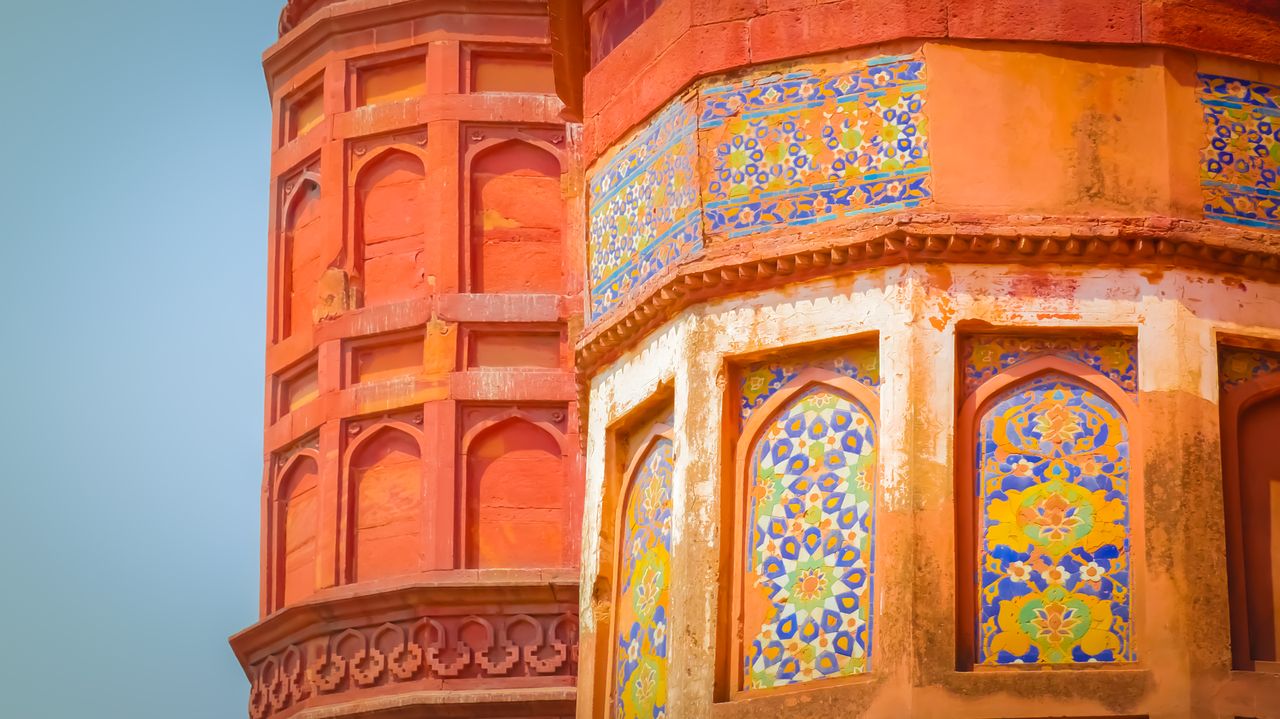
The third gateway still gleams with its original 16th-century ceramic tiles, their vibrant colors standing out against the rugged red sandstone towers. © Vivvi Smak / Shutterstock
In 1565, Emperor Akbar began constructing the magnificent Jahangiri Mahal as a private palace for his beloved son, Prince Jahangir. Instead of erasing the past, Akbar wove it into his vision — incorporating sections of the earlier Ibrahim Lodi Palace (built in 1518). These older portions, forming the eastern and northeastern wings, are still easy to spot today. Their refined craftsmanship and distinctive building techniques stand out like elegant relics from another era, seamlessly woven into the Mughal masterpiece.
When Akbar died in 1605, Jahangir ascended the throne and became emperor. Although he preferred the cool valleys of Kashmir and the grandeur of Lahore, he returned to Agra frequently, staying in the Red Fort during his visits. The palace his father built for him became not only a residence, but a symbol of the bond between father and son — a place where imperial duties intertwined with personal memory.
Then, in 1628, the throne passed to Jahangir’s third son — Shah Jahan, the visionary emperor who would later gift the world the Taj Mahal. With a deep love for white marble and delicate ornamentation, Shah Jahan reshaped the Agra Fort in his own artistic image. He began replacing many of Akbar’s red sandstone structures with shimmering marble creations that reflect his refined aesthetic.
Among his most celebrated contributions are:
• The elegant Nagina Masjid,
• The exquisitely crafted Mina Masjid,
• The breathtaking octagonal Jasmine Tower (Musamman Burj) — where he is believed to have spent his final years, gazing toward the Taj Mahal,
• And the grand Diwan-i-Aam (Hall of Public Audience).
All of these were constructed between 1631 and 1640, marking a golden decade in Mughal architectural history — a period when strength met grace, and the Red Fort transformed into a living canvas of imperial splendor.
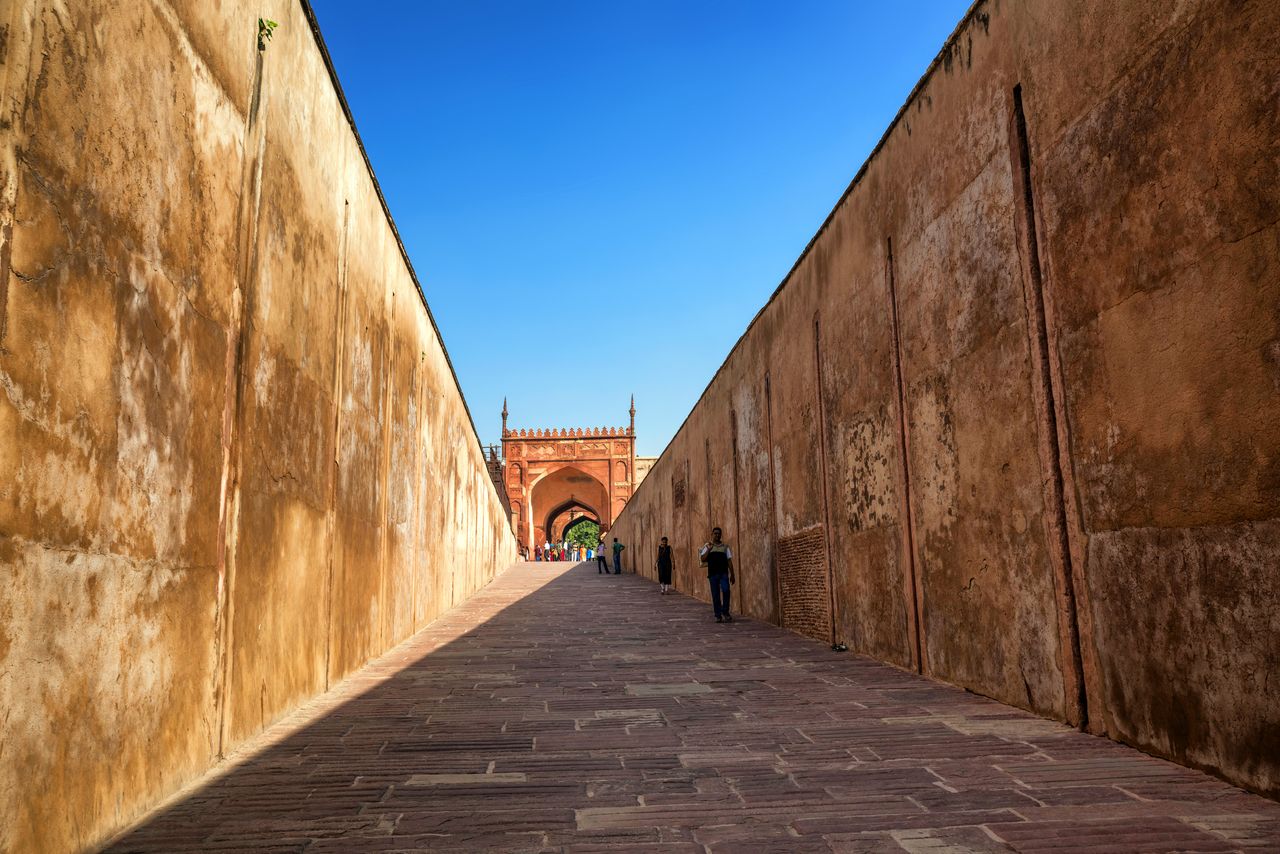
A gently sloping ramp flanked by towering sandstone walls guides visitors toward the royal courtyard—a dramatic approach that echoes centuries of imperial footsteps. © Images of India / Shutterstock
Diwan-i-Aam and the Grand Courtyard
Once reserved exclusively for the emperor and his royal entourage, the Amar Singh Gate now welcomes every visitor who enters Agra Fort. But in its day, it was a brilliant defensive marvel. Comprising three interconnected gates placed at sharp right angles, the zigzag layout confused invaders and made it nearly impossible for them to wield weapons or gain momentum.
Beyond the gates, a gently rising ramp enclosed by towering walls leads deeper into the fort until it opens dramatically into a vast inner courtyard, shaded by orderly rows of trees — a peaceful contrast to the intimidating entrance.
Along one end of the courtyard stands a graceful three-sided portico, commissioned by Shah Jahan in 1628 to replace an older wooden structure. This portico forms the approach to the breathtaking Diwan-i-Aam, or Hall of Public Audience. Perfectly proportioned columns and intricately carved arches create a sweeping, unobstructed view of the elevated marble throne platform, where the emperor once sat in judgment and heard petitions from his subjects.
In Mughal times, this hall was nothing short of splendid. Imagine it adorned with rich carpets, satin canopies, and shimmering brocade — transformed into a palace of color and luxury during the festive Nauroz celebrations. Gold-woven Persian and Gujarati fabrics, velvet drapes from Constantinople, and even European umbrellas were part of the lavish décor that elevated the festival into a regal spectacle.
The throne itself, famously crafted to support the gem-studded Peacock Throne, later journeyed to Delhi before being plundered by Nadir Shah and ultimately ending up in Tehran. The original throne room at Agra Fort was a masterpiece of Mughal design — decorated with recessed niches, marble inlay, and elegant three-winged arches. On either side, delicately perforated marble screens allowed the royal women to watch the proceedings unseen, preserving their privacy while keeping them connected to courtly life.
This sacred chamber, once known as the Nasheman-e-Zill-e-Ilahi or Jharoka-e-Daulat Khana, also housed the small marble baithak — the table where ministers received petitions, issued orders, and conducted trials. Here, justice was not only heard but swiftly carried out.
North of the Diwan-i-Aam lies an area closed to the public, yet the white marble domes and chhatris of the Moti Masjid (Pearl Mosque) rise above the walls like a serene vision. Although elegant, its slightly heavy proportions give it a distinctive, memorable presence.
Just outside the audience hall stands a surprising — and historically poignant — marker: a small Gothic Christian tomb, out of place amid Mughal splendor. It marks the resting place of John Russell Colvin, the Lieutenant Governor of the Northwestern Provinces, who died inside the fort during the 1857 uprising when Agra’s British residents barricaded themselves inside for safety.
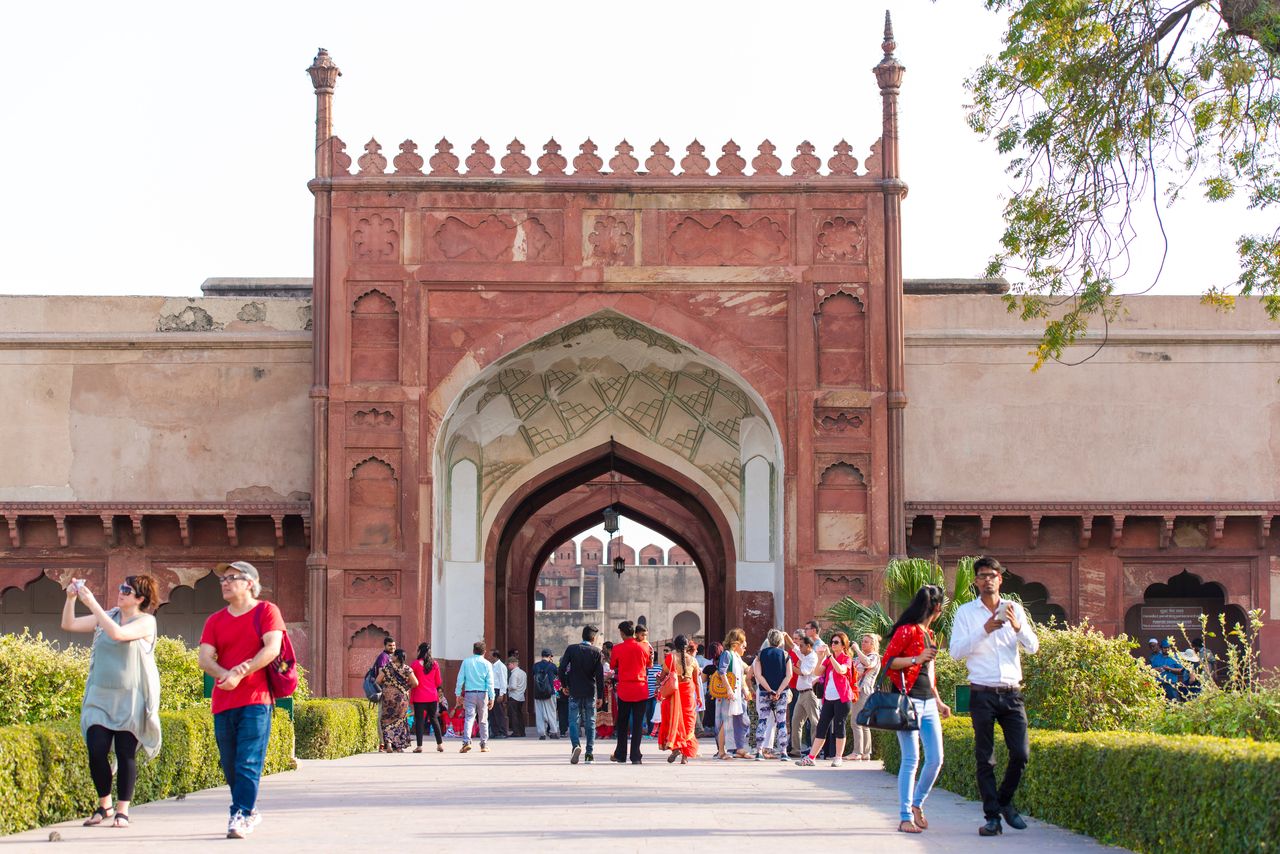
After passing through its series of monumental gates, visitors finally step into the heart of Agra Fort—and the sheer scale of the inner complex never fails to astonish. © Savvapanf Photo / Shutterstock
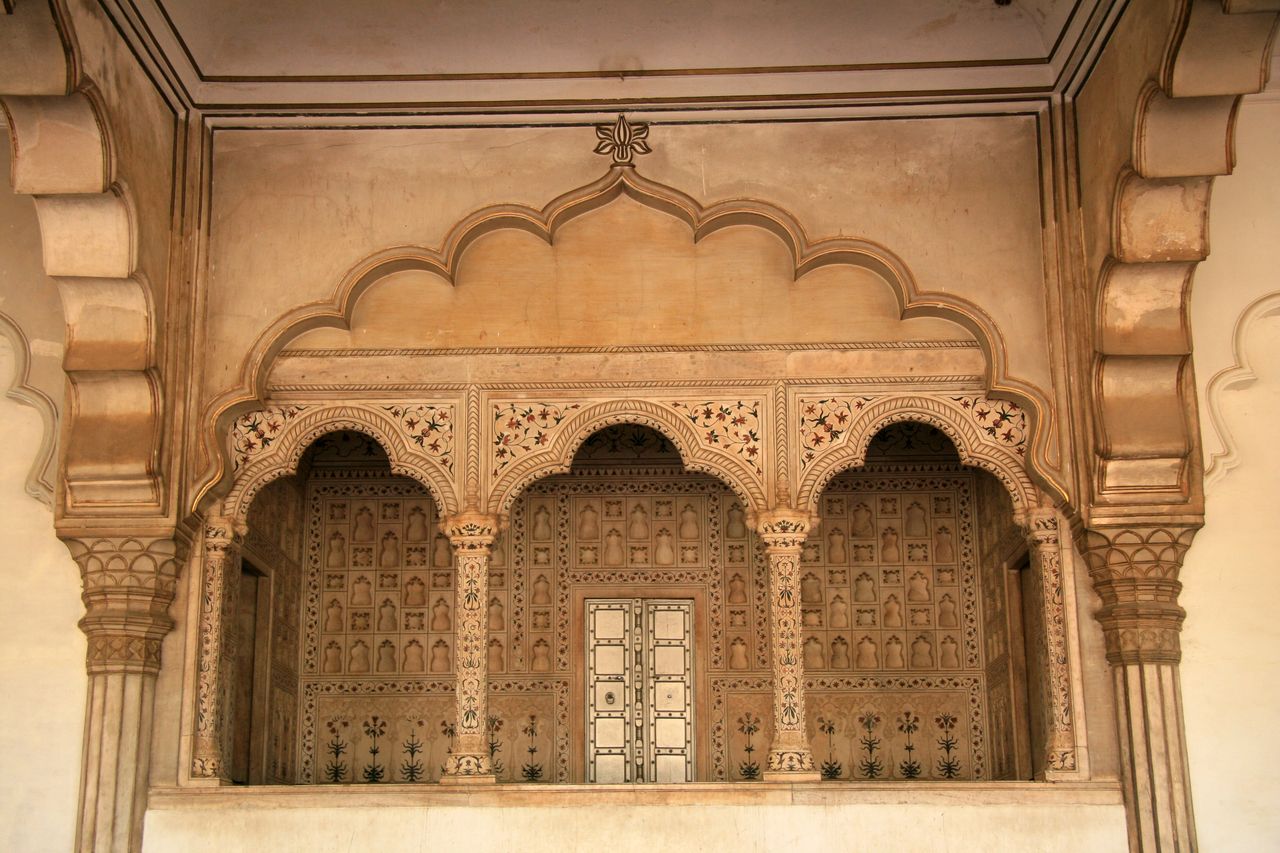
The Peacock Throne once glittered here in the Diwan-i-Aam—where emperors listened to the grievances of their people. Its marble base still glows with inlaid semi-precious stones, a reminder of its former splendor.
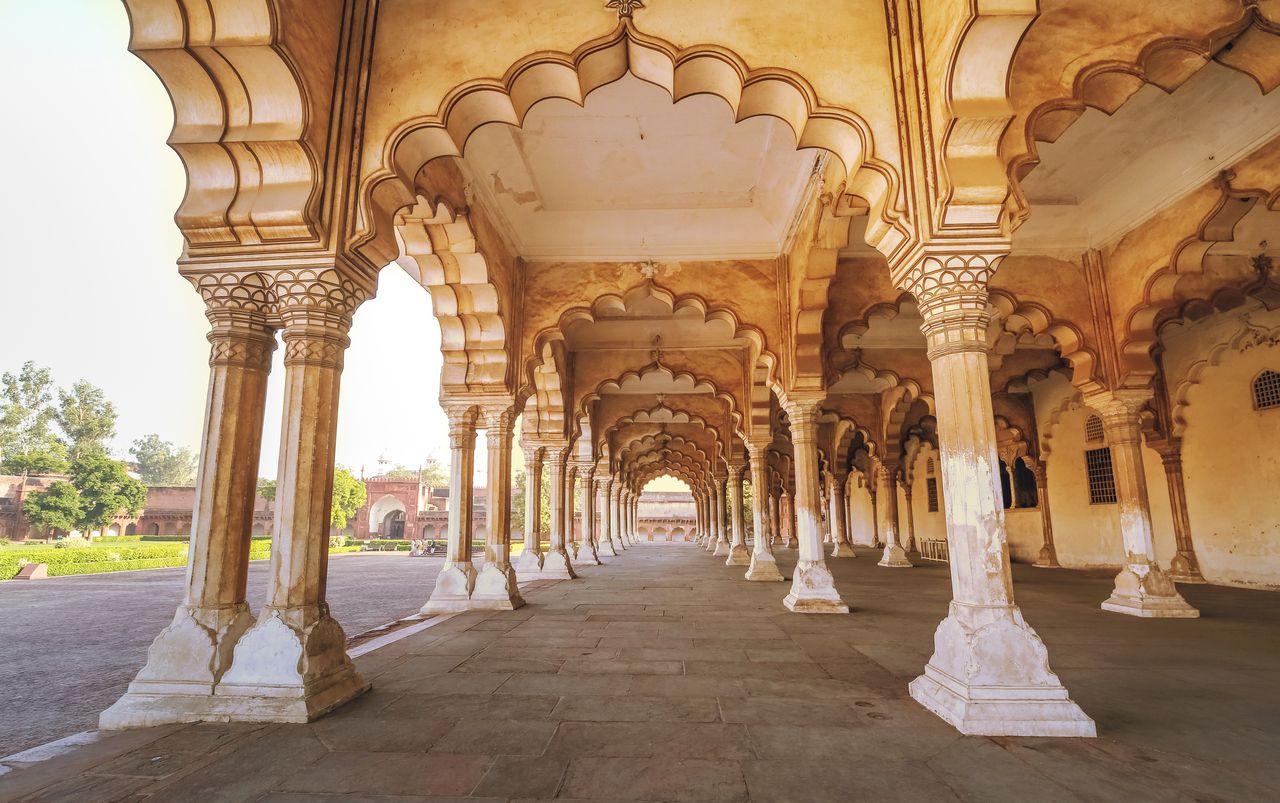
An exterior view of the Diwan-i-Aam reveals elegant double columns framing the airy public audience hall where Mughal emperors addressed their subjects. Agra Fort
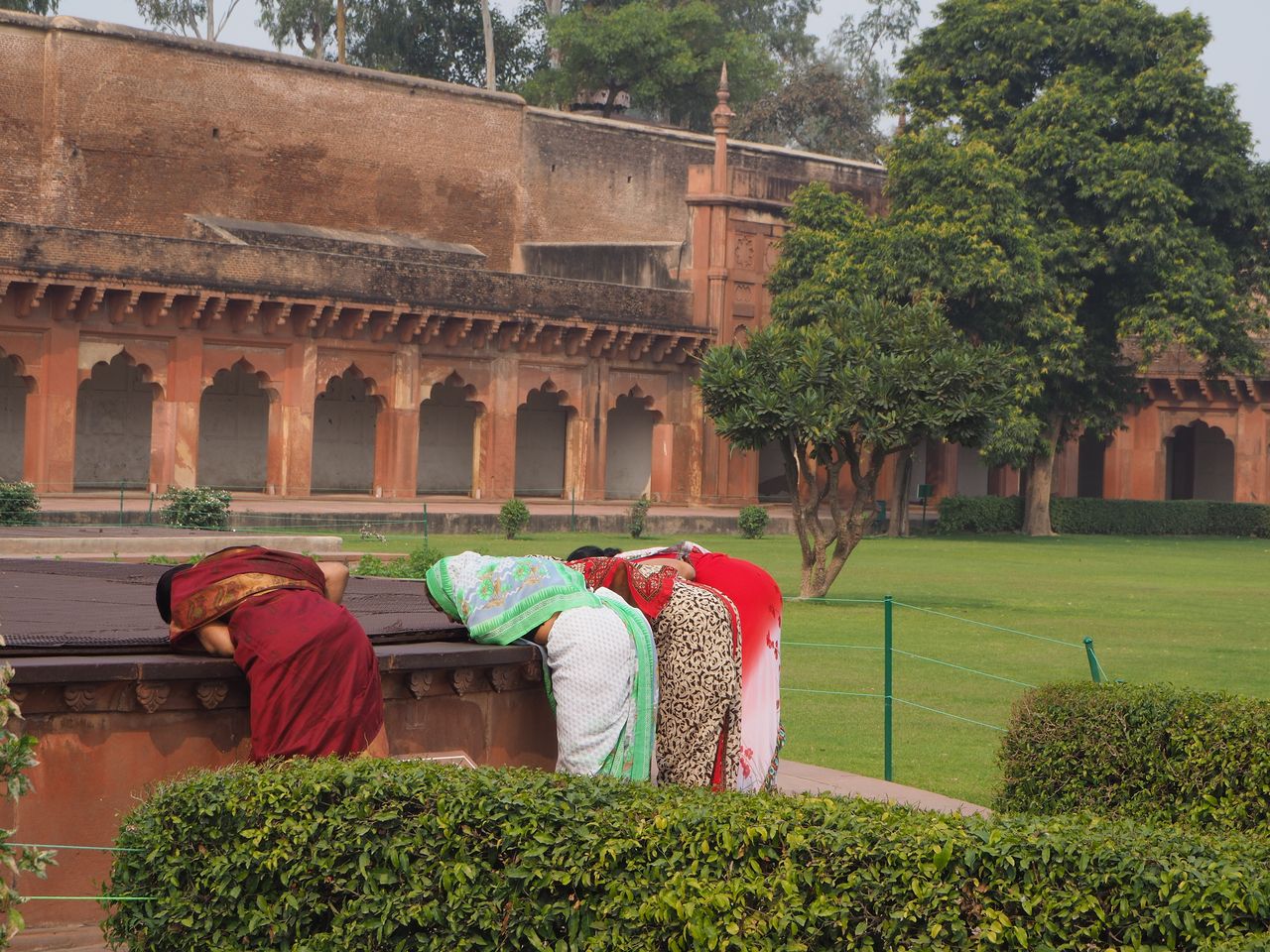
Curious visitors gather around an ancient well inside Agra Fort—now safely covered, but still sparking imagination about the lives that once depended on it.

A visitor leans near a historic well as the ethereal white domes of the Moti Masjid rise gracefully behind a red sandstone wall. This serene mosque was reserved exclusively for royalty. © Yurataranik / Dreamstime
The Macchi Bhavan and the Diwan-i-Khas
A hidden doorway to the left of the emperor’s throne in the Diwan-i-Aam leads to something extraordinary. Slip through this small, almost secret door and climb the narrow staircase, and you emerge into the upper level of the Macchi Bhavan — the famed Fish Palace.
Once a magnificent double-storeyed complex surrounding a grand courtyard, the Macchi Bhavan served as the royal treasury, safeguarding the Mughal empire’s priceless ornaments and jewels. But it wasn’t all business and security here — the courtyard itself was designed for pleasure and leisure. Historians believe it once held shimmering water channels and tanks filled with fish, where the emperor and his closest companions indulged in the noble pastime of angling. Imagine fountains playing gently, flower beds blooming in symmetry, and the tranquil sound of water echoing through the royal courtyard — a serene oasis at the heart of a powerful fortress.
Unfortunately, Macchi Bhavan has endured its share of plunder. The Maharaja of Bharatpur stripped away much of its original marble to embellish his Deeg Palace. Later, during the British era, Governor-General William Bentinck (1828–1835) sold off much of the intricate fretwork and mosaic designs that once decorated this splendid structure.
Yet even today, despite these losses, the Macchi Bhavan retains a ghost of its former grandeur. As you walk through its courtyard, you can still feel whispers of its opulence — the glint of jewels once stored here, the laughter of emperors fishing for sport, and the elegance of gardens that adorned one of the Mughal empire’s most enchanting palace spaces.
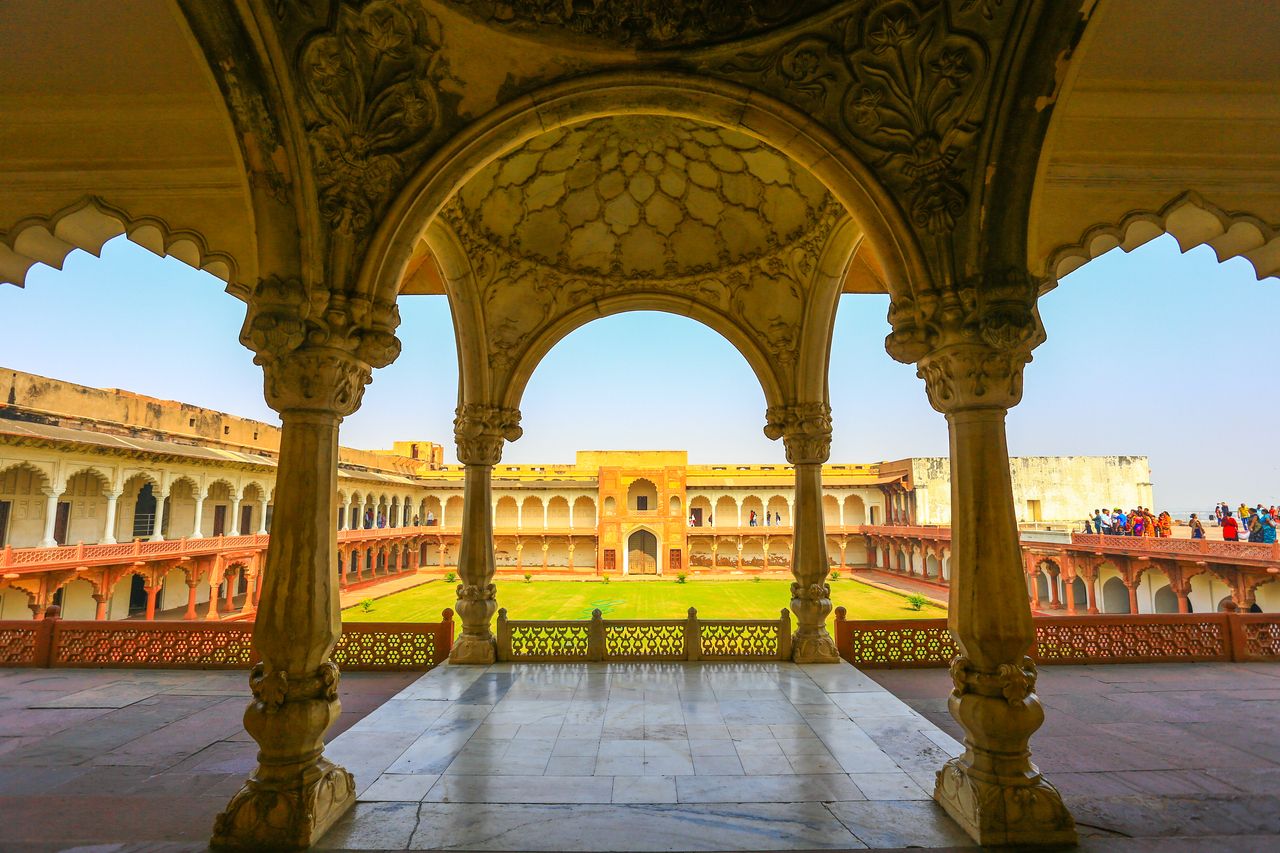
The Macchi Bhavan, or Fish Palace, surrounds a vast courtyard where sparkling pools once teemed with fish for the emperor’s amusement—a royal retreat of leisure and elegance. © Club4Traveler
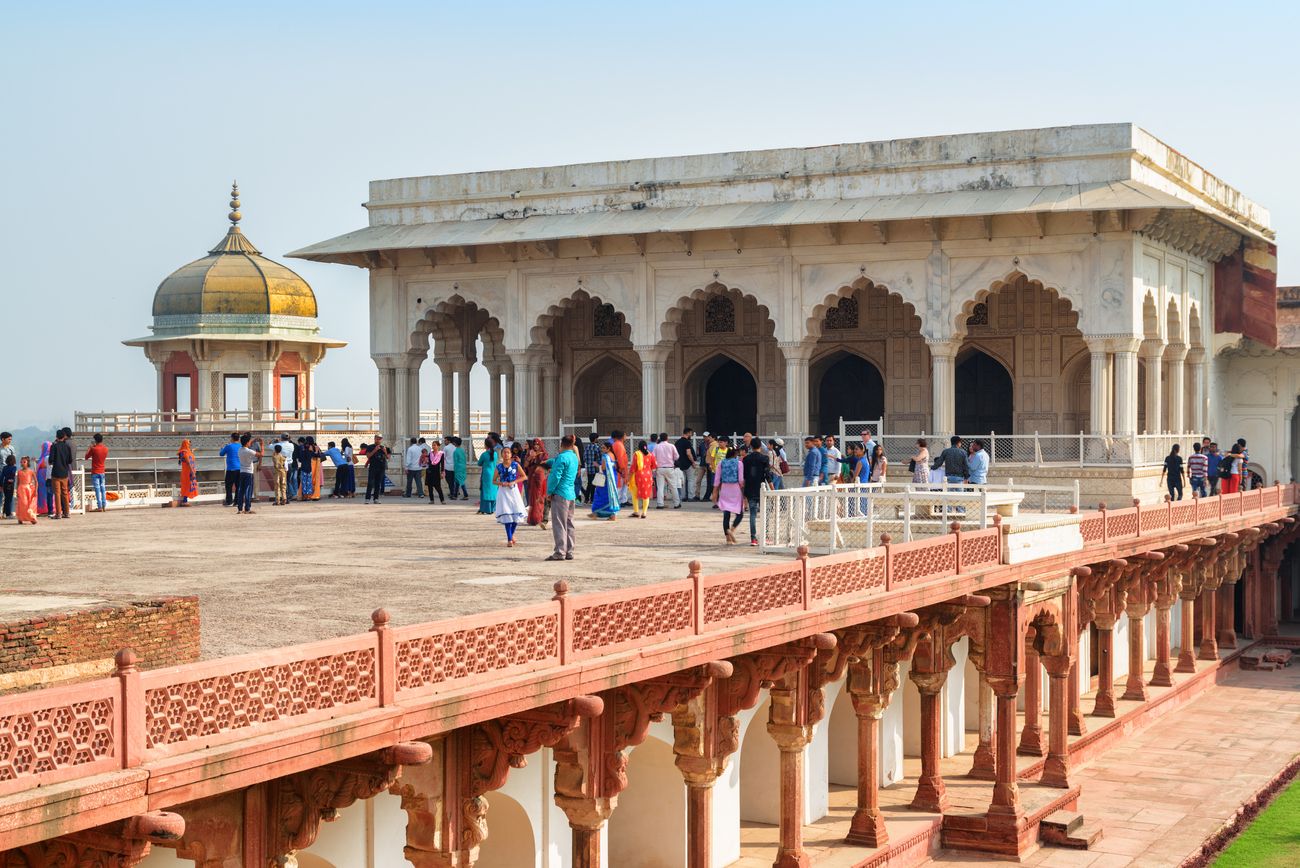
The Diwan-i-Khas, adorned with double-arched columns, hosted Mughal emperors as they held intimate meetings with nobles, rulers, and foreign dignitaries from across the world. © efired
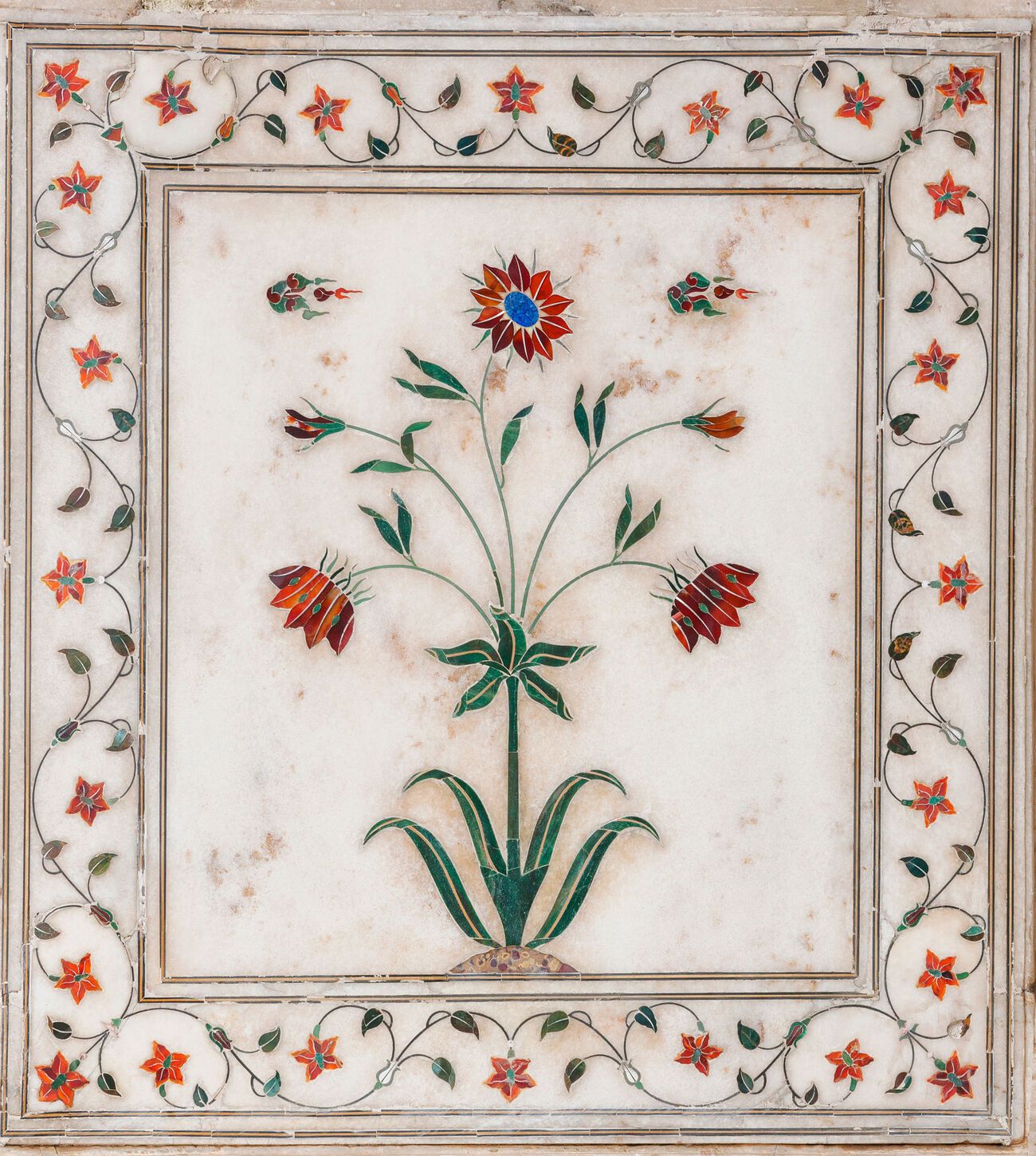
A close-up of intricate pietra dura inlay work on a marble column—semi-precious stones forming delicate floral patterns identical to those seen in the Taj Mahal. © Powerofforever
Just north of the Macchi Bhavan courtyard lies a jewel of serene beauty — the Nagina Masjid, or Gem Mosque. Crafted entirely from pure white marble, this intimate sanctuary glows softly even in the gentlest light. Its graceful façade is divided into three arched sections, each leading toward a tranquil prayer chamber crowned by three majestic domes.
Shah Jahan, known for his poetic sense of beauty, built this mosque exclusively for the women of his zenana — the royal harem. It was their private place of prayer, reflection, and spiritual retreat, far removed from the bustle of the imperial court.
One of the mosque’s most charming features is a small marble balcony overlooking the courtyard below. Hidden behind a delicate filigree screen, the royal ladies could discreetly browse luxurious items brought by select merchants — glittering jewelry, rich brocades, fine silks — all displayed beneath them. From behind this carved lattice, they enjoyed a rare blend of privacy, comfort, and royal indulgence.
The Nagina Masjid may be small, but every inch of it radiates calm elegance, standing as a quiet testament to Shah Jahan’s enduring love for marble, symmetry, and refined beauty.
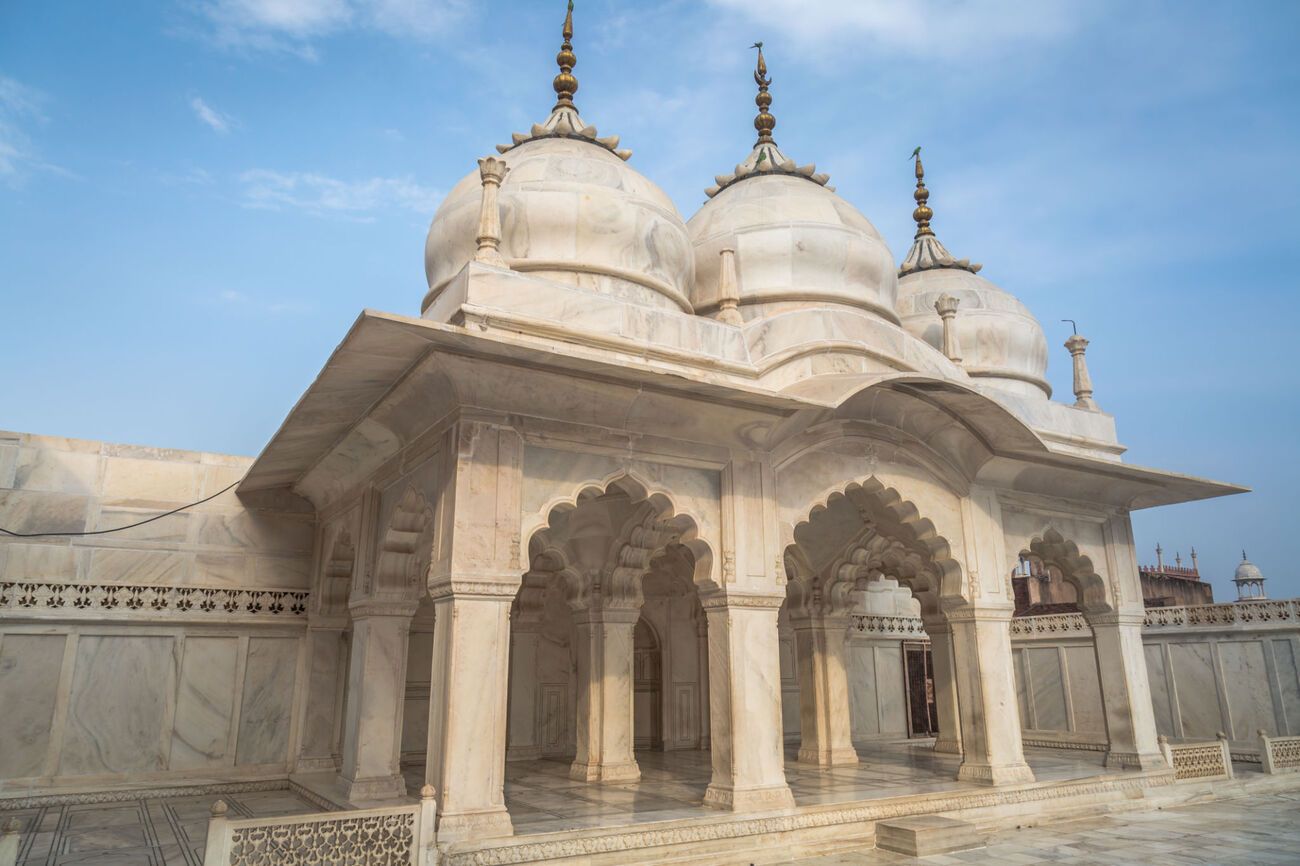
The serene Nagina Masjid, crafted in spotless white marble, stands as a private place of worship once used exclusively by the women of the royal household. © Roop_Dey
On the southern side of the Macchi Bhavan stands a charming pavilion with an elevated terrace — once a more intimate reception space within the imperial complex. This terrace holds two remarkable thrones: one carved from deep black slate, the other from luminous white marble. The inscription on the black throne dates it to 1602, adding a touch of timeless authenticity to the scene.
These thrones are more than decorative relics; they tell a story. As a young prince, Shah Jahan would sit on the white marble throne while his father, Emperor Jahangir, occupied the black one beside him. Together, they watched elephant combats staged in the eastern enclosure — a popular entertainment of the royal courts and a dramatic spectacle of power and might.
A Persian inscription inlaid in black stone, dating to 1636, poetically refers to the emperor as the sun and the pavilion as the sky, symbolizing the cosmic grandeur of Mughal kingship.
Today, the setting has a gentler purpose. With the Taj Mahal rising gracefully in the background, this pavilion has become one of the fort’s most romantic photo spots — a place where couples stand where emperors once did, capturing memories framed by the world’s greatest monument to love.
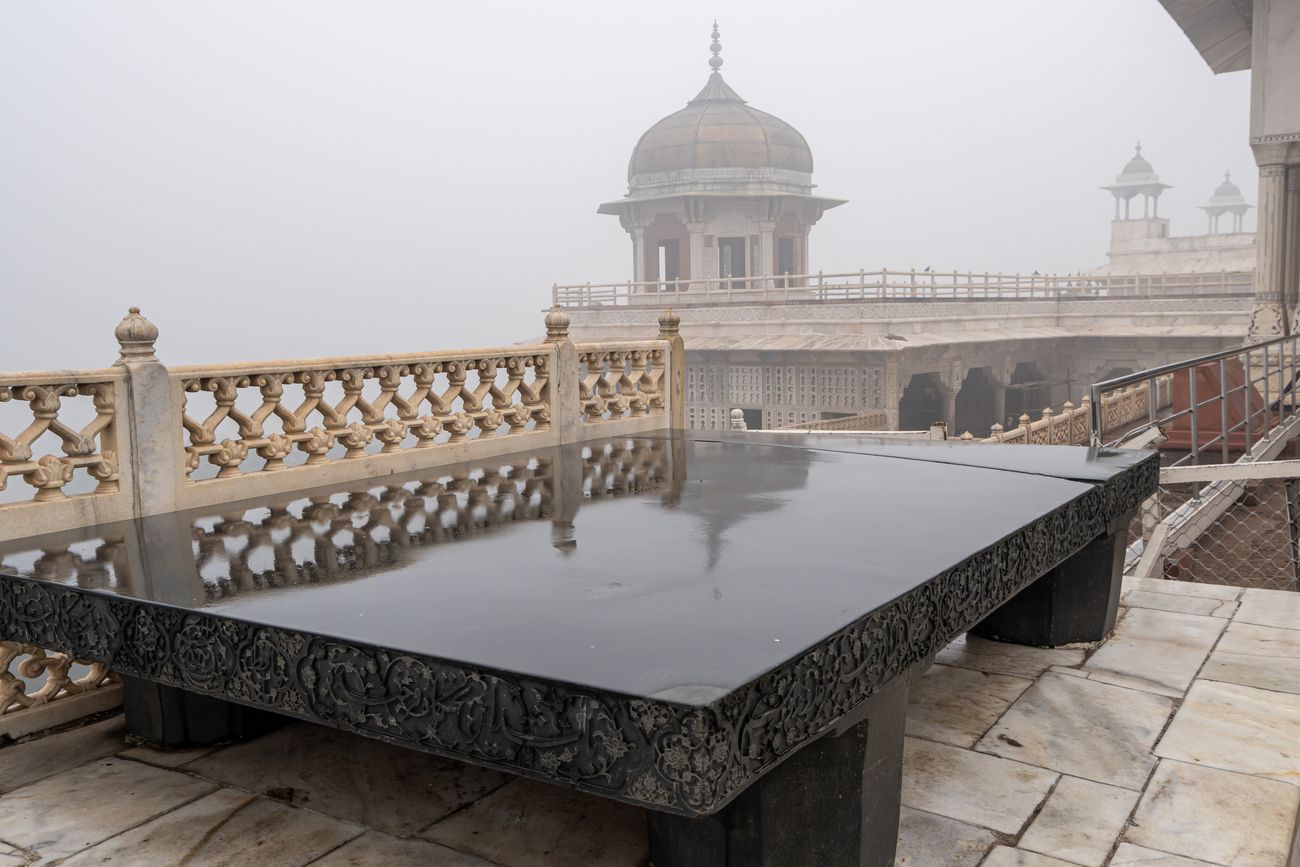
Takht-i-Jahangir—Jahangir’s grand black-marble throne—glows with carved Quranic verses, reflecting the power and artistry of the Mughal court.
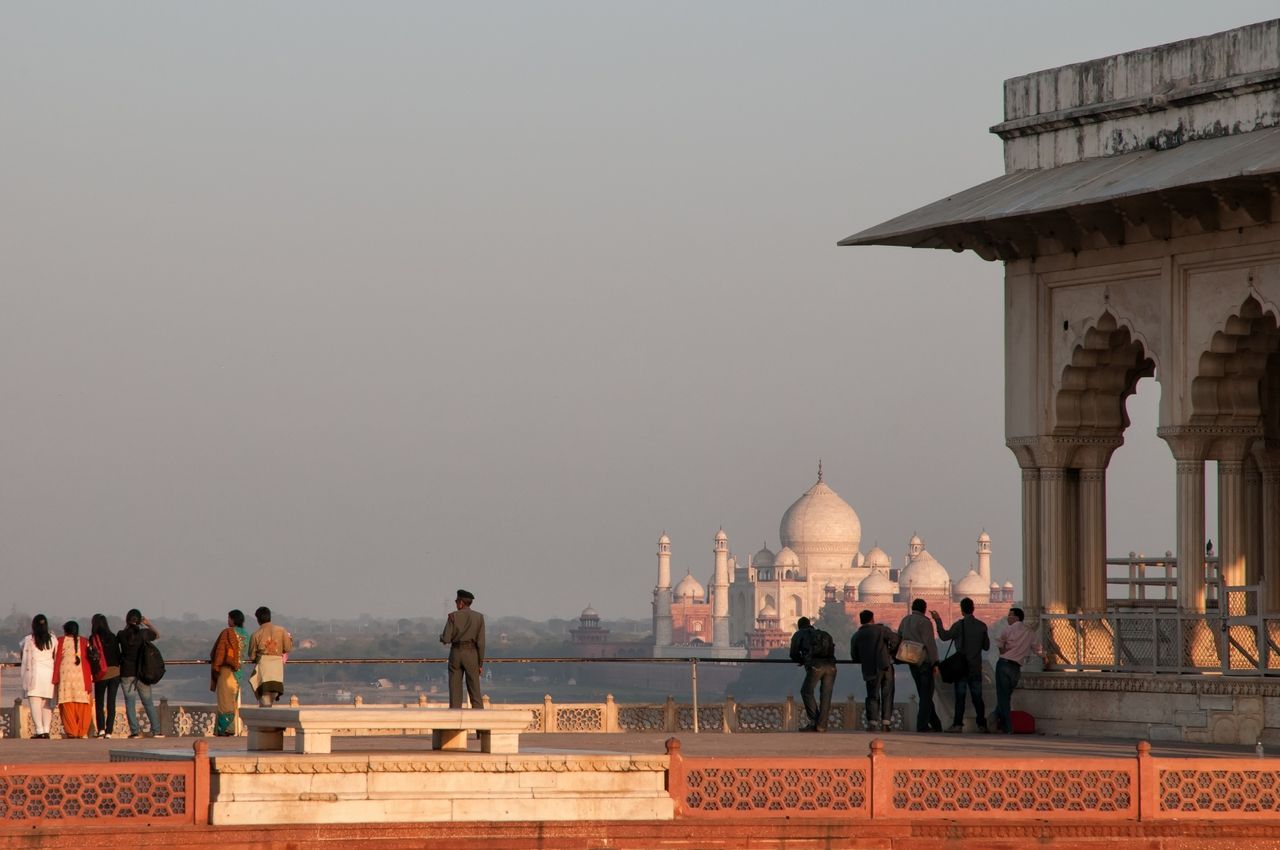
Facing Jahangir’s black throne, a luminous white marble seat was reserved for Mughal princes. From this elegant terrace, visitors today enjoy one of the most beautiful views of the Taj Mahal. © Rolf_52 / Shutterstock
Set along the river’s edge, where cool breezes drift gently across the water, rises a high terrace lined with spacious royal apartments. Among them stands the exquisite Diwan-i-Khas, the Hall of Private Audience, built in 1635. This was the space where the Mughal emperor received foreign dignitaries, ambassadors, and kings — a room where global diplomacy unfolded in the shimmering glow of marble. Its décor once dazzled visitors with peacock-shaped brackets inlaid with jasper and lapis lazuli, and rows of elegant marble columns that reflected the emperor’s refined taste.
Just beyond this hall lies Shah Jahan’s private palace, the Khas Mahal, completed in 1636. Designed like a personal sanctuary, it consists of three graceful sections. Its flat ceiling is engineered with clever recesses that naturally cooled the rooms during India’s scorching summers. From here, Shah Jahan could relax in comfort, gazing out at serene gardens and the tranquil river flowing below — the perfect retreat for an emperor who adored beauty in every form.
His Royal Bed Chamber, known as Aramgah-e-Muqaddas, was described by historian Hamid Lahauri as one of Shah Jahan’s architectural masterpieces. It was a space where artistic elegance met the soothing rhythms of palace life.
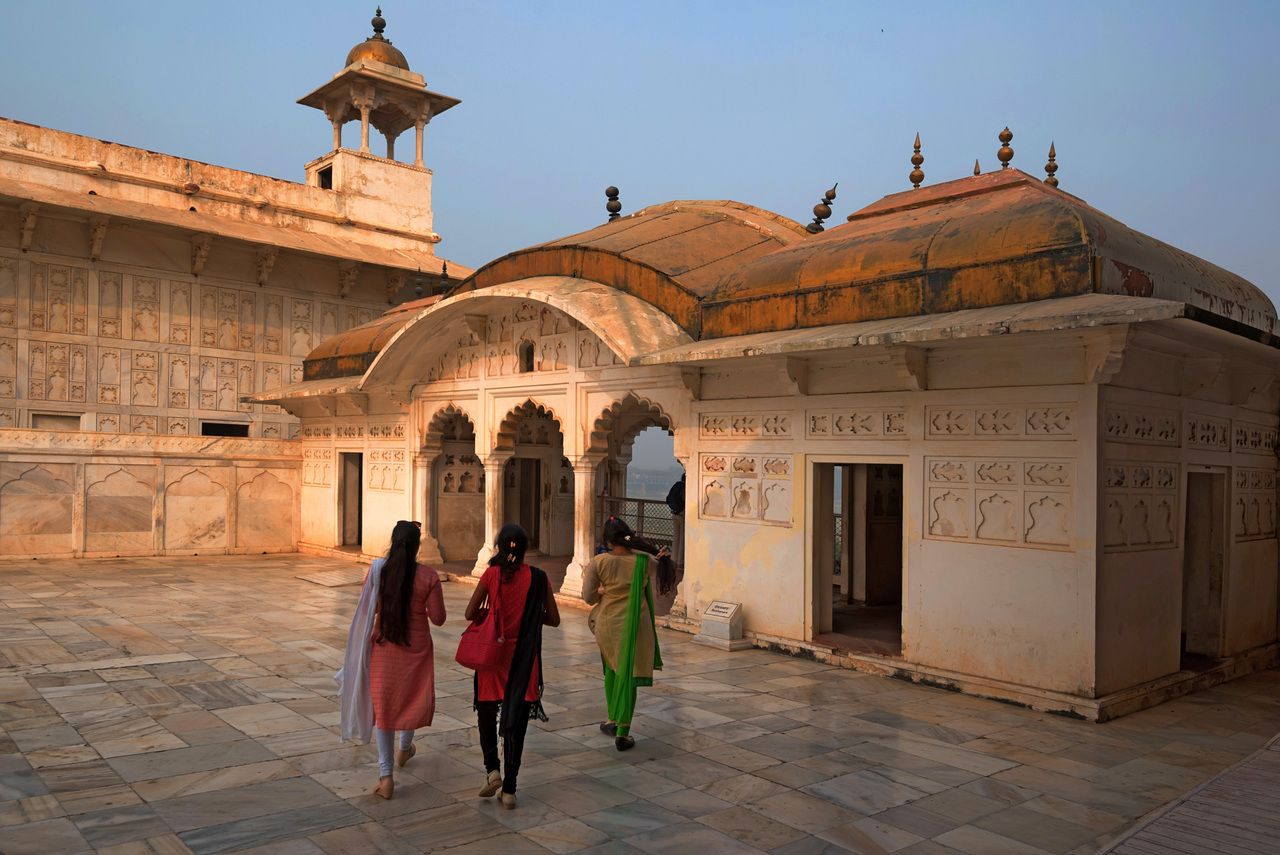
Flanking the palace are two enchanting Golden Pavilions, named after the gold tiles that once adorned their curved Bengal-style roofs. Their elegant arches and sweeping shapes would later inspire Rajput architecture across northern India. Though their original purpose is uncertain, legend claims they belonged to Shah Jahan’s beloved daughters — Jahan Ara Begum and Roshan Ara Begum — adding a soft, personal touch to the grand Mughal narrative.
Together, these river-facing structures create one of the most magical corners of Agra Fort — where power, poetry, art, and family intertwine in timeless harmony.
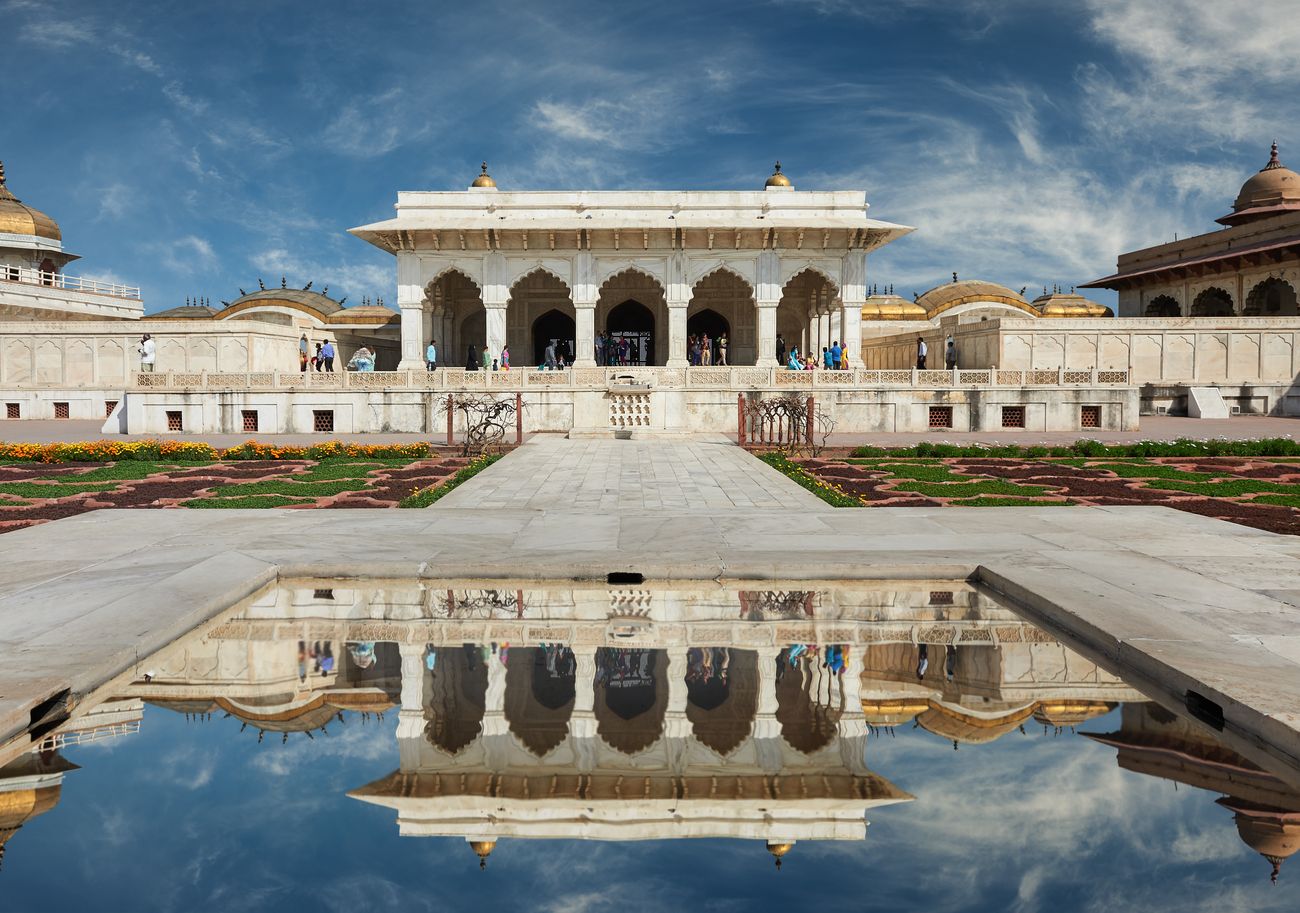
The Khas Mahal casts its reflection in a serene ornamental pool surrounded by Charbagh-style gardens—once the emperor’s tranquil private retreat. © Yurataranik / Dreamstime
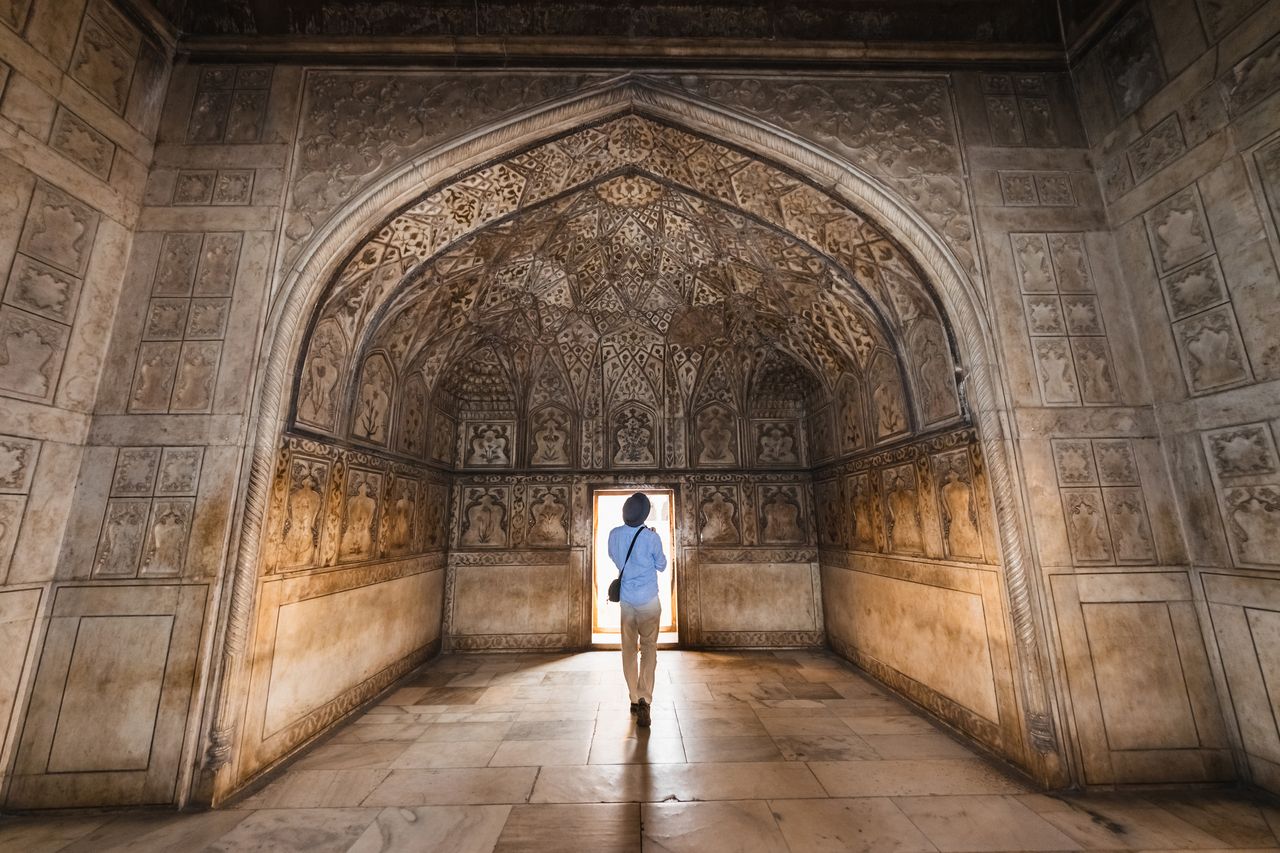
A visitor pauses inside the Khas Mahal, admiring one of the few surviving wall paintings—a rare glimpse into the fort’s original grandeur. © Pamela Loreto Perez
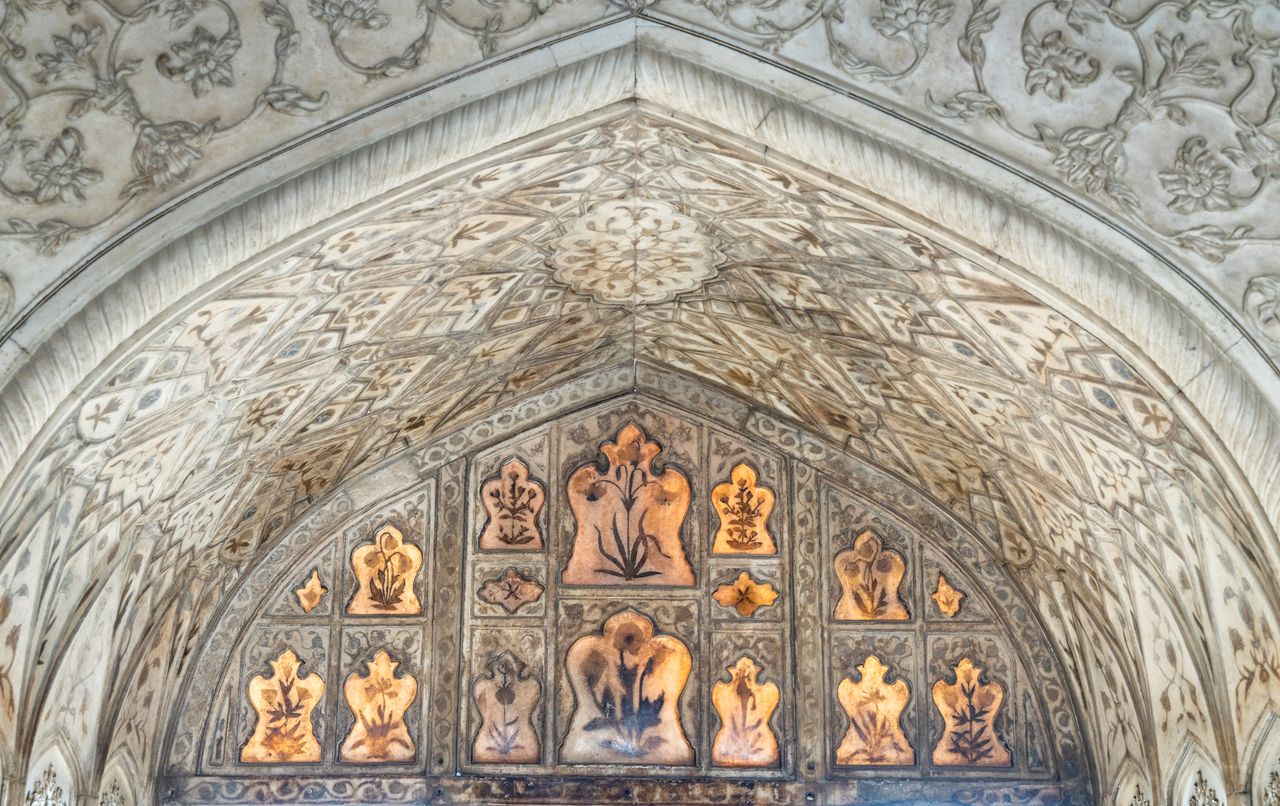
This delicate marble panel glows like a lantern when sunlight hits it. Crafted from ultra-thin slabs of marble, it showcases Mughal mastery at its finest. © Kevin Standage
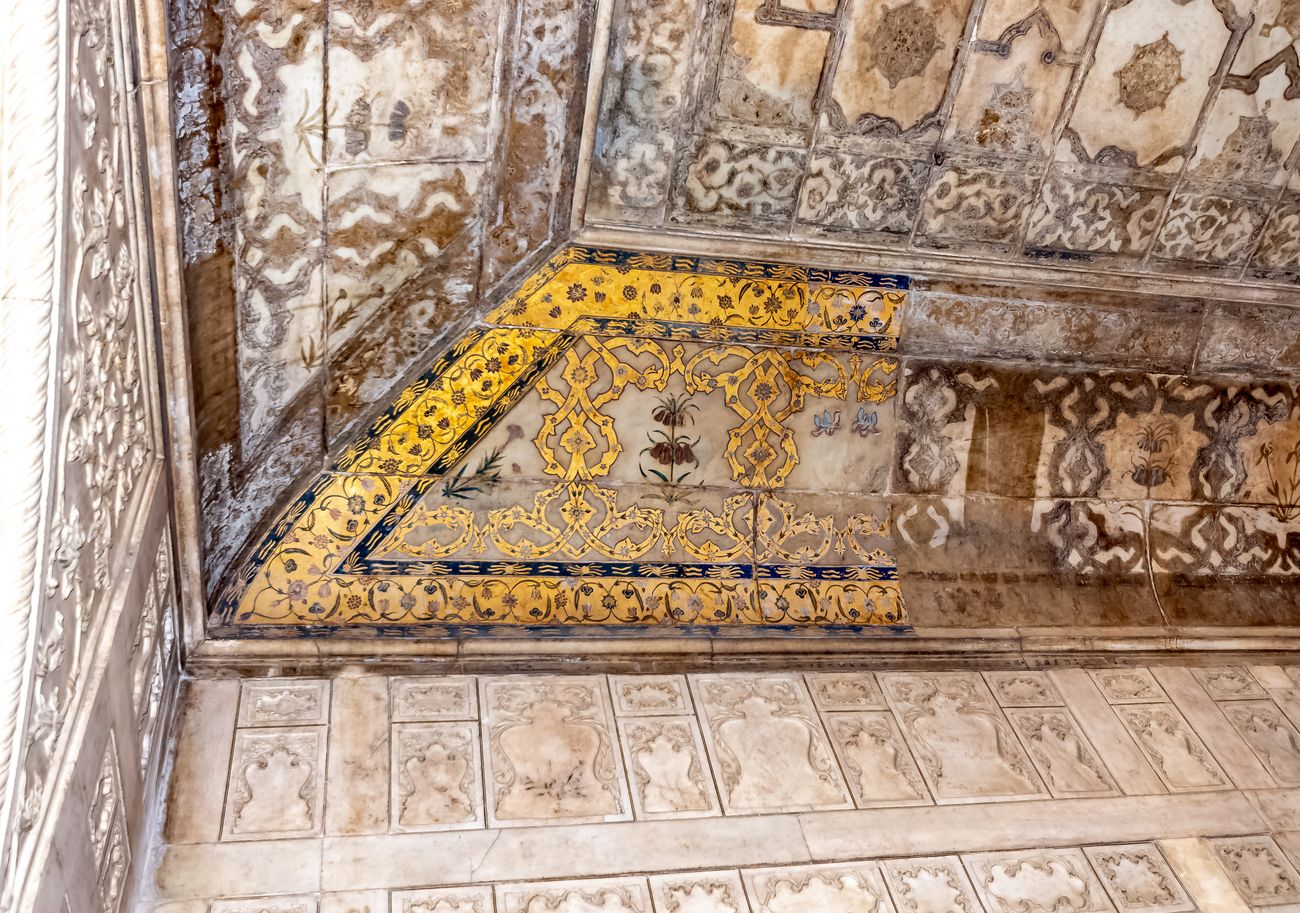
A section of the emperor’s private chamber now displays restored gold-painted décor—an effort by the Archaeological Survey of India to revive the palace’s former brilliance. © Marcin
In 1637, Shah Jahan’s love for beauty blossomed once more when he commissioned the enchanting Anguri Bagh, a rectangular Charbagh-style garden laid out just west of his private palace. Into its carefully prepared beds, he ordered soil to be brought all the way from the saffron fields of Kashmir — a luxurious touch worthy of a Mughal emperor obsessed with refinement. Here he planted fragrant flowers and lush grapevines, giving the garden its poetic name: the Garden of Grapes.
This serene paradise served as a private retreat for the royal ladies living in the red sandstone zenana apartments that surrounded the garden on three sides. Within these shaded, perfumed pathways, they strolled, chatted, and escaped the stiffness of palace protocol — a little world of calm carved out of imperial grandeur.
In the northeastern corner of the Khas Mahal, a discreet flight of steps descends into one of the fort’s most magical spaces — the Shish Mahal, or Crystal Palace. This lavish chamber was crafted as an exclusive retreat for the royal women. Its walls and ceilings shimmered with intricate mirror mosaics and vibrant glass inlays set into smooth white marble. In the soft glow of lamplight, the entire room must have twinkled like a fairy-tale cavern of stars, wrapping its visitors in a dream of sparkling reflections.
Sadly, the Shish Mahal is closed to the public today, so visitors can only peer through its windows — catching just a hint of the glittering wonder that once dazzled Mughal royalty.
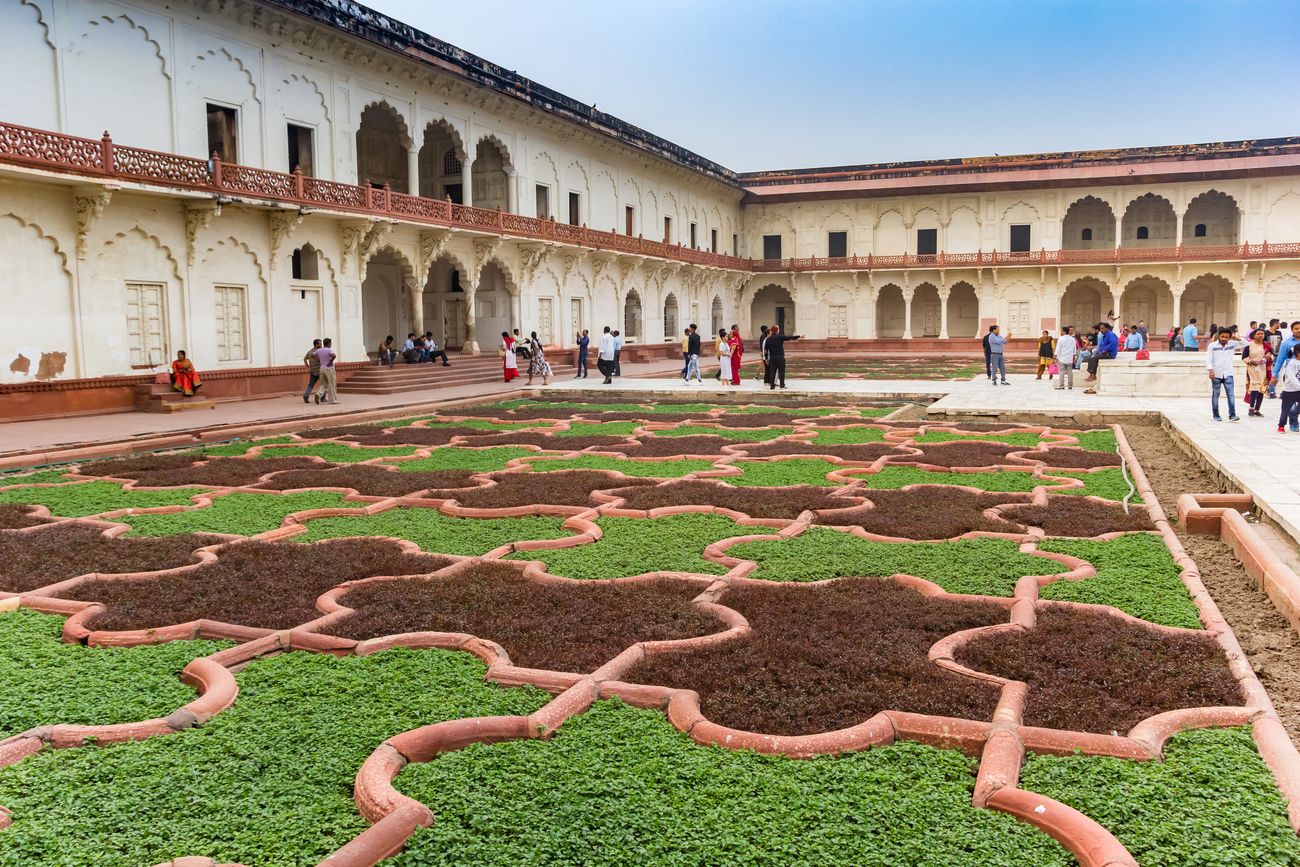
The Anguri Bagh—once lush with grapevines used for Mughal winemaking—is framed by elegant palaces and living quarters built in shining white marble. © Venemama
Golden-roofed, palanquin-shaped pavilions flank the Khas Mahal. Legend says these charming structures were home to Shah Jahan’s beloved daughters. © Yakov Oskanov
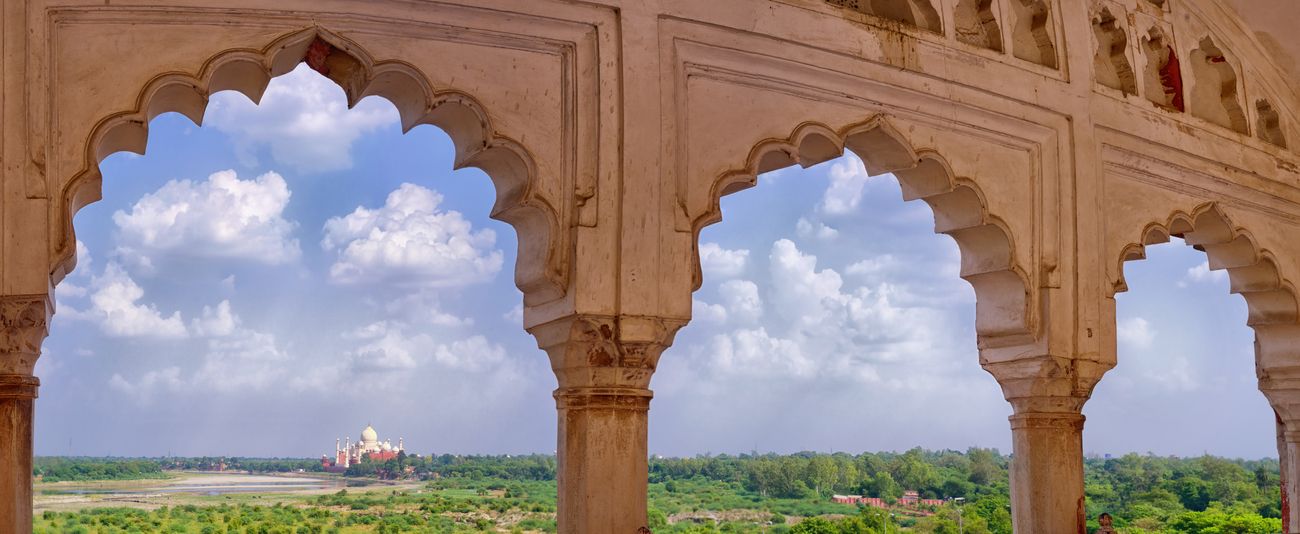
The Taj Mahal appears like a dream framed within the arch of one of the Golden Pavilions—an unforgettable sight of elegance meeting eternity. © Belikova Oksana
A narrow corridor gently guides you toward one of Agra Fort’s most breathtaking treasures — the Musamman Burj, a two-storied octagonal pavilion that stands as the fort’s most exquisite architectural jewel. Legend says this is where Shah Jahan, imprisoned by his son Aurangzeb, spent his final days gazing longingly at the shimmering Taj Mahal — the monument he built for his beloved Mumtaz.
The Musamman Burj’s front hall is a masterpiece of artistry. Its walls bloom with rare marble filigree, carved so delicately that light filters through like lace. The lower panels, or dados, are adorned with graceful plant motifs and swirling Chinese cloud patterns, adding an almost celestial softness to the space. Everywhere you look, the niches are alive with spectacular pietra dura inlay — the same luminous technique used in the Taj Mahal. Semi-precious stones and richly colored marble create vibrant mosaics of flowers, especially the fragrant jasmine that the Mughals adored.
The pavilion rises above the fort’s most prominent round bastion along the river, but only five of its eight octagonal sides jut forward — a deliberate design that frames a perfect view of the Yamuna and the Taj beyond. Within its marble embrace lies a beautifully carved recessed tank shaped like a stylized lotus, complete with a delicate fountain. The elegance of this feature alone shows the level of refinement Mughal artisans achieved.
Just outside the tower stretches a marble-lined courtyard — a seemingly simple space with a delightful story. Here, Shah Jahan played Pachisi, an ancient strategy game resembling modern Ludo. His grandfather Akbar famously played the same game at Fatehpur Sikri, using his dancing girls as living pieces. Shah Jahan, however, preferred a quieter, more intimate match on this serene terrace overlooking the river.
Every corner of the Musamman Burj feels alive with whispers of history, artistry, love, and royal leisure — a place where the Mughal passion for beauty still lingers in the marble.
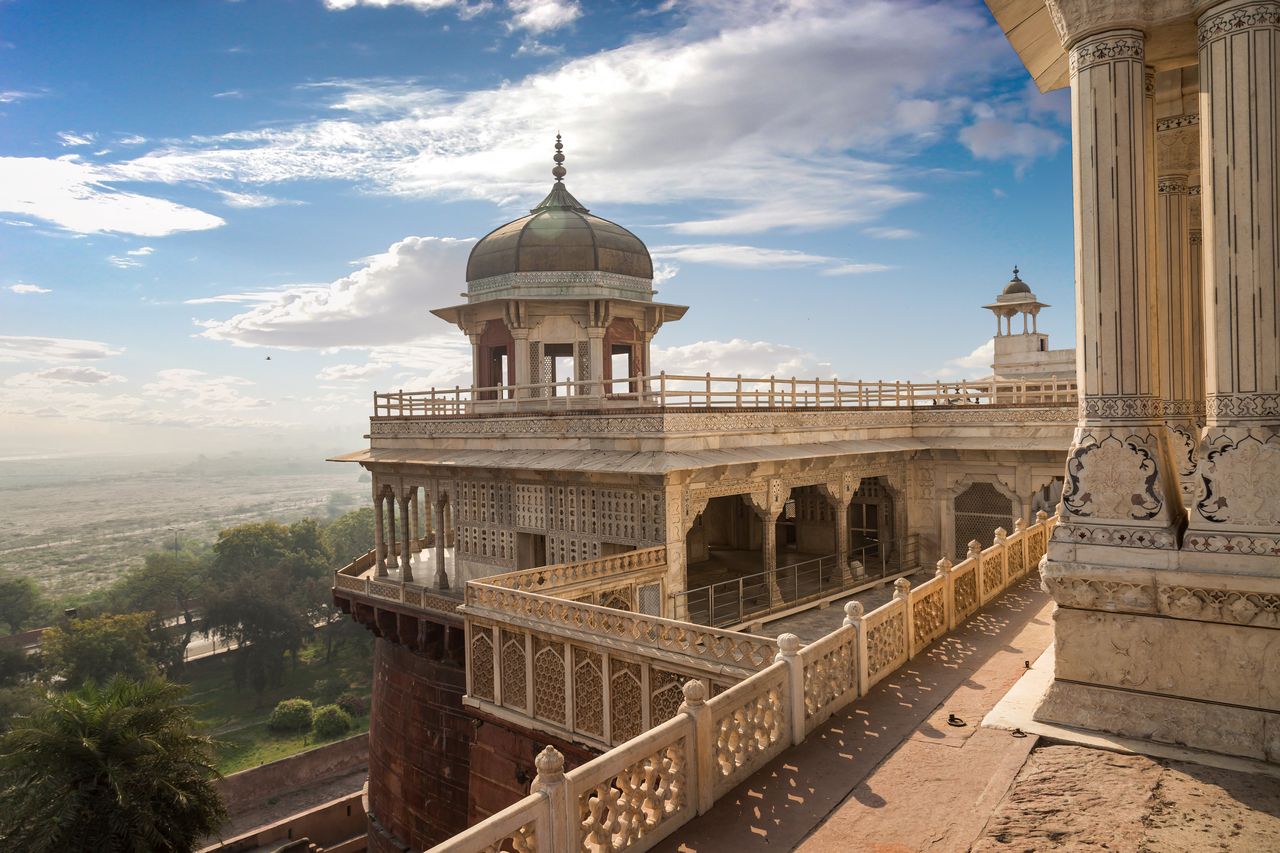
From the platform of the Diwan-i-Khas, the Musamman Burj—Shah Jahan’s final residence—rises above the Yamuna. This tower witnessed both his imprisonment and his last gaze upon the Taj Mahal. © Roop_Dey / Shutterstock
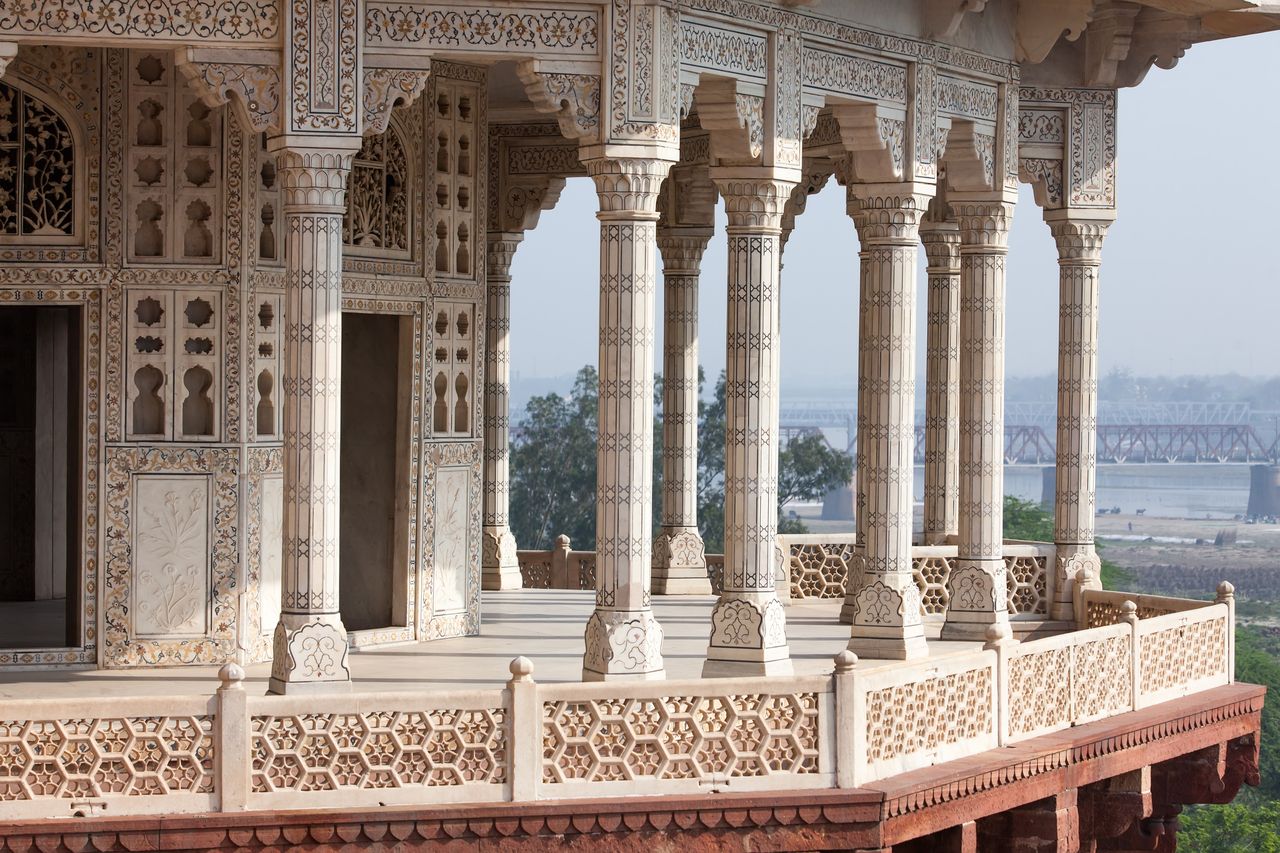
A close view of the Musamman Burj reveals the exquisite octagonal tower where Shah Jahan spent his last years, looking out at the Taj Mahal beyond the river. © My Good Images / Shutterstock
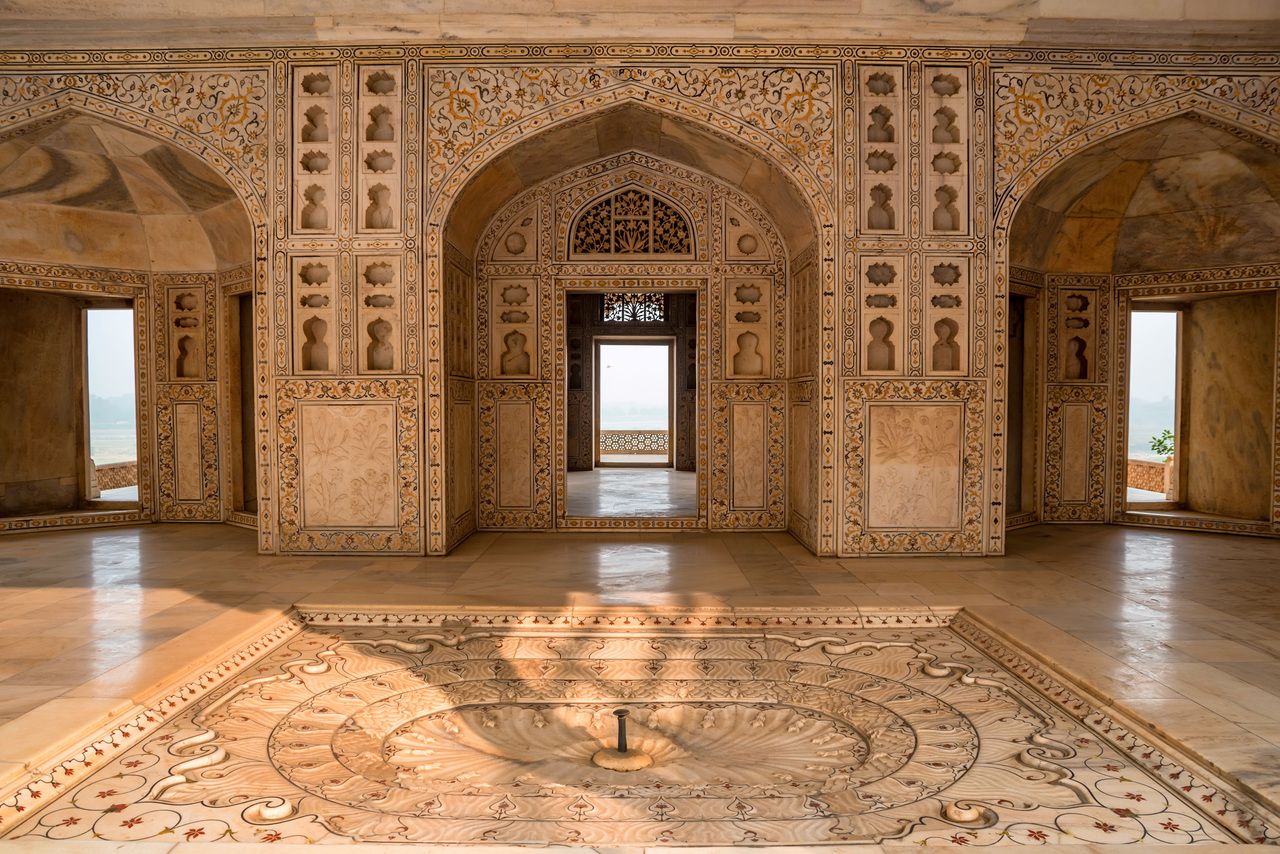
Inside the Golden Pavilion of the Jasmine Tower, fountain basins and pietra dura mosaics shimmer in the white marble—an intimate space of royal luxury. © Yakov Oskanov / Shutterstock
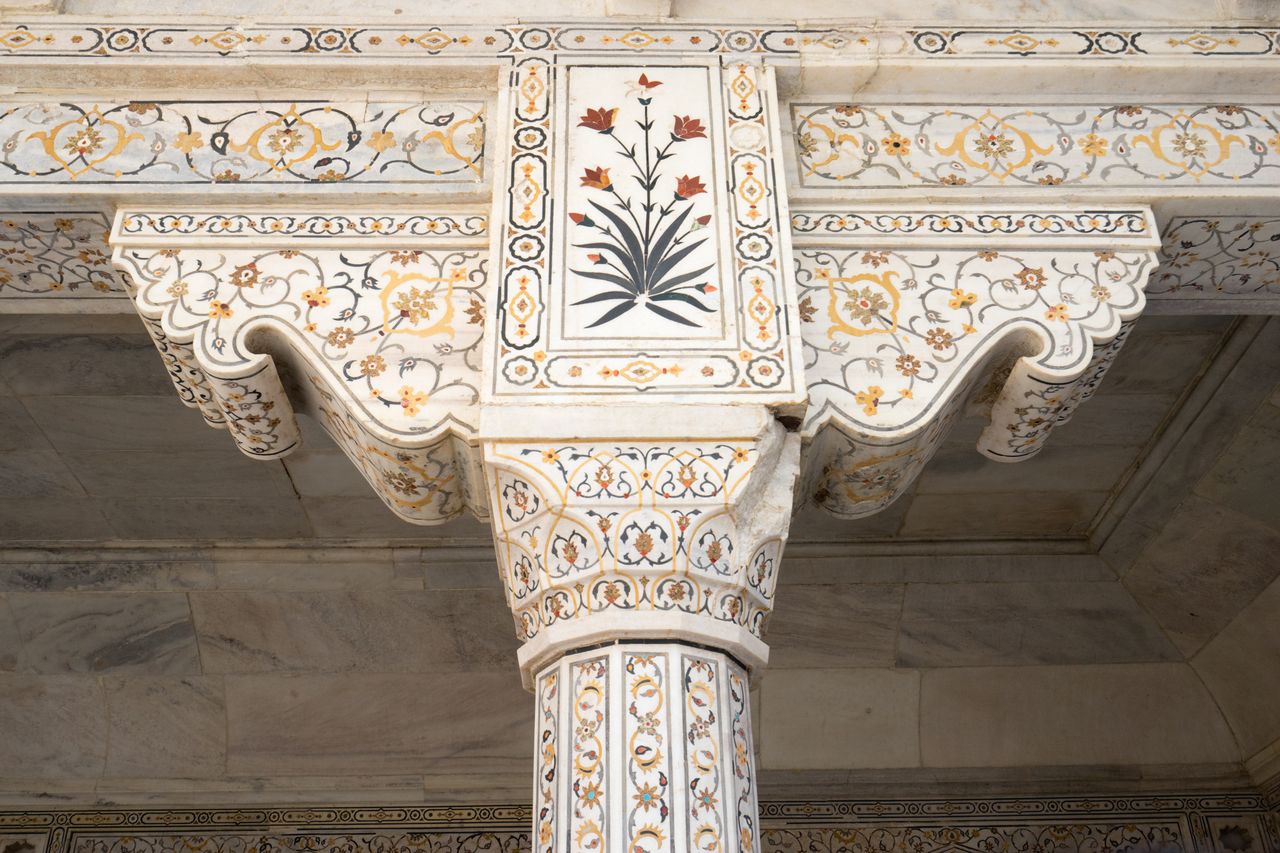
A detailed look at the pietra dura inlay inside the Jasmine Tower—semi-precious stones forming vibrant floral motifs on smooth marble. © yong922760 / Shutterstock
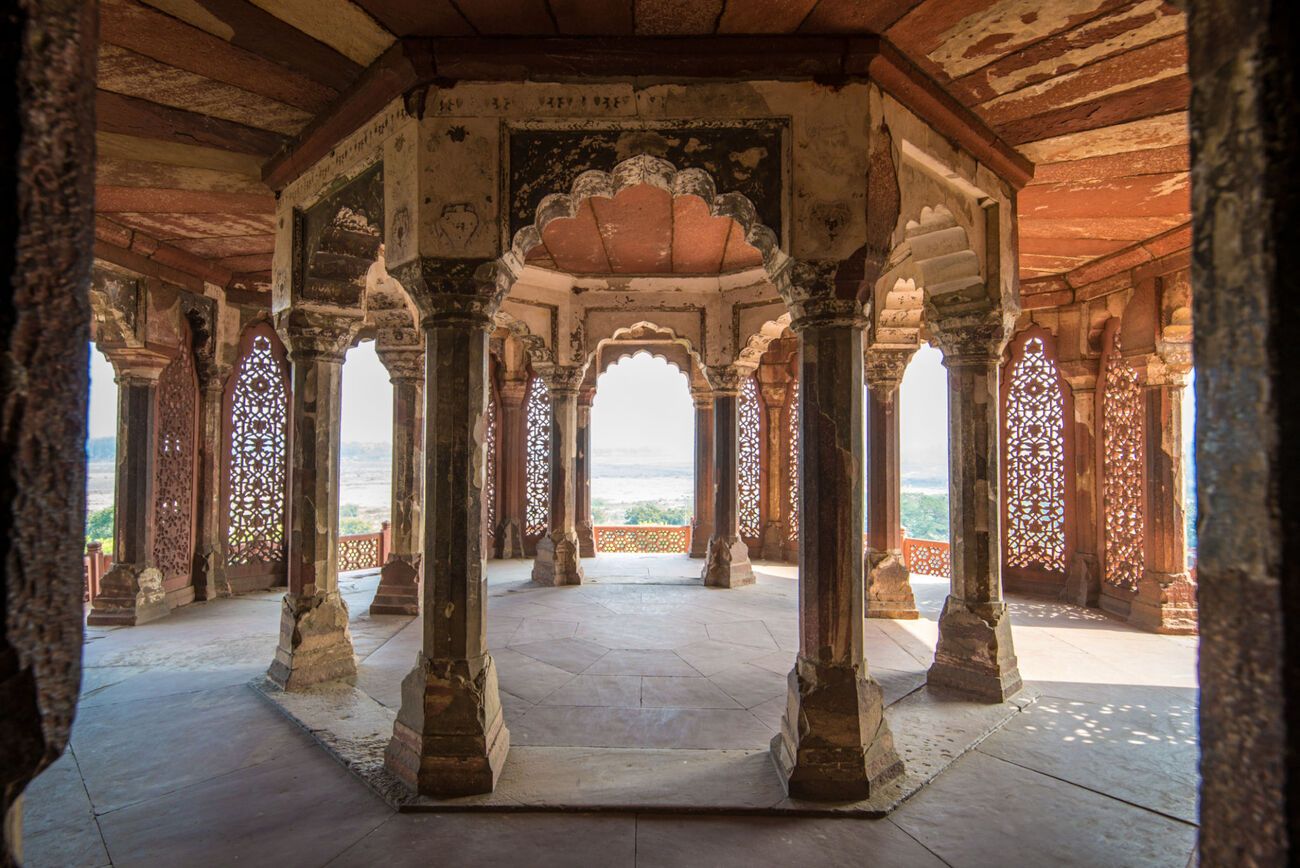
Several open pavilions across Agra Fort offer panoramic views of the distant Taj Mahal and the Yamuna River—here pictured with its dry summer riverbed. © Edwin Remsberg
Jahangiri Mahal
The Jahangiri Mahal rises like a commanding jewel of Agra Fort — a massive palace with an equally magnificent façade. Crafted in deep red sandstone and delicately accented with white marble geometric patterns, it is one of the rare structures from Akbar’s time that still stands almost completely intact.
Although the palace bears Jahangir’s name, it was actually built by his father, Emperor Akbar, as a private royal residence. And while it may seem at first glance to be a princely abode for Jahangir, its design reveals something different. The palace was constructed with maximum seclusion, making it ideally suited as the living quarters for Akbar’s harem. It is believed that Akbar’s chief wife, Jodh Bai, resided in one section of this grand complex.
The architecture of Jahangiri Mahal beautifully reflects the blend of cultures that defined the Mughal era. It combines Hindu and Islamic elements in perfect harmony — from intricately carved brackets and pillars inspired by Rajput styles to arches, ceilings, and niches characteristic of Persian influence. This fusion, typical of Akbar’s architectural vision, lends the palace a warmth and elegance that sets it apart from the more marble-heavy structures introduced during Shah Jahan’s reign.
Walking through the Jahangiri Mahal, you can almost imagine the quiet inner world of the royal women — their chambers, courtyards, whispers, and rituals — preserved in the symmetry, artistry, and timeless grace of this extraordinary palace.
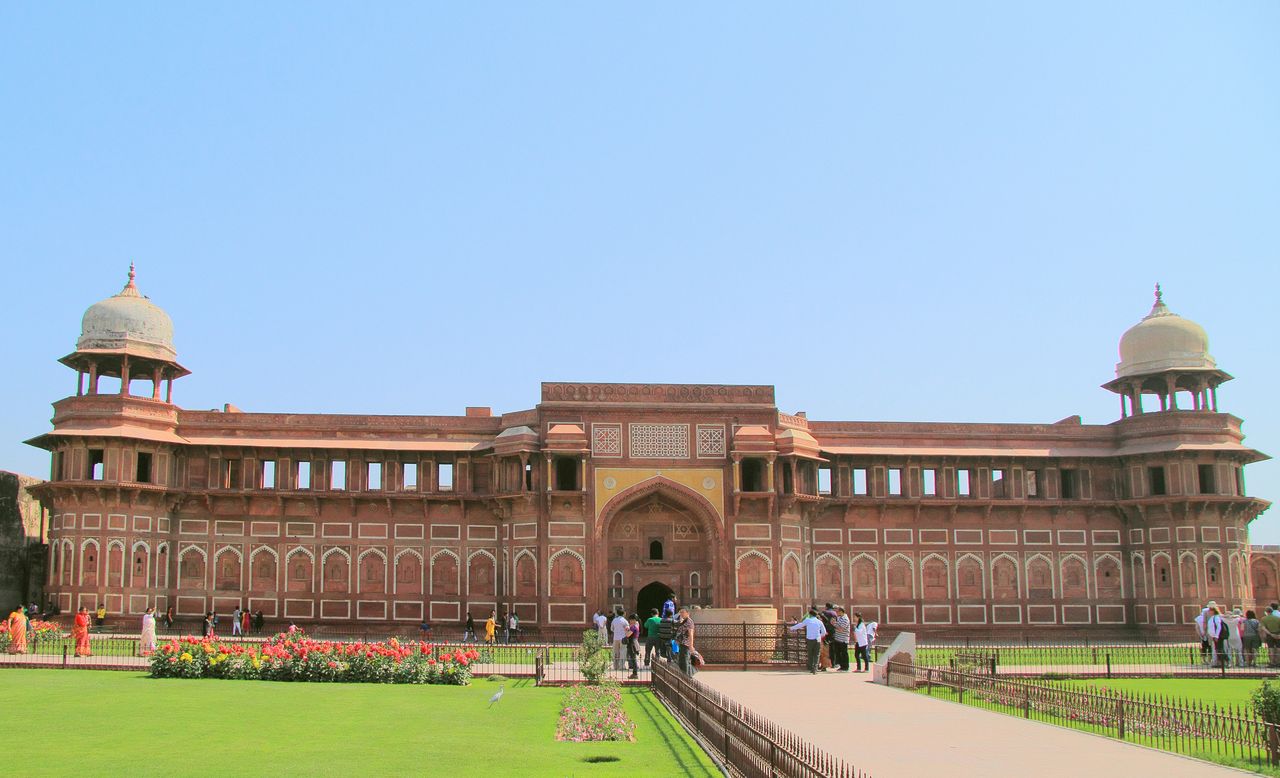
The red sandstone façade of the Jahangiri Mahal stands proudly—one of the oldest parts of Agra Fort, untouched by time and still radiating its original beauty. © Andrew
The first courtyard of the Jahangiri Mahal greets visitors with a playful, almost experimental blend of design elements — a hint of what is to come. But it is the central courtyard that truly captivates. Here, the architecture shifts dramatically into an almost entirely Hindu aesthetic, showcasing collared arches, robust carved pillars, and heavy overhanging eaves that cast deep, dramatic shadows across the stone floor.
Above this, a second story rises with fantastical balconies supported by intricately sculpted roof consoles. Their creativity seems almost boundless, as if the artisans were given free rein to let imagination take the lead.
Along the courtyard’s edges stand large halls, each rich with architectural surprises. On the northern side, enormous stone beams support the ceiling, their surfaces carved with mythical creatures — including a twisting, serpentine form emerging from the mouth of a dragon. These dramatic carvings bring a sense of life and movement to the stone, turning the courtyard into an open-air gallery of ancient legends.
This entire section of the palace represents a fascinating moment in Mughal history — a bold, though brief, shift in architectural style. Earlier Mughal buildings were primarily Islamic in design, gently infused with Hindu flourishes. But here, the script is flipped: Hindu elements dominate, while the few Islamic motifs — like the pointed arches above — are almost hidden beneath a lavish abundance of indigenous forms.
This mix-and-match aesthetic mirrors the cultural philosophy of Akbar’s reign. He fostered an atmosphere of religious tolerance and cross-cultural harmony, and this openness found its way into the architecture — a unified expression of different traditions standing side by side. You see the same creative fusion at his palace complex in Fatehpur Sikri.
Yet, this stylistic phase was temporary. Under Shah Jahan, Mughal architecture evolved into a more refined, balanced blend of Persian elegance and Indian craftsmanship — a synthesis that reached its pinnacle in the creation of the Taj Mahal.
The courtyard of Jahangiri Mahal remains a unique testament to that vibrant moment of artistic experimentation — a living stone reflection of an emperor’s enlightened worldview.
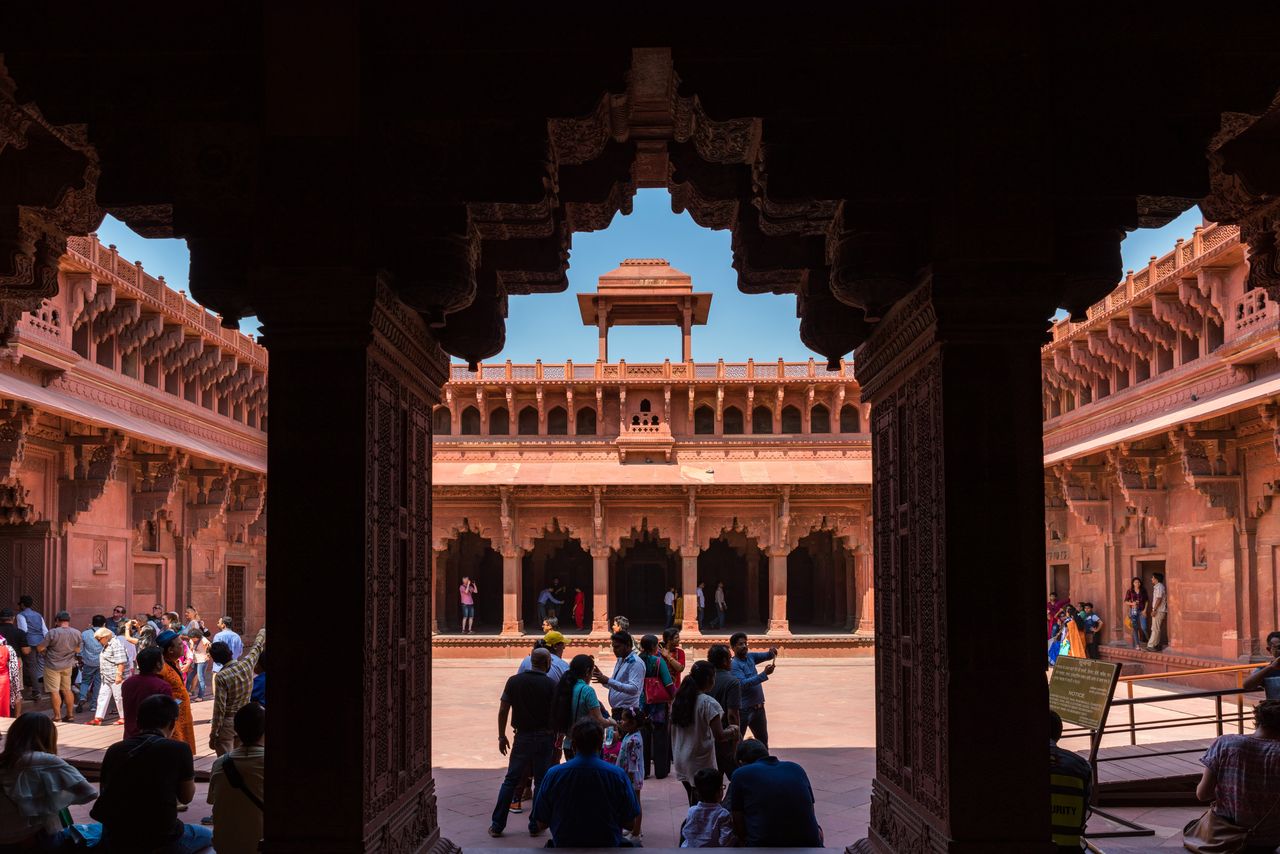
The courtyard of the Jahangiri Mahal bursts with Hindu-inspired elements—balconies, pillars, halls, and even a small temple—reflecting the diverse cultural influences of Akbar’s court. © Images of India / Shutterstock
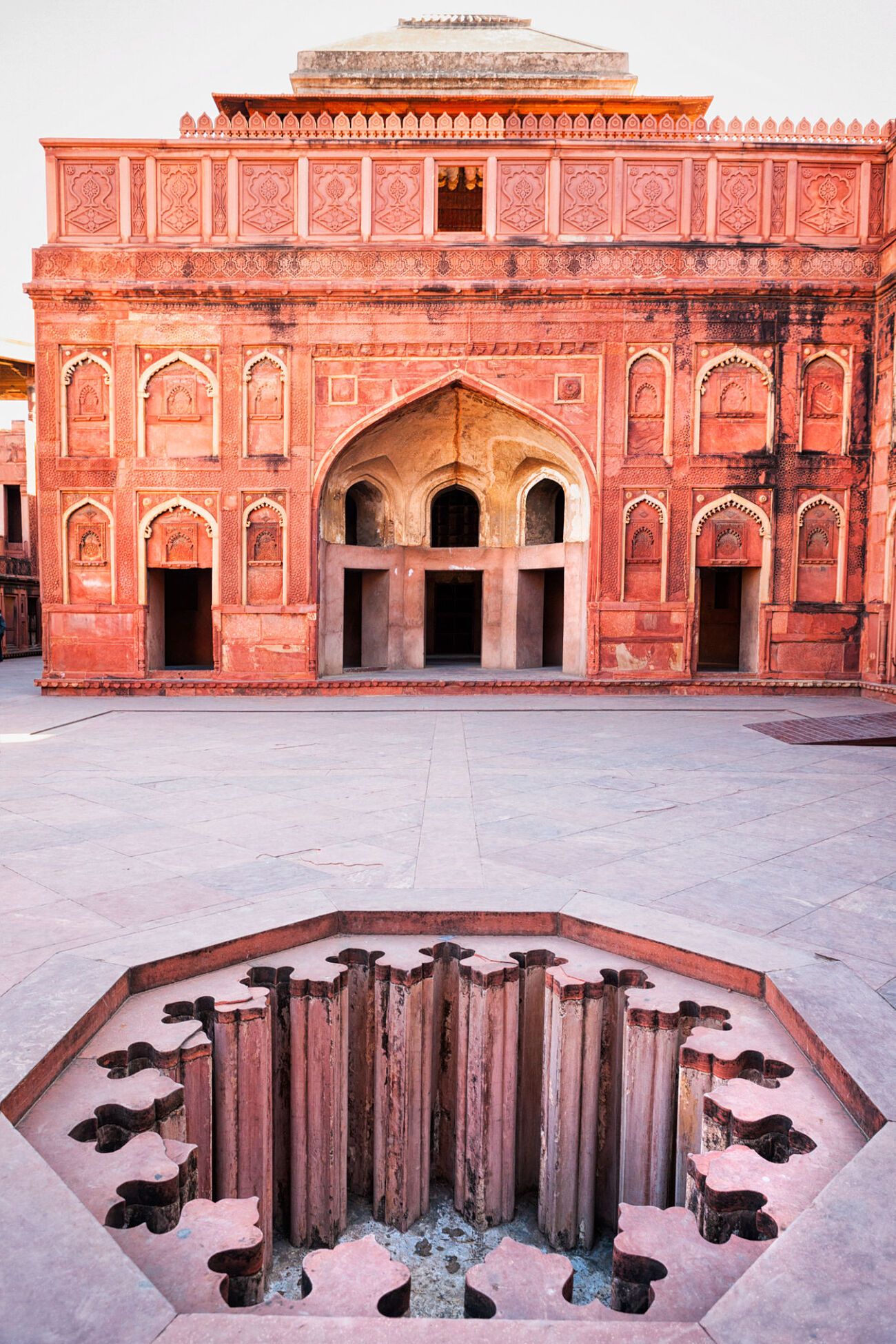
A beautifully carved fountain graces the interior of the Jahangir Mahal—an elegant testament to Mughal artistry. © Powerofforever
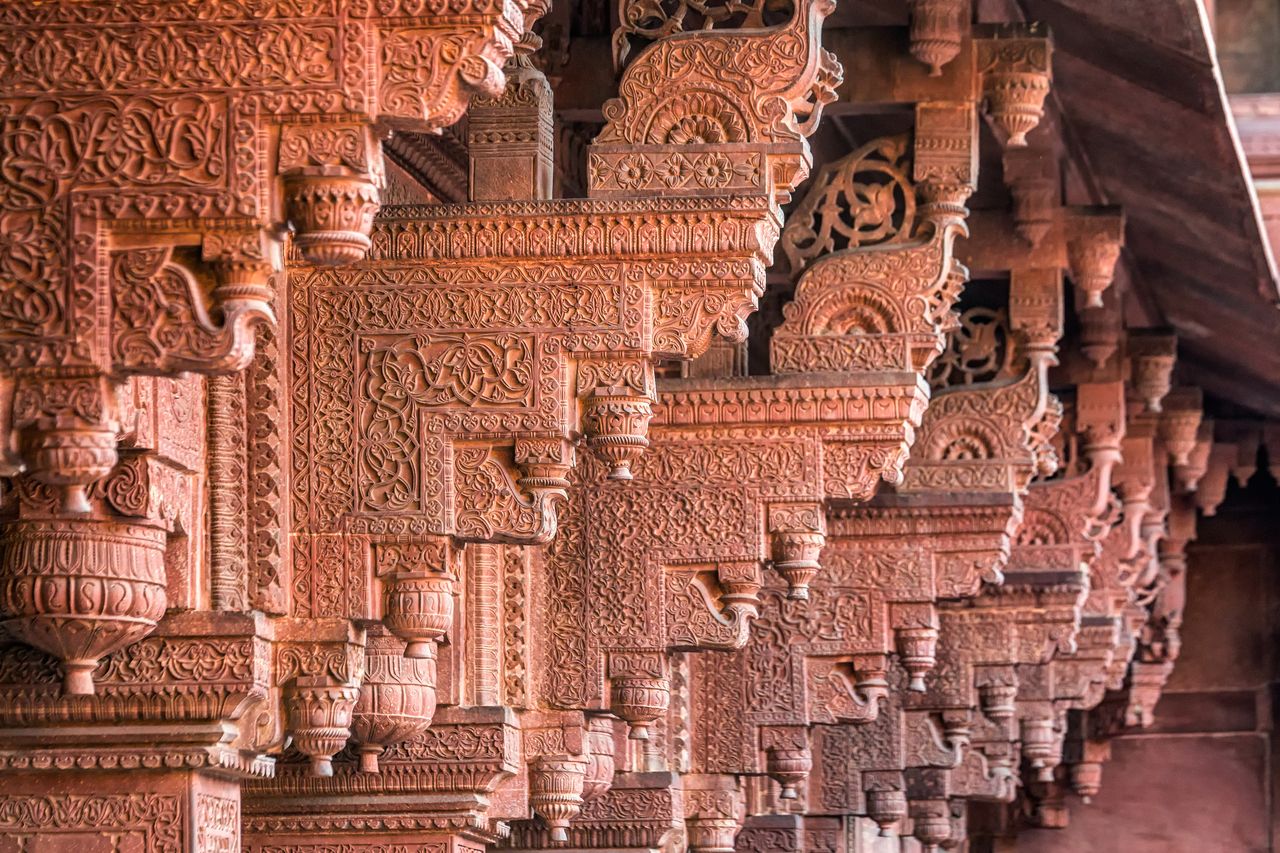
Delicately sculpted stone brackets decorate one of Agra Fort’s preserved royal palaces, showcasing the unmatched craftsmanship of Mughal artisans. © Ruslan Kalnitsky / Shutterstock
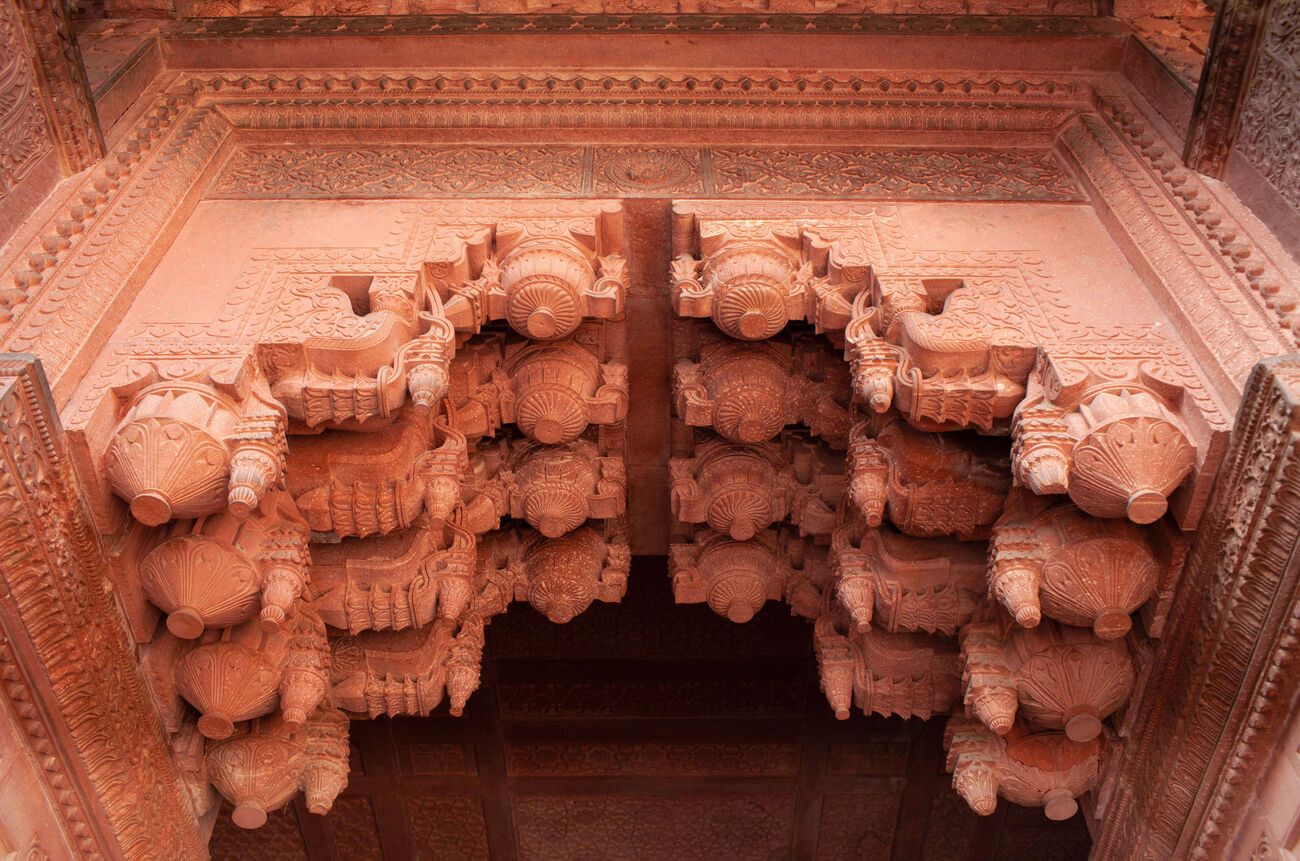
An intricately carved red-sandstone arch features Hindu-style motifs—including temple-style bells—highlighting the rich diversity of Mughal design. © Zzvet
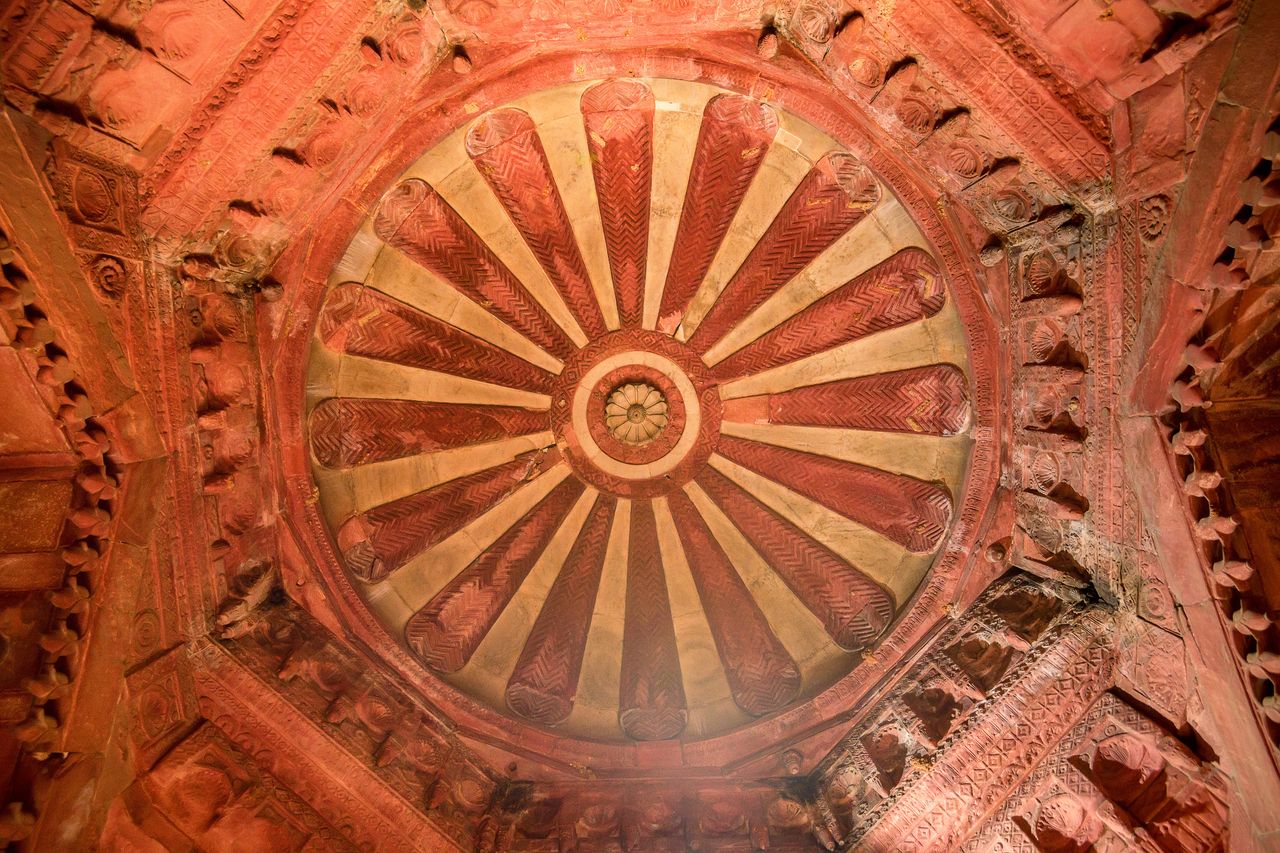
The ceiling of Jahangir’s Palace displays artistic carvings and patterns that reflect the imaginative flair of Mughal-era architecture.
Stepping through the entrance beyond the main gate, visitors are immediately greeted by the palace’s grand façade—a spectacular blend of Indian and Mughal artistry. The structure comes alive with intricate inlaid mosaics, pointed Mughal arches, and bold Hindu-style eaves that extend outward, supported by deep, gracefully curved brackets. It’s an architectural dialogue between two cultures, perfectly preserved in stone.
Facing the palace entrance stands one of its most intriguing relics: Jahangir’s Hauz—a massive bathing cistern carved from a single piece of reddish porphyry. Created in 1611, this enormous basin is an engineering marvel. Its interior and exterior are ringed with steps, allowing Emperor Jahangir to descend into the tub and bathe in luxurious water scented with rose petals.
Legend whispers that Jahangir loved this cistern so much that he took it with him on his travels. While the idea adds charm to the tale, anyone standing before this colossal block of stone can’t help but smile—moving it would have been nearly impossible. Yet such stories only add to its mystique.
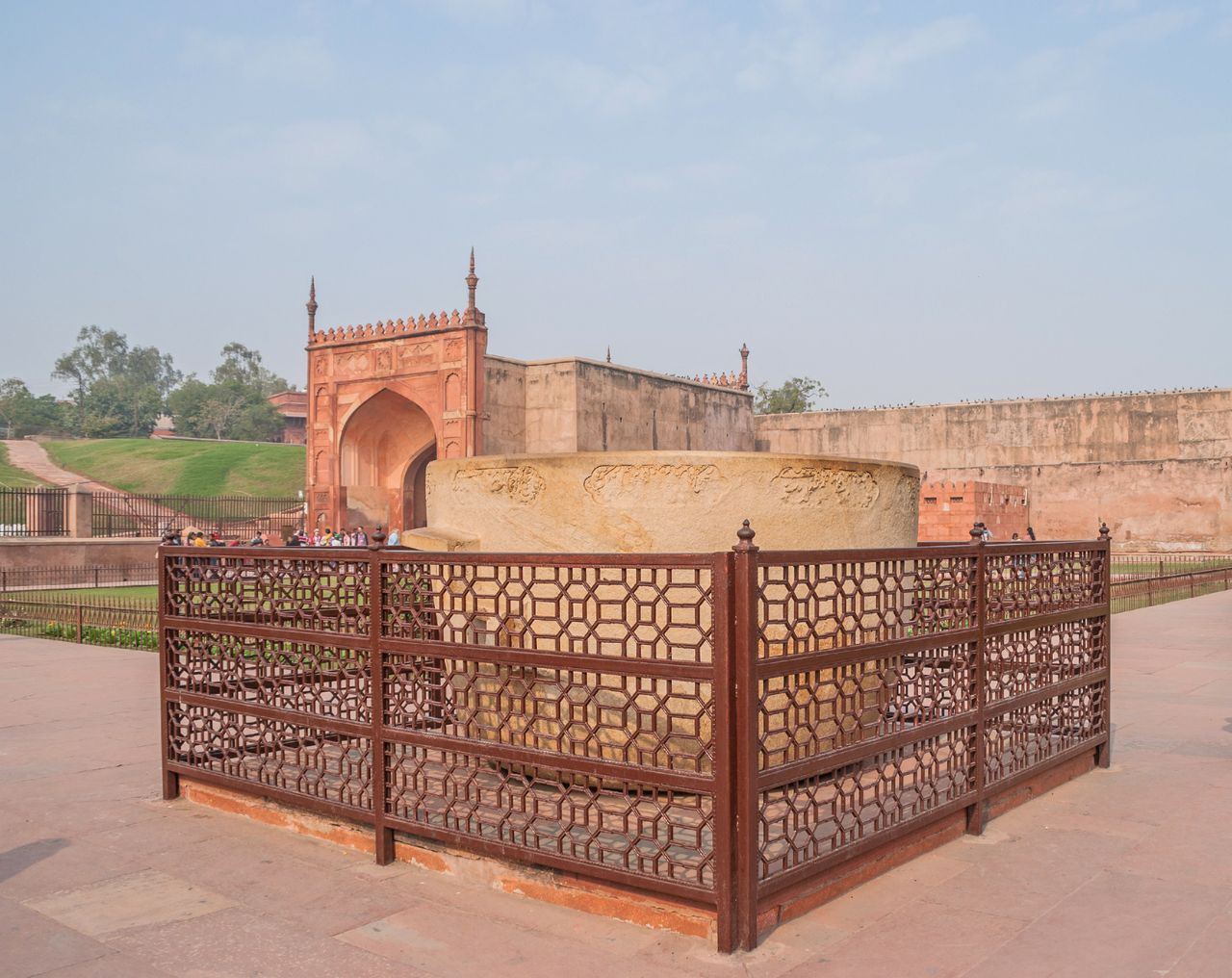
Jahangir’s Hauz – The Emperor’s Majestic Bathtub: Jahangir’s massive granite bathtub—known as the Jahangir Hauz—stands proudly facing the palace. Perfectly circular, this astonishing cistern was carved from a single giant block of granite, measuring 2.4m in diameter, 1.22m deep, and 7.62m in circumference. Built in 1611, as confirmed by a Persian inscription in elegant Nasta’liq script, the Hauz may once have been used not only by the emperor but also by the ladies of the Mughal harem. Standing before it, you can almost imagine it filled with fragrant rose water, shimmering under the royal courtyard’s sunlight.
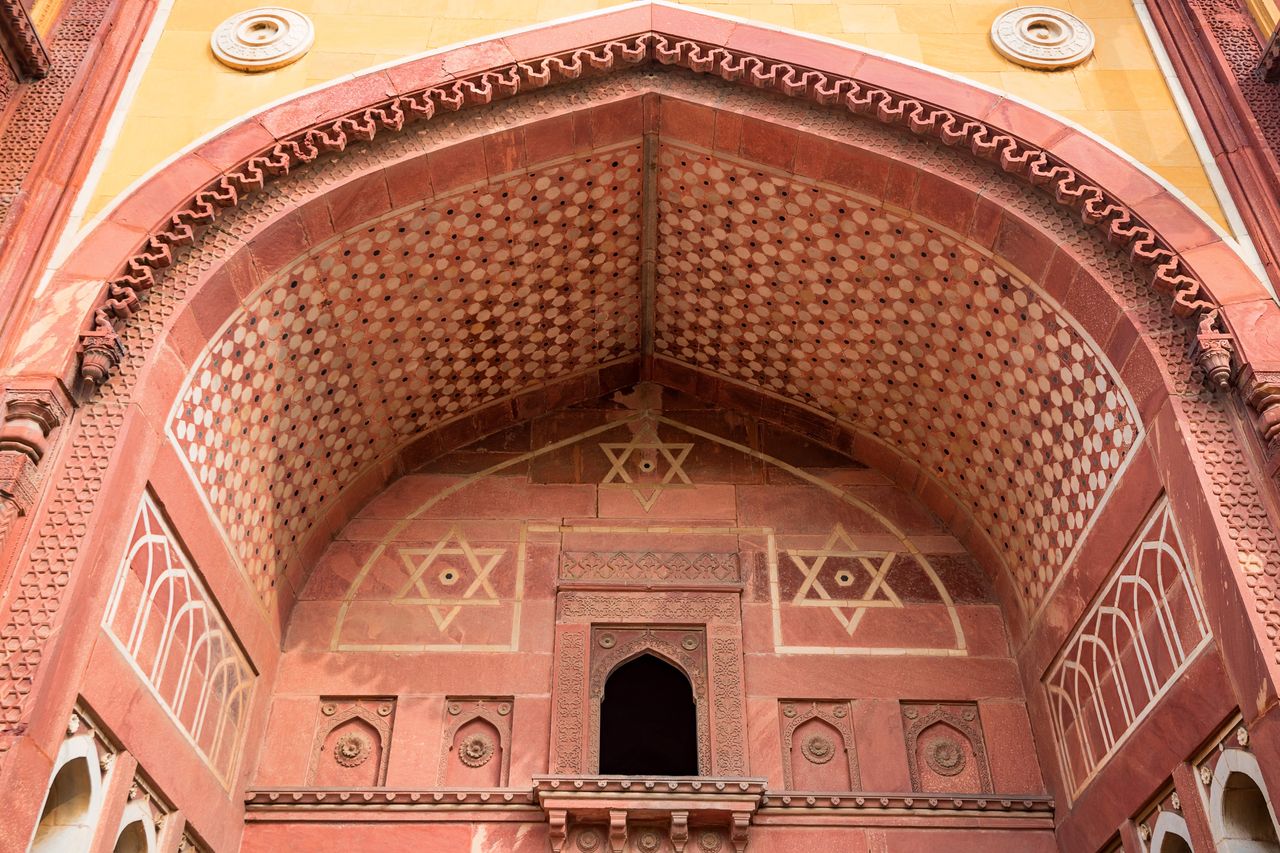
A Symbolic Entrance – Not the Star of David, But Something Older: At the entrance of Jahangir’s Palace, geometric motifs resembling the Star of David catch every visitor’s eye. But these designs are not Jewish symbols at all. Instead, they reflect an ancient Hindu symbol of Muruga—representing the harmonious union of masculine (Shiva) and feminine (Shakti) energies. Much like the yin and yang, the two intersecting triangles face opposite directions to complete the whole. These powerful symbols, also seen in Humayun’s Tomb in Delhi, reveal the Mughal era’s deep respect for diverse cultural aesthetics.
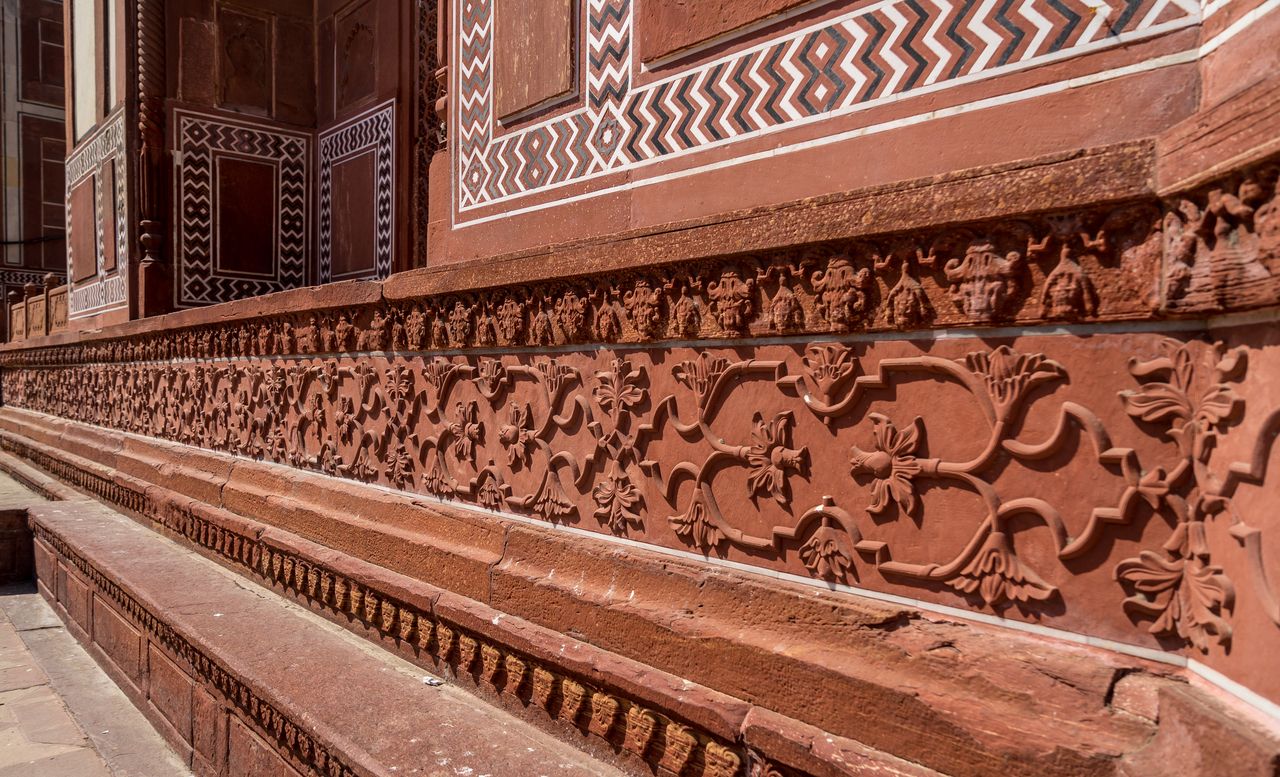
The lower façade of Jahangir Palace features exquisite red-sandstone carvings and striking inlay work in black and white marble—an artistic triumph of Mughal India. © Eillen
When Shah Jahan shifted his capital to Delhi in 1638, Agra Fort didn’t lose its importance. It remained his cherished residence — a place filled with memories, artistry, and the quiet glow of the empire he had shaped. But in a cruel twist of fate, the palace he loved eventually became his prison.
In 1657, political ambition fractured the Mughal court. Shah Jahan’s son, Aurangzeb, seized power and placed his father under house arrest inside Agra Fort. What had once been a royal home turned into a gilded cage. For the next nine years, the emperor lived confined within the fort’s walls — aging, ailing, yet still surrounded by the marble beauty he had commissioned.
From the Musamman Burj, his octagonal marble tower, Shah Jahan gazed daily at the shimmering Taj Mahal across the Yamuna. But what drew him was not merely the perfection of the monument — it was the presence of his beloved Mumtaz Mahal, resting eternally within. The Taj was not just a masterpiece of architecture; for Shah Jahan, it was the embodiment of love, grief, and memory.
Shah Jahan passed away on January 22, 1666, at the age of 75. At that time, the Yamuna flowed directly against the eastern walls of Agra Fort. Following tradition, his body was gently lowered through the Water Gate, placed on a boat, and carried across the river.
His final wish was simple and deeply human — to be reunited with Mumtaz Mahal. And so, the emperor who built the world’s greatest monument to love was laid to rest beside the woman who inspired it.
Even today, Shah Jahan and Mumtaz lie together in the Taj Mahal, their love story carved forever in marble.
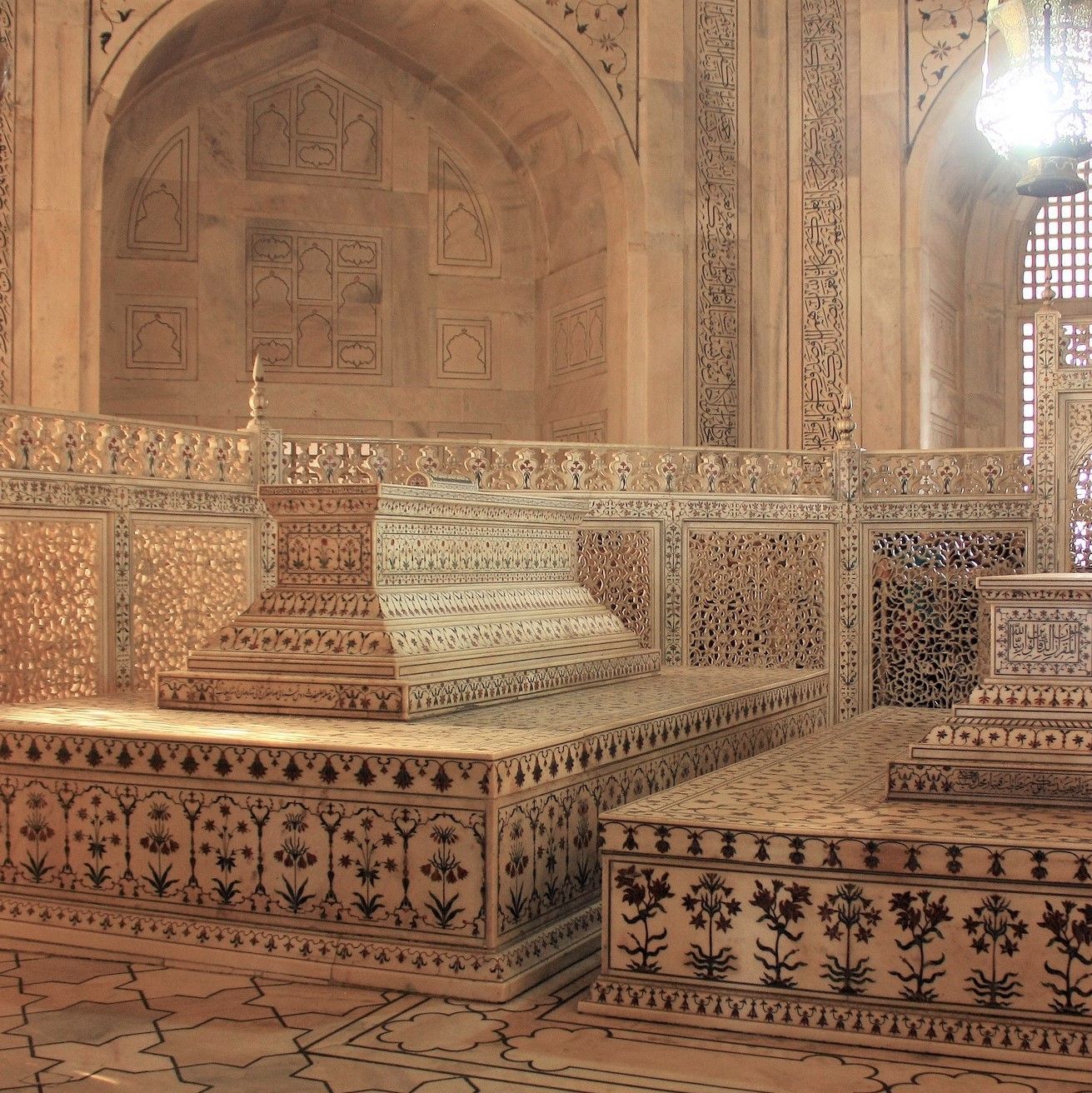
The serene tomb chamber of Shah Jahan and Mumtaz Mahal inside the Taj Mahal—eternal lovers united for all time in India’s most iconic monument.
After Shah Jahan’s death, the brilliance of Agra Fort slowly dimmed. Although Aurangzeb, constantly preoccupied with wars in the Deccan, occasionally visited the fort and held imperial durbars there, the fort’s golden age was clearly passing.
When Aurangzeb died in 1707, the mighty Mughal Empire began to crumble. Fragmentation set in, and the once-unshakeable dynasty found itself losing control over its territories. Agra Fort, too, became a prize passed from hand to hand.
Between 1761 and 1774, the fort fell into the hands of the Jats, who seized control during the empire’s weakened state. Then, in 1784, Mahadji Scindia and the Marathas took over, ruling until 1803, when the British — led by Lord Lake — marched in and claimed the fort for themselves.
But the British era was especially unkind to the fort’s architectural heritage. From 1803 to 1862, many of Agra Fort’s splendid Mughal structures were demolished to make space for British military barracks. During the earlier Jat occupation, Suraj Mal had already removed several marble tanks, transporting them to his palace at Deeg, where they were used to embellish his gardens. These losses left lasting gaps in the fort’s artistic legacy.
Curiously, the British never attacked the fort directly. Yet, during the Uprising of 1857, it became a refuge. More than 4,000 Europeans barricaded themselves inside its immense walls as chaos spread through northern India. Among them was John Russell Colvin, the Lieutenant Governor of the North-Western Provinces. Tragically, he succumbed to cholera on September 9, 1857, while still inside the fort. His grave, marked by a small Gothic-style tomb, still stands near the Diwan-i-Aam, a colonial echo amidst Mughal grandeur.
Through centuries of conflict, conquest, and change, Agra Fort has survived — scarred but unbroken, carrying the weight of empires within its red sandstone walls.
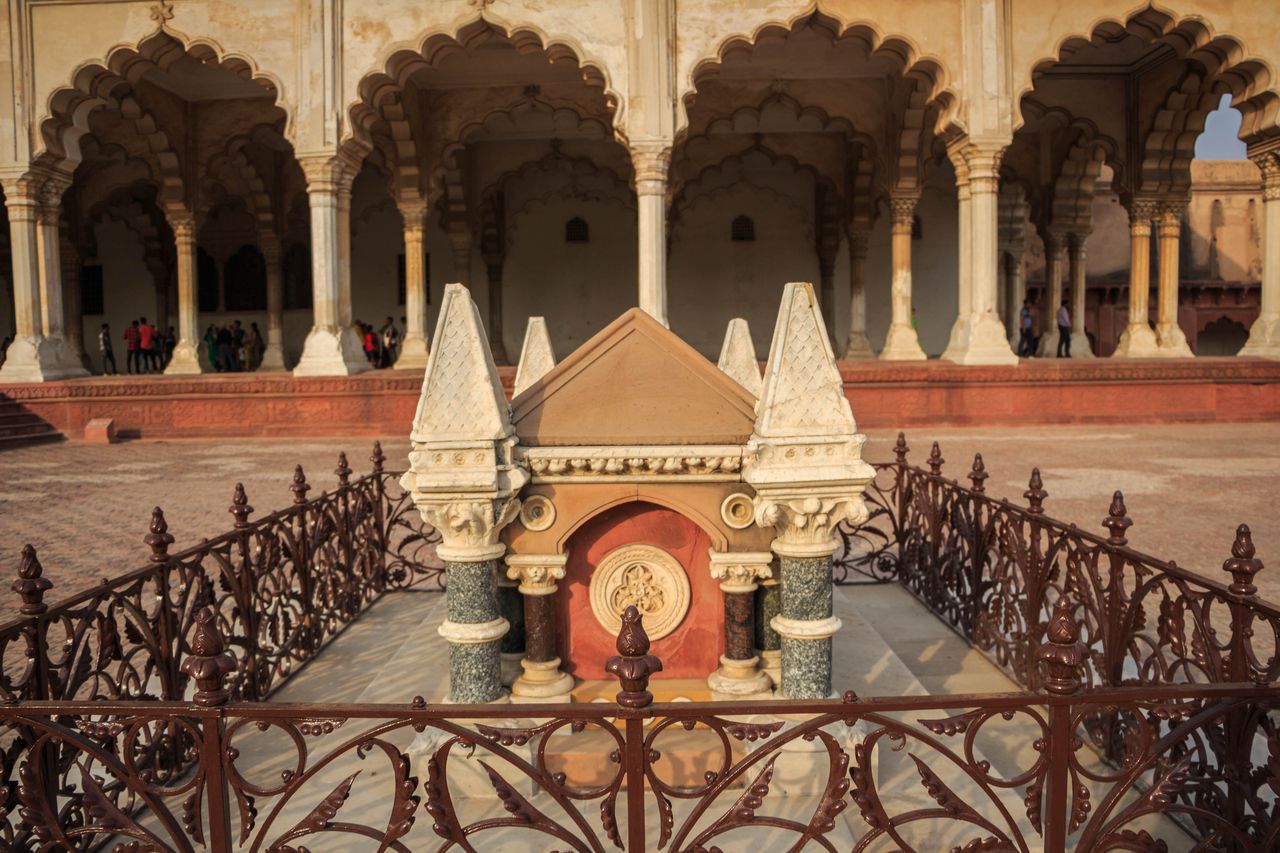
The tomb of John Russell Colvin, Lieutenant Governor during the 1857 uprising, stands solemnly near the Diwan-i-Aam—a colonial memory amid Mughal grandeur. © Arif Areeman / Shutterstock
Even today, Agra Fort stands as one of India’s most extraordinary historical treasures — a place where the past feels alive, etched into every courtyard, arch, and tower. Its breathtaking architecture and centuries-long saga of emperors, battles, artistry, and love combine to form a narrative as compelling as any epic.
In 1983, the fort was rightfully declared a UNESCO World Heritage Site, recognized for its outstanding universal value. Later, it also received the prestigious Aga Khan Award for Architecture, further honoring the genius and craftsmanship behind its creation. These accolades are testaments to the fort’s enduring significance and the extraordinary minds that shaped it. And yet, no award can fully capture the imagination, intellect, and creativity that brought this masterpiece to life.
Walking through Agra Fort is to walk through time — through Mughal grandeur, political intrigue, artistic brilliance, and human stories that refuse to fade.
Traveler Tip
Exploring Agra Fort can be wonderfully immersive but also physically demanding. There are no shops selling drinks inside the complex, and the walk can feel long under the sun.
👉 Be sure to carry your own water to stay refreshed throughout your visit.

A laborer shapes sandstone for ongoing restoration works at Agra Fort. With a history stretching back to 1080, the fort requires constant conservation. © travelview / Shutterstock
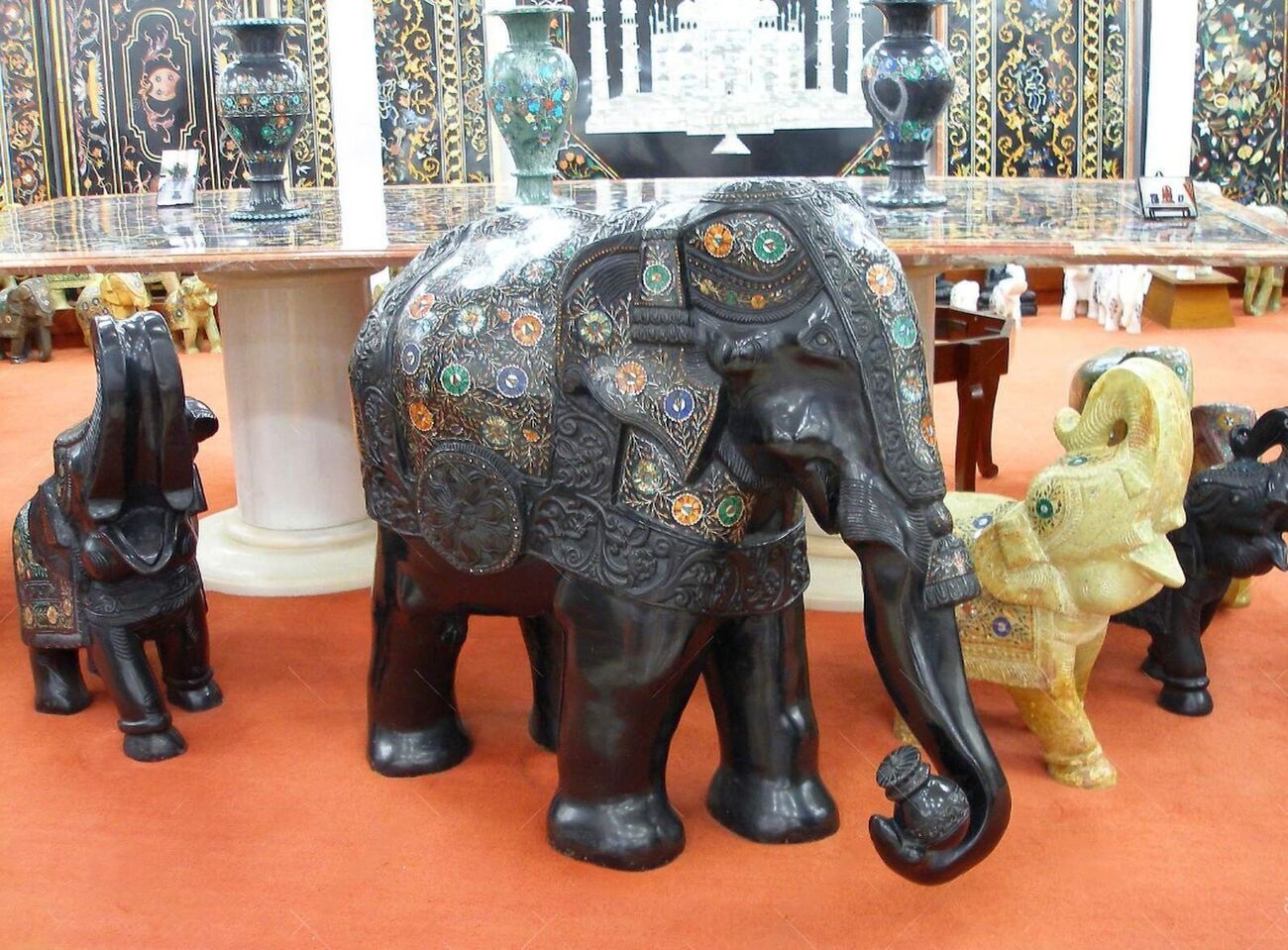
Near Agra Fort, shops overflow with intricate marble elephants, pietra-dura tabletops, and stone vases—treasures echoing the artistry of the Taj Mahal.

![Golden Triangle Tour with Goa [Culture + Beach Vacation] (12 days)](https://www.vacationindia.com/wp-content/uploads/2022/06/golden-triangle-tour-with-beach-vacation-270x160.jpg "Golden Triangle Tour with Goa [Culture + Beach Vacation] (12 days)")










































Nagpur, located in the state of Maharashtra in central India, is sometimes referred to as the “Heart of India” because of its central location in the country. The city is situated almost exactly at the center of the Indian mainland, and is often considered the geographical center of the country.
The term Agravana hence means grove forest. Agra was also known as Akbarabad in the Mughal era. The name was coined by the emperor Shah Jahan, in honour of his grandfather Akbar.
“Red Fort – ek timeless architectural masterpiece.”