

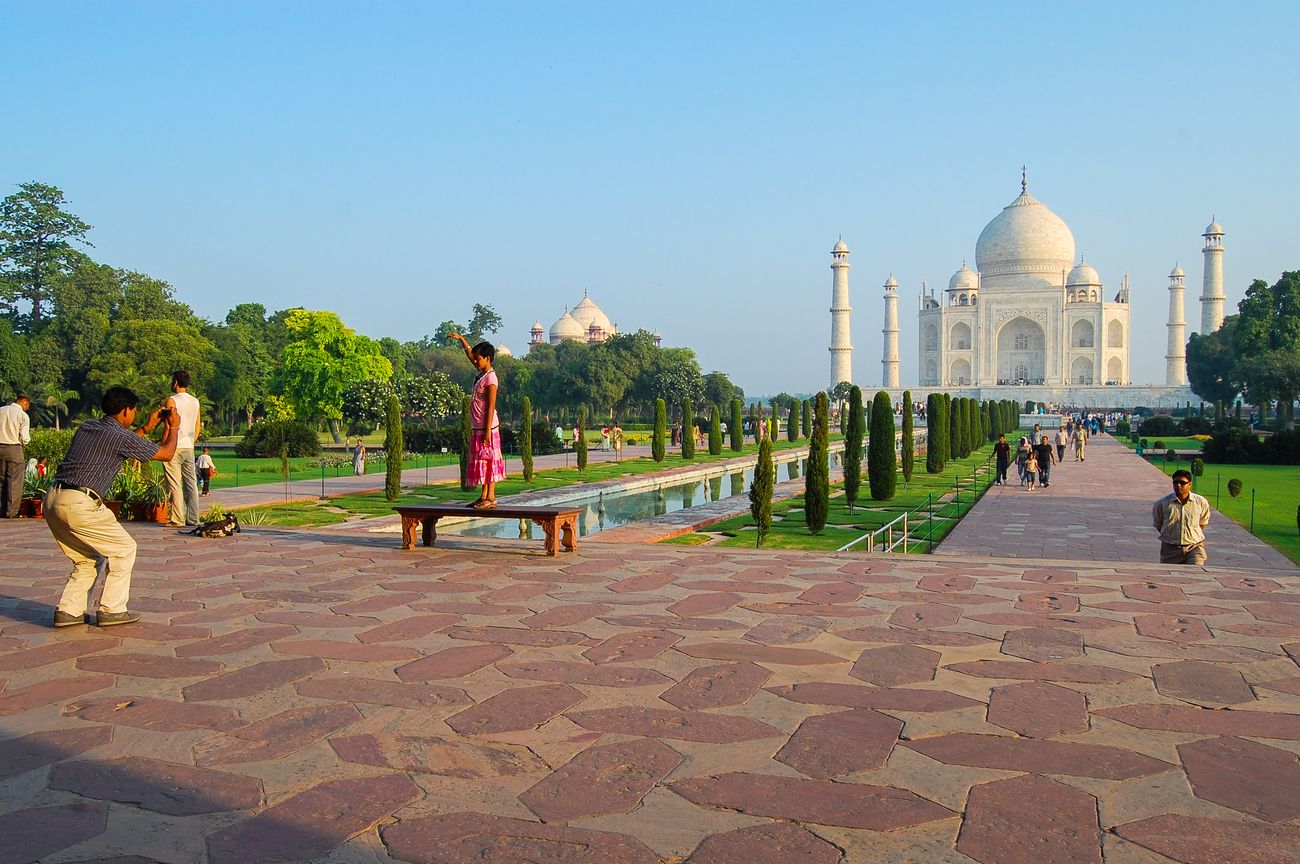
Taj Mahal – An Epitome of Love
Marble Poetry
The Great Mughal Empire
Shah Jahan on the Throne
Lasting Love
A Golden Time in Architecture
The Last Days of the Emperor
Symbol of eternal love
Mughal Architecture
The Entrance to the Taj Mahal
Symmetry and Alignment
Naubat Khana in the Taj Mahal
The Layout of the Complex
Octagonal Plan
Building Materials
Charbagh
Geometric Patterns
The Lotus Pool
The Foundation and the Plinth
The Marble Plinth and Cladding
The Central Doorway
Pietra Dura
The Smaller Pishtaqs
The Majestic Dome
The Chhatri
The Pilasters
The Minarets
The Funerary Chamber
The Screen
The Crypt
The Mosque
The Mehman Khana (Guest House)
The Outline of the Finial
Tourist Information
Some Useful Information about Visiting the Taj Mahal Illustrated Through Images
Where to Stay in Agra to visit Taj Mahal
Cleaning and Restoration of the Taj Mahal
Many years ago, American poet and travel writer Bayard Taylor compared the Taj Mahal to “a castle conjured up in the heavens, then set down on earth to be marveled at forever.” He could not have described it better. Even today, this celestial vision in marble continues to enchant millions, casting the same spell of wonder it has for centuries.
The Taj Mahal is more than a monument—it is the world’s most breathtaking ode to love. Its story has traveled across oceans, deserts, and continents, drawing visitors from every corner of the globe. People come not just to see its flawless symmetry and shimmering white marble, but to feel the emotion carved into every stone.
Built by Shah Jahan, the great Mughal emperor, the Taj was a tribute to his beloved wife Mumtaz Mahal. Construction began in 1631, and for the next 17 years, the finest artisans, craftsmen, and calligraphers poured their skill and soul into creating this masterpiece of Islamic art. The result was a monument so perfect, so ethereal, that it has never been matched—before or since.
No king has ever honored love in a more spectacular or enduring way. The Taj Mahal stands not just as a tomb, but as a timeless reminder of devotion, beauty, and the human longing to make love immortal.
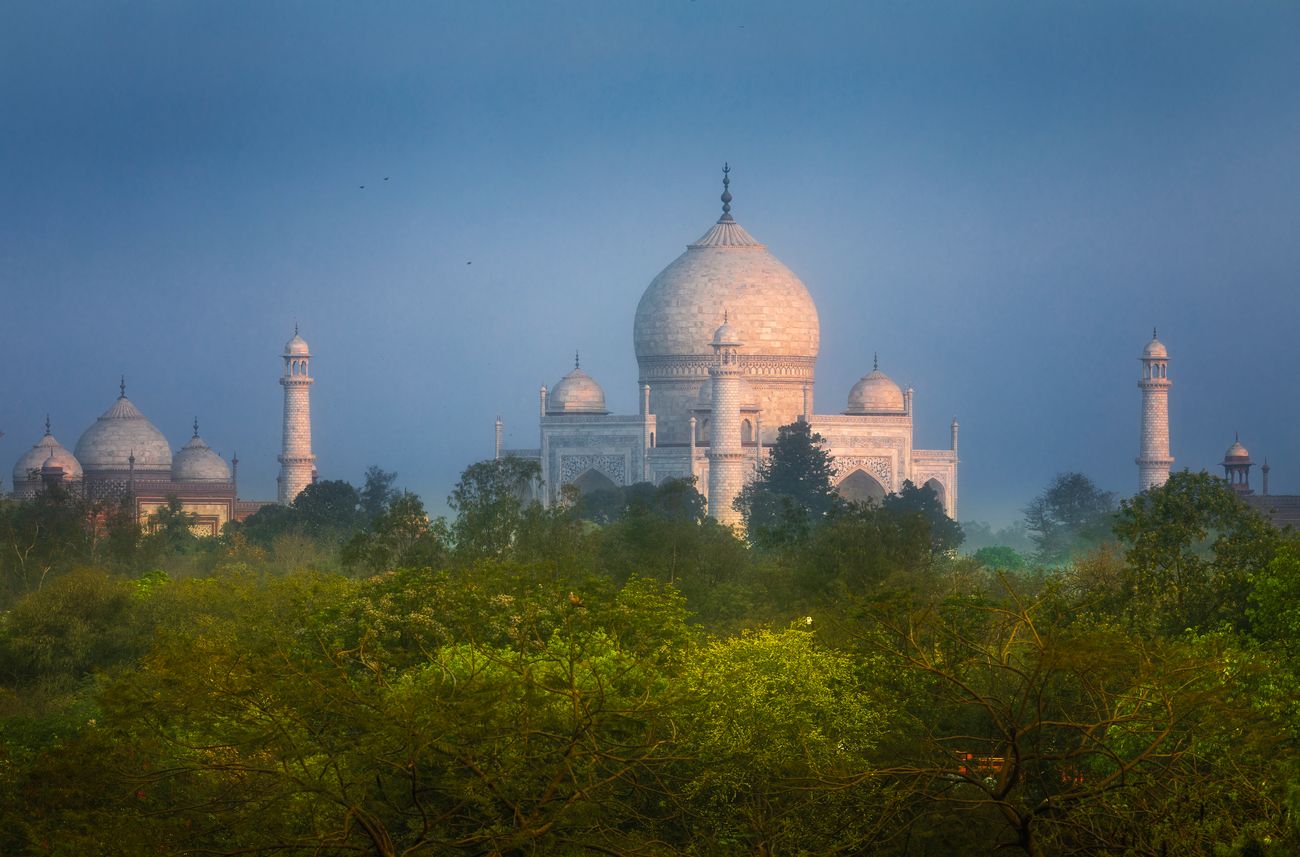
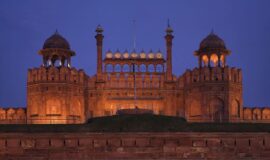
From the ramparts of the Red Fort, the Taj Mahal rises like a moonlit dream — captured here by Michail Vorobyev.
Marble Poetry
For centuries, the Taj Mahal has stood like a poem carved in marble—captivating, astonishing, and inspiring all who gaze upon it. In 1983, UNESCO declared it a World Heritage Site, calling it a masterpiece admired universally. Few places on earth deserve such praise more than this serene, luminous tomb built by the Mughal emperor Shah Jahan in memory of his beloved wife, Mumtaz Mahal. Today, it is celebrated as one of the Seven Wonders of the World.
The creation of the Taj was nothing short of monumental. Beginning in 1632, an army of 20,000 laborers, along with master stonemasons, architects, calligraphers, and artisans from across India and even distant Persia, spent nearly twenty years bringing this vision to life. Shah Jahan, himself a passionate builder and connoisseur of architecture, personally oversaw the design, ensuring that every curve, every inlay, every proportion matched the grandeur of his love.
Interestingly, during his lifetime, the monument was known simply as the rauza—the tomb. Only later, after the Shah’s death, did it take on the now iconic name: The Taj Mahal.
The setting is as spectacular as the structure itself. Perched at a dramatic eastward curve of the Yamuna River, the Taj rests on a vast marble platform, flanked by four elegant, free-standing minarets at each corner. Perfect symmetry defines the entire complex—enhanced by the two nearly identical buildings on either side: the Masjid (mosque) to the west, and the Mehman Khana (guest house) to the east.
To experience Agra’s history more fully, continue your journey to other Mughal landmarks such as:
• Akbar’s Tomb at Sikandra
• Agra Fort
• Fatehpur Sikri, the abandoned imperial capital
• The Tomb of Itmad-ud-Daulah, often called the “Baby Taj”
To truly appreciate the Taj Mahal, it helps to understand the world of the Mughals, especially the remarkable emperor Shah Jahan, whose love and vision shaped this eternal symbol of beauty.
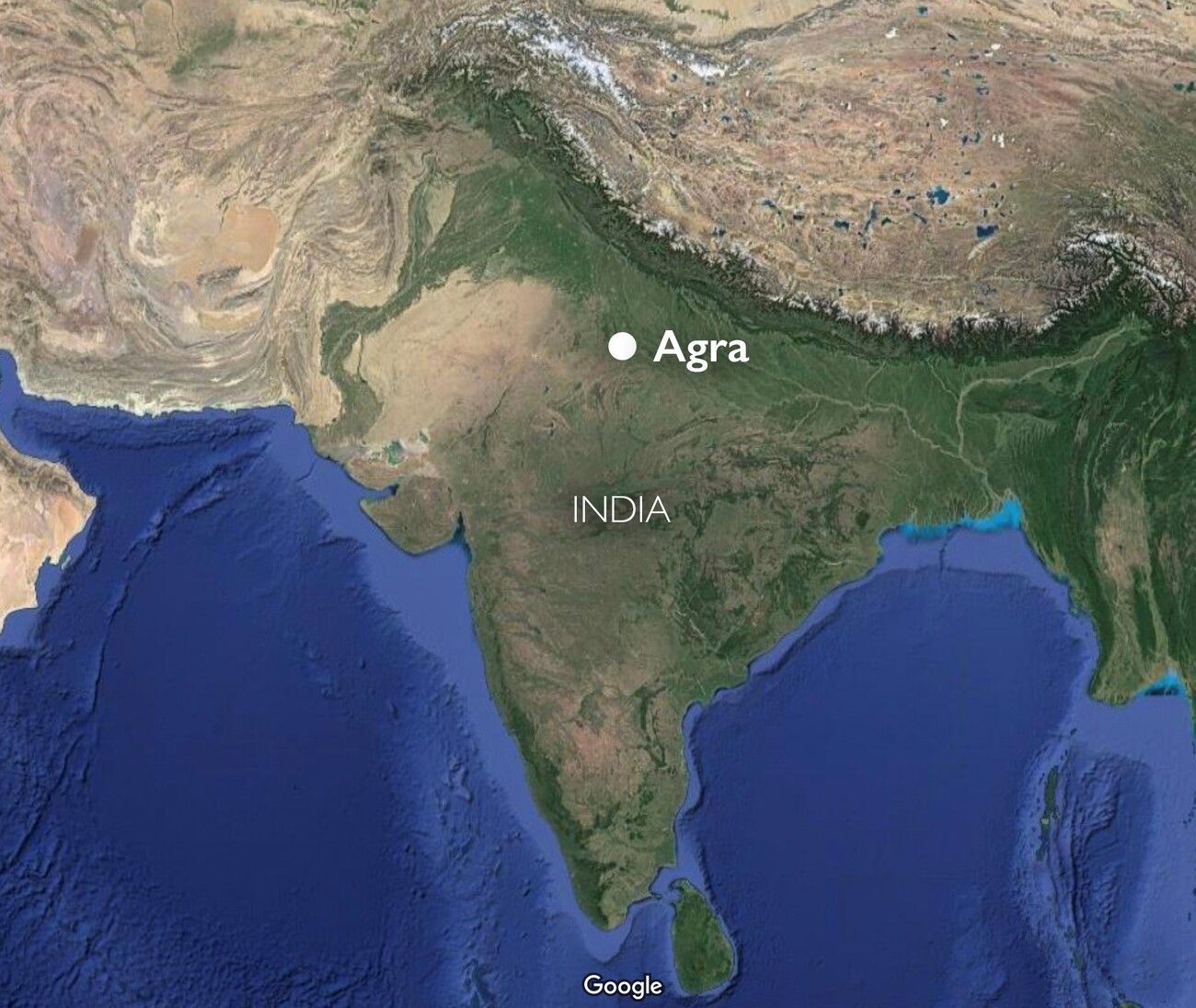
For more than two centuries Agra was the beating heart of the Mughal Empire; today it remains the imperial capital of Uttar Pradesh in northern India.
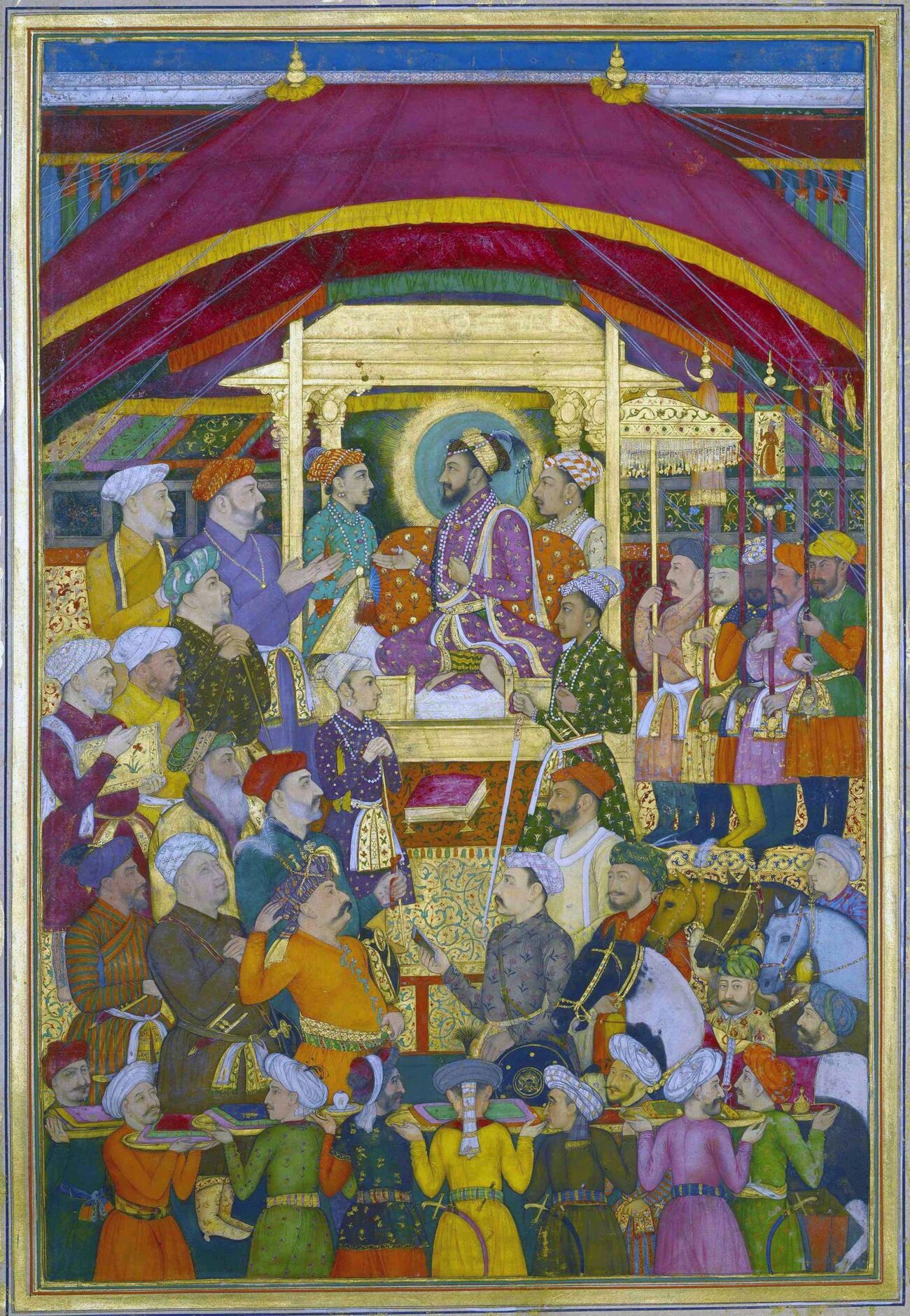
A 17th-century painting shows Shah Jahan surrounded by his nobles — their positions around the throne governed by strict court hierarchy.
The Great Mughal Empire
In the 17th century, the Mughal Empire stood as one of the most powerful and sophisticated states in the world. Its administrative system was so advanced and efficient that it governed more than 100 million people across the Indian subcontinent—an extraordinary achievement for its time.
For nearly 180 years, from 1526 to 1707, the empire thrived. It expanded its territories, consolidated its power, and became famous worldwide for the grandeur of its royal courts, the brilliance of its culture, and its breathtaking architectural creations.
Yet, after generations of splendor, the empire slowly slipped into decline. Its final chapter closed in 1857, when Britain removed the last Mughal emperor, Bahadur Shah Zafar, marking the end of an era.
Below is the timeline of the empire’s most defining moments:
A Glimpse at the Mughal Timeline
• 1526: The Mughal Empire is founded by Babur, who establishes Agra as the capital.
• 1530–1556: Humayun reigns, navigating war, exile, and eventual restoration.
• 1556–1605: Akbar the Great governs with vision and tolerance, shaping the golden age of Mughal rule.
• 1605–1627: Jahangir reigns, blending his father’s administrative genius with his own love of art and refinement.
• 1627: After Jahangir’s death, a fierce war of succession erupts.
• 1628: Shah Jahan ascends the throne, ushering in the empire’s most architectural glorious period.
• 1612: Years earlier, Shah Jahan weds Arjumand Banu Begum, better known as Mumtaz Mahal, the love of his life.
• 1631–1632: Following Mumtaz’s tragic death, construction of the Taj Mahal begins—an enduring tribute to eternal love.
• 1654: The Taj Mahal is completed, dazzling the world with its marble perfection.
• 1658: Shah Jahan is deposed by his son Aurangzeb and confined to Agra Fort.
• 1666: Upon his death, Shah Jahan is laid to rest beside Mumtaz within the Taj Mahal, united with her forever.
Shah Jahan on the Throne
Born in 1592 as Prince Khurram, the young Mughal royal would one day earn the grand title Shah Jahan—King of the World. In 1628, he succeeded his father, Emperor Jahangir, becoming the 5th Mughal emperor and ushering in an era of unmatched grandeur.
During his thirty-year reign, Shah Jahan expanded the Mughal Empire deep into the southern Deccan, strengthening its reach and securing its prosperity. Yet, his legacy stretches far beyond military expansion. Much like his illustrious grandfather Akbar, Shah Jahan possessed an extraordinary passion for architecture and beauty.
Under his rule, a remarkable number of palaces, mosques, gardens, and monuments rose from the earth, each reflecting his refined taste and visionary imagination. He was not only a patron of artists and craftsmen but also a devoted collector of jewels, precious stones, and fine art—a connoisseur whose personal love for elegance shaped the Mughal aesthetic.
It was this devotion to beauty—and to love—that would ultimately give the world its greatest treasure: the Taj Mahal.

This exquisite Mughal-era painting captures a moment of grandeur: ambassadors and envoys from European nations presenting lavish gifts to Emperor Shah Jahan (1592–1666) as he ascends the throne as the fifth ruler of the Mughal Empire. Shah Jahan — grandson of Akbar the Great and one of India’s most celebrated emperors — is remembered not only for his unmatched architectural legacy, including the Taj Mahal, but also for commissioning the Padshahnama, the richly illustrated chronicle of his reign. Under his rule, the Mughal Empire reached the peak of its power and sophistication. His opulent court, symbolized by the legendary Peacock Throne, was admired by dignitaries from across the world. Major cities like Delhi, Agra, Lahore, and Ahmedabad blossomed into thriving hubs of craft and commerce, connected to distant lands by bustling roads and seaways.
Shah Jahan later shifted his capital from Agra to Delhi, overseeing the construction of monumental landmarks such as Jama Masjid and the Red Fort, Lahore’s Shalimar Gardens, parts of Lahore Fort, and the mausoleum of his father, Jahangir. This artwork beautifully reflects the splendor, influence, and global allure of his golden reign.
Lasting Love
Shah Jahan was only fourteen when he first saw Arjumand Banu Begum—and in that single moment, his world changed forever. It was the legendary love-at-first-sight, the kind that poets write about and storytellers guard for centuries.
Five years later, he married her and gave her a name that captured exactly what she meant to him: Mumtaz Mahal, the Jewel of the Palace. From that day forward, they were inseparable. Whether he traveled for royal duties or marched into battle, she was always by his side—his confidante, his strength, his closest companion.
But in 1631, tragedy struck. Mumtaz Mahal died while giving birth to their fourteenth child, leaving the emperor shattered. Consumed by grief yet driven by love, Shah Jahan vowed to honor her memory in a way the world would never forget.
And so began the creation of the Taj Mahal—the most beautiful monument ever built, a timeless tribute to a love so profound that it still touches hearts across the globe.
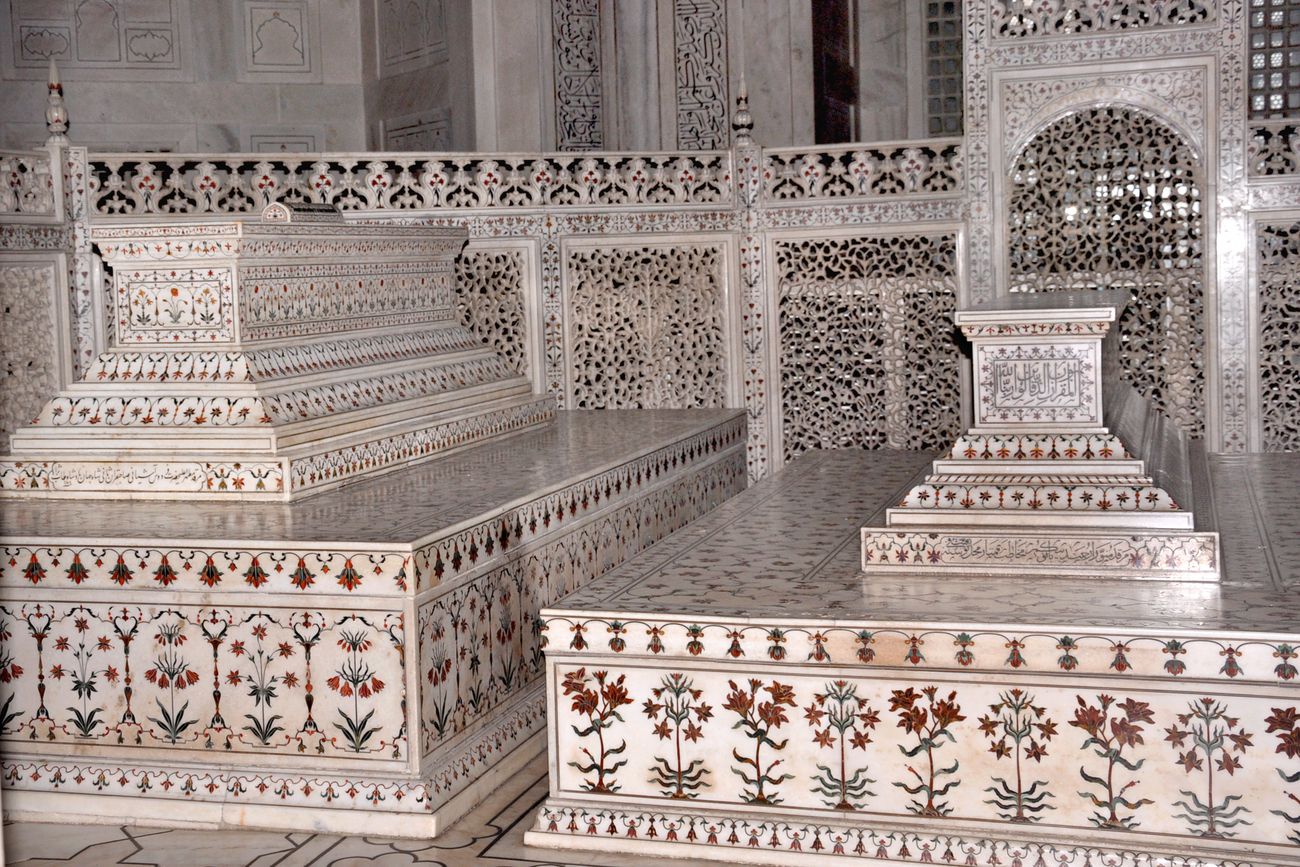
The tomb chamber where emperor and queen rest, exquisitely paired — Shah Jahan’s larger cenotaph is topped with a symbolic pen (marking it as male); their true graves lie in the sealed rectangular crypt below, not open to the public. © AHSAN SHEIKH
A Golden Time in Architecture
Under Shah Jahan’s reign, the Mughal Empire entered a golden age of architecture—a period so dazzling that its creations continue to draw visitors from around the world. Shah Jahan was not merely a ruler; he was a visionary builder whose masterpieces reshaped the skyline of India.
Among the many treasures he gifted to the world are the majestic Jama Masjid, the imposing Red Fort in his newly designed capital Shahjahanabad, and, of course, the incomparable Taj Mahal. Each monument reflects the extraordinary wealth and artistic sophistication of the Mughal court.
Precious and semi-precious stones, shimmering white marble, and exquisite craftsmanship were used with lavish generosity. The result? Structures defined by perfect symmetry, graceful proportions, and an unmistakable sense of timeless beauty.
What made Shah Jahan’s style truly unique was his ability to blend Islamic and Hindu architectural traditions with remarkable harmony. Arches and domes met lotus motifs and chhatris; marble merged with intricate inlay; geometric precision softened into floral elegance.
In every corner of his empire, Shah Jahan left behind monuments that stand today as poetic expressions in stone—testimonies to a ruler whose passion for beauty transformed Indian architecture forever.
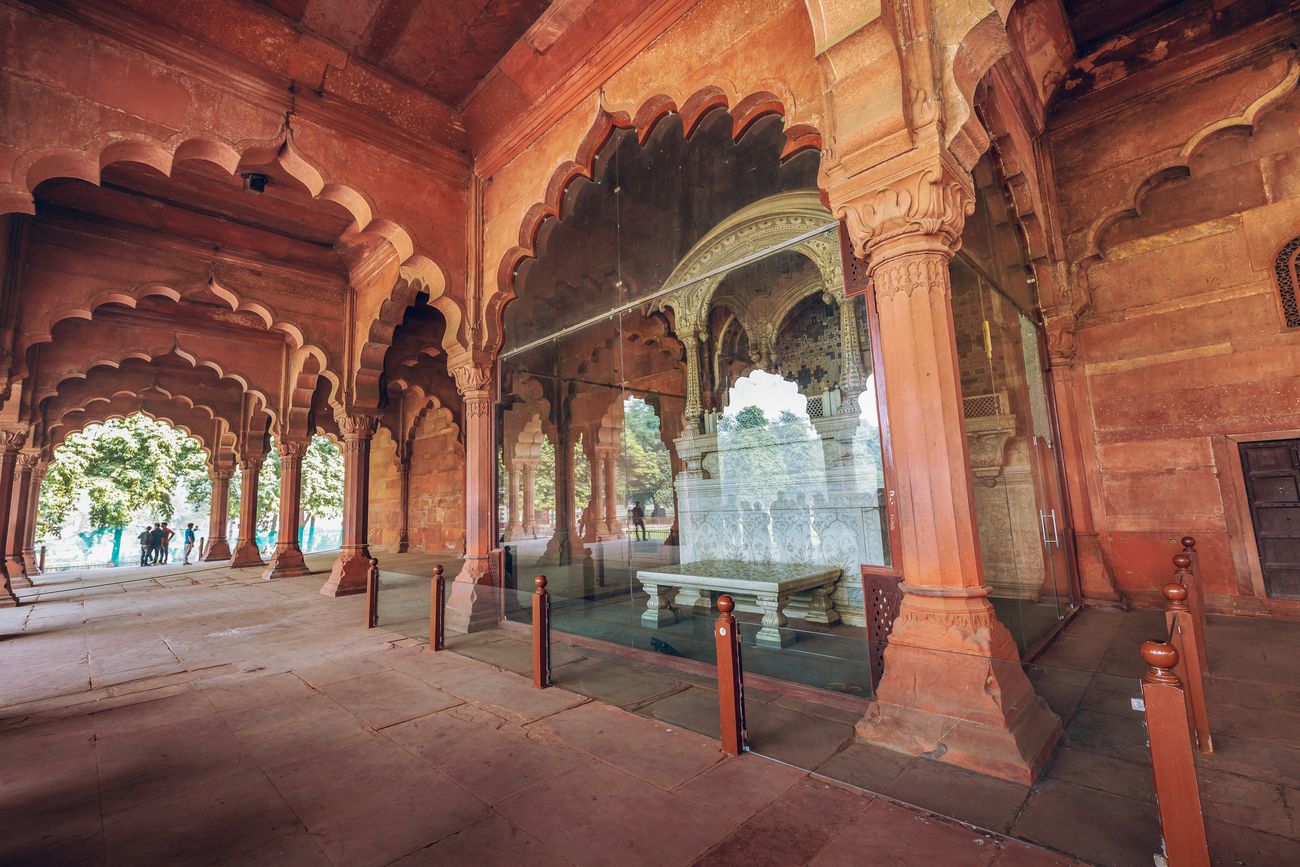
Behind glass stands the famed Peacock Throne of Shah Jahan — marble, rubies, diamonds, pearls, emeralds — a masterpiece of Mughal opulence and world-renowned craftsmanship. © Roop_Dey
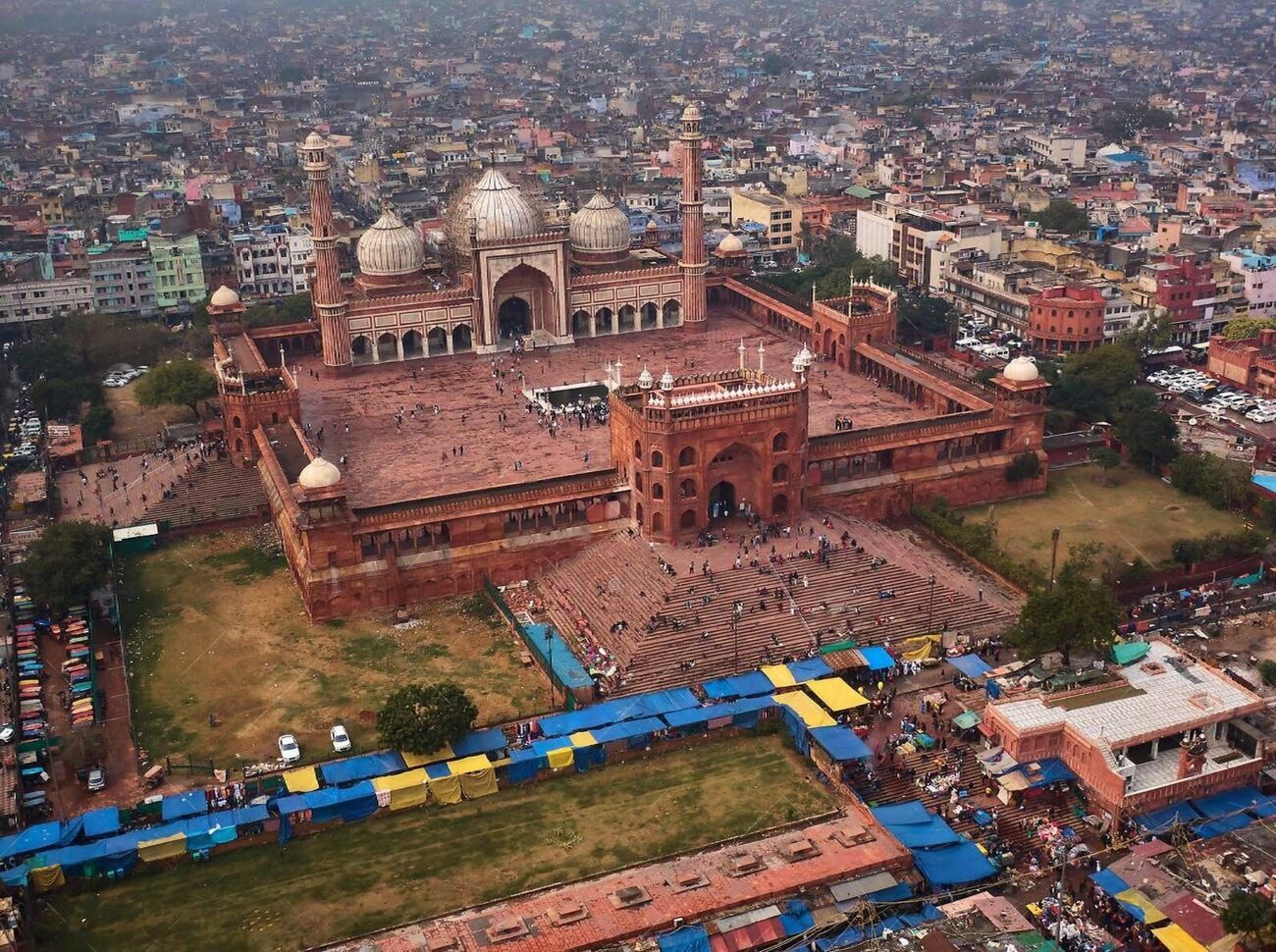
The Jama Masjid in Old Delhi stands proudly as India’s largest mosque — a monumental masterpiece of Mughal architecture. Rising above the bustling lanes of Old Delhi, its grand domes, soaring minarets, and expansive courtyard create a breathtaking space where history, faith, and community come together in timeless harmony.
The Last Days of the Emperor
In his final years, Shah Jahan—once the mighty creator of the world’s most beautiful monuments—found himself weakened by age and illness, forced to witness a painful struggle for power among his own sons. The ambition and rivalry that erupted within the royal family would seal his fate.
In a tragic turn, he was imprisoned by his son Aurangzeb inside Agra Fort, just across the river from the Taj Mahal. For the next eight years, the emperor lived in quiet confinement, tended with unwavering devotion by his eldest daughter, Jahanara Begum.
From the window of his chamber, he could see the shimmering silhouette of the Taj Mahal, the monument he built for his beloved Mumtaz. Legend says that in his final moments, his gaze remained fixed on this marble symbol of eternal love—his last and most comforting sight.
In 1666, at the age of seventy-four, Shah Jahan breathed his last. His body was carried across the Yamuna and placed beside Mumtaz Mahal within the Taj itself, completing the love story he had immortalized in stone.
Side by side, they lie together—united in death as they were in life—within the world’s greatest monument to love.
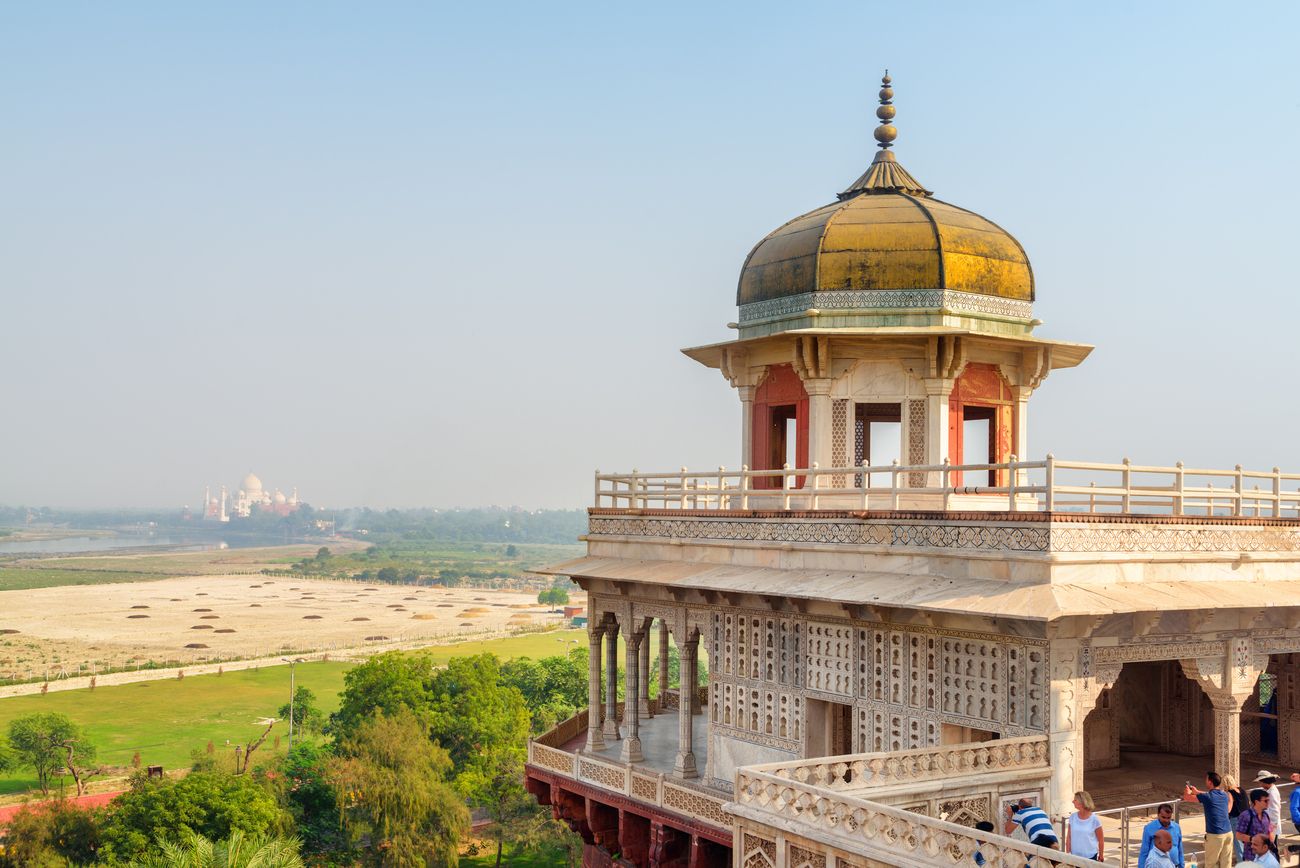
Shah Jahan built the Musamman Burj — a multi-storied marble tower inlaid with gemstones — to gaze upon the Taj Mahal he raised for Mumtaz Mahal. Ironically, it later became his place of house arrest for 16 years under Aurangzeb, where he died in 1666. © Efired
Symbol of eternal love
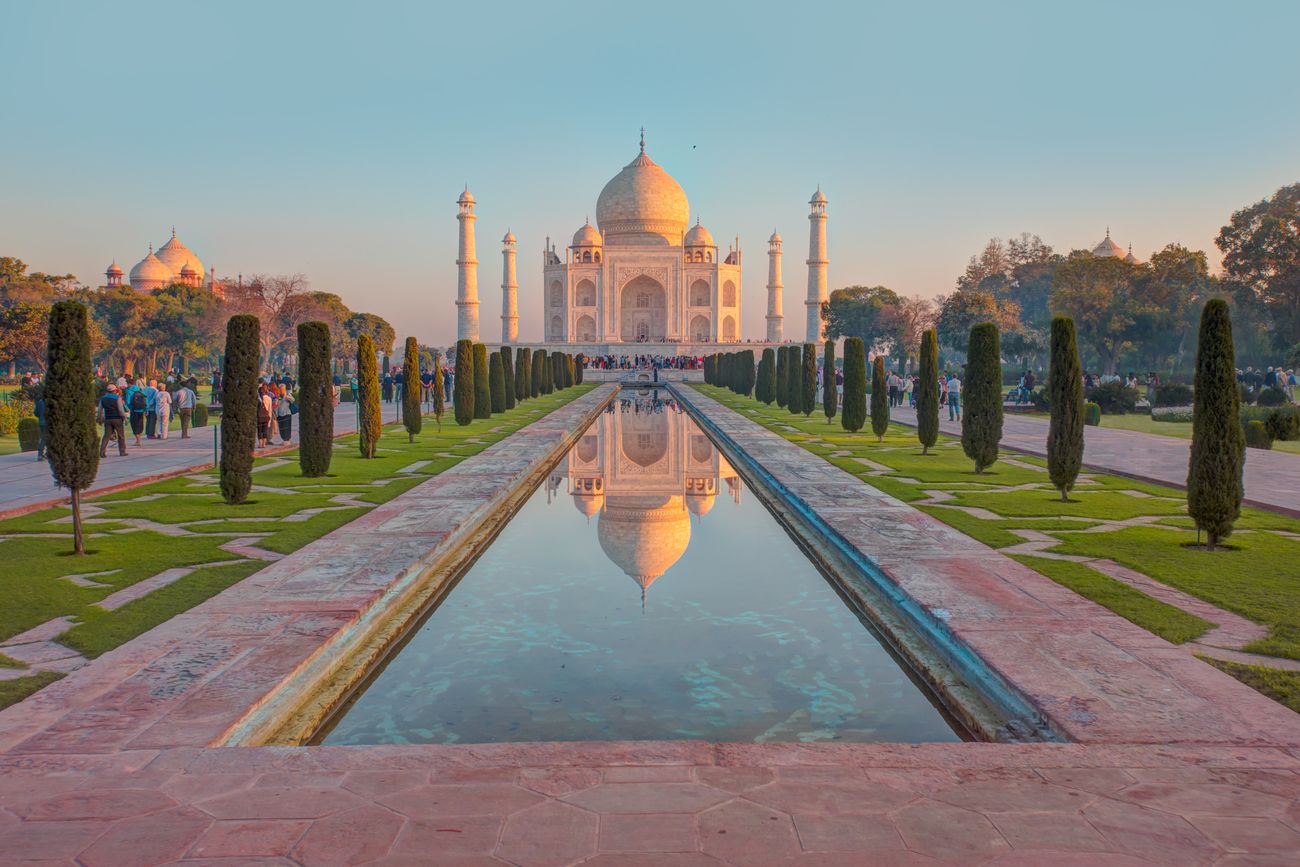
Sunset casts a golden glow over the Taj Mahal, one of the world’s most iconic masterpieces. Built by Emperor Shah Jahan in honor of his beloved queen Mumtaz Mahal, this marble wonder also reflects the height of his Mughal-era achievements. Celebrated for its flawless symmetry and breathtaking craftsmanship, it has long been described as “a prayer, a vision, a dream, a poem, and a wonder.” Nearly 20,000 laborers spent 22 years bringing it to life, using materials that cost 500 kg of gold and 41 million rupees. Its perfectly laid-out gardens evoke the Islamic vision of Paradise. Since 1653, the Taj Mahal has stood as an enduring symbol of eternal love. © muratart
Mughal Architecture
In the sixteenth and seventeenth centuries, the Mughal emperors perfected a breathtaking Indo-Persian architectural style, blending foreign craftsmanship with Indian creativity. This fusion—marked by majestic domes, graceful minarets, and exquisite symmetry—reached its unrivaled pinnacle with the creation of the Taj Mahal.
The Taj embodies this blend beautifully. Its Rajput influences appear in the elegant chhatris—the elevated dome-shaped pavilions crowning the gateway—and in the wide, protective chhajjas, the overhanging eaves that soften the building’s profile.
The Iranian touch is unmistakable in the pishtaqs: the tall rectangular frames that embrace each arched opening, giving the façade its dramatic rhythm.
Even the visitor’s first encounter with the monument is carefully choreographed. The Taj is designed so that your initial glimpse is perfectly framed within the pointed arch of its monumental gateway, almost like a living painting revealed at just the right moment.
Step through, and you are welcomed by the serene beauty of the charbagh—the classic Persian quadrilateral garden. Its lush greenery stretches out in perfect symmetry, leading your gaze toward the radiant white marble mausoleum shimmering at its far end.
This seamless blend of styles, symbolism, and geometry is what makes Mughal architecture not just impressive, but unforgettable—an art form that speaks across centuries.
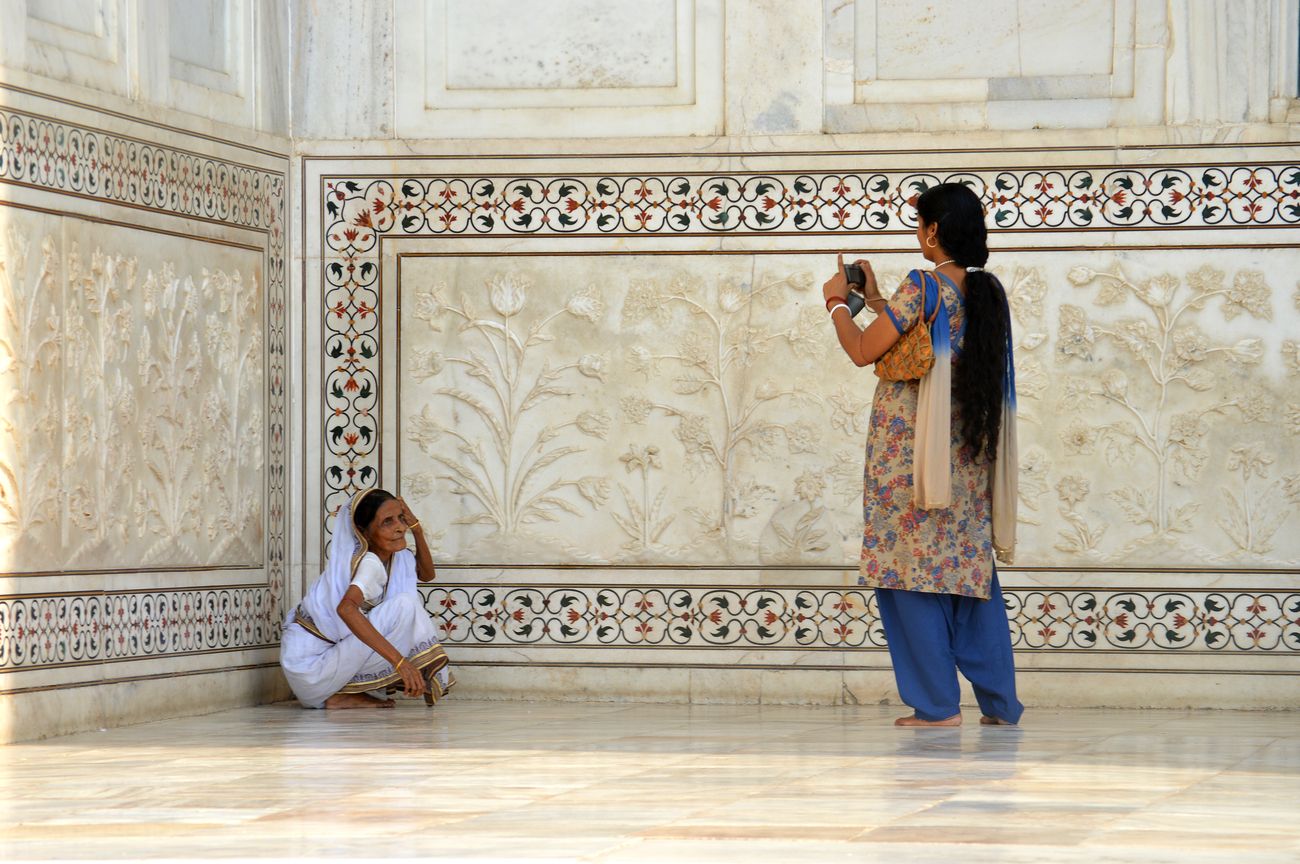
The Mughals adored gardens and flowers, a love reflected in the Taj Mahal’s exquisite carvings of plants and blossoms all over its white marble surfaces. © Agus.d.wahyudi
The Entrance to the Taj Mahal
The journey into the Taj Mahal begins at the majestic Great Gate, or darwaza-i-rauza—a grand architectural statement that prepares you for the splendor that lies beyond. Standing apart from the rest of the complex, this gateway is one of the finest examples of Islamic architectural design, both in scale and craftsmanship.
Rising three storeys high, the gate is a commanding rectangular structure built in warm red sandstone. As you approach, its massive central arch towers above you, flanked by elegant halls and smaller rooms that enhance its symmetry.
Every surface is a canvas for artistry. The walls and ceilings are adorned with intricate geometric patterns, each angle and line placed with astonishing precision. The pointed arches shine with delicate arabesque inlays, echoing the designs that later reappear on the façade of the Taj Mahal itself.
Passing through this gateway feels like stepping from one world into another—leaving behind the noise of the outside and entering the serene, dreamlike realm of the Taj.
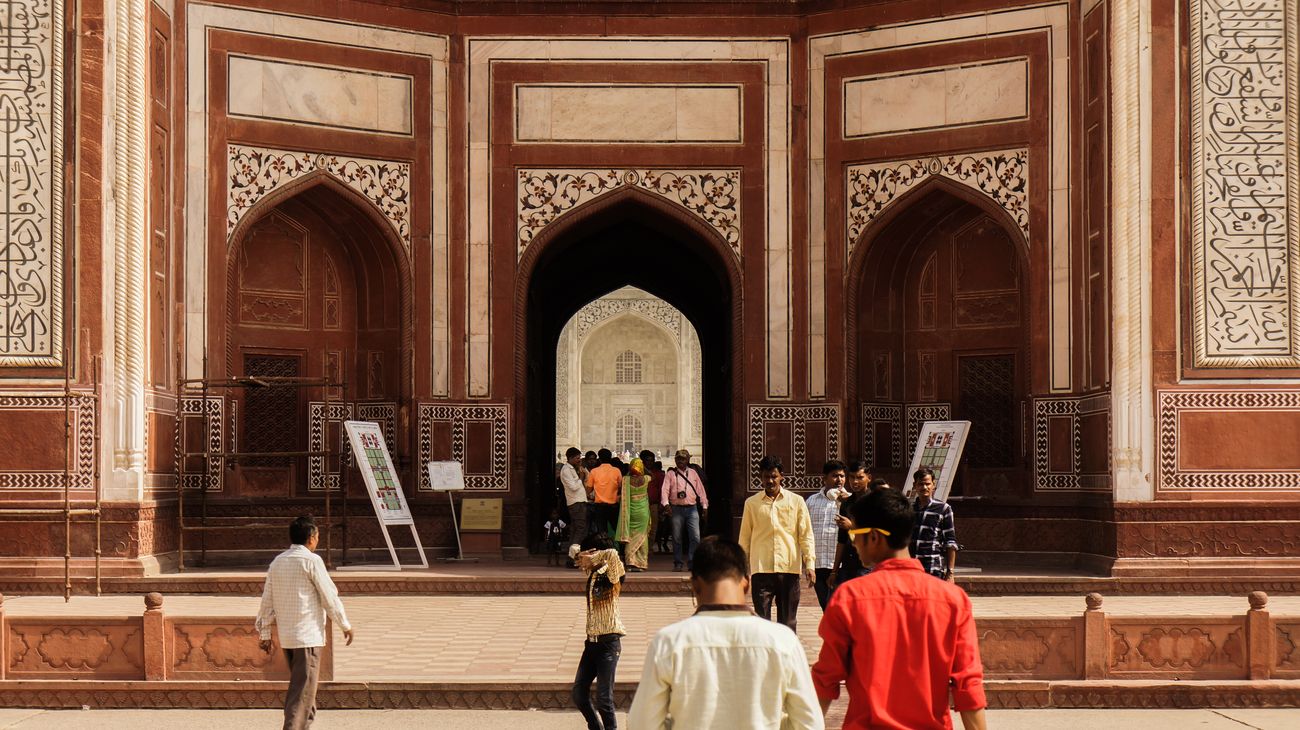
The grand entrance to the Taj Mahal sets the tone for the breathtaking beauty that unfolds beyond. © isaray
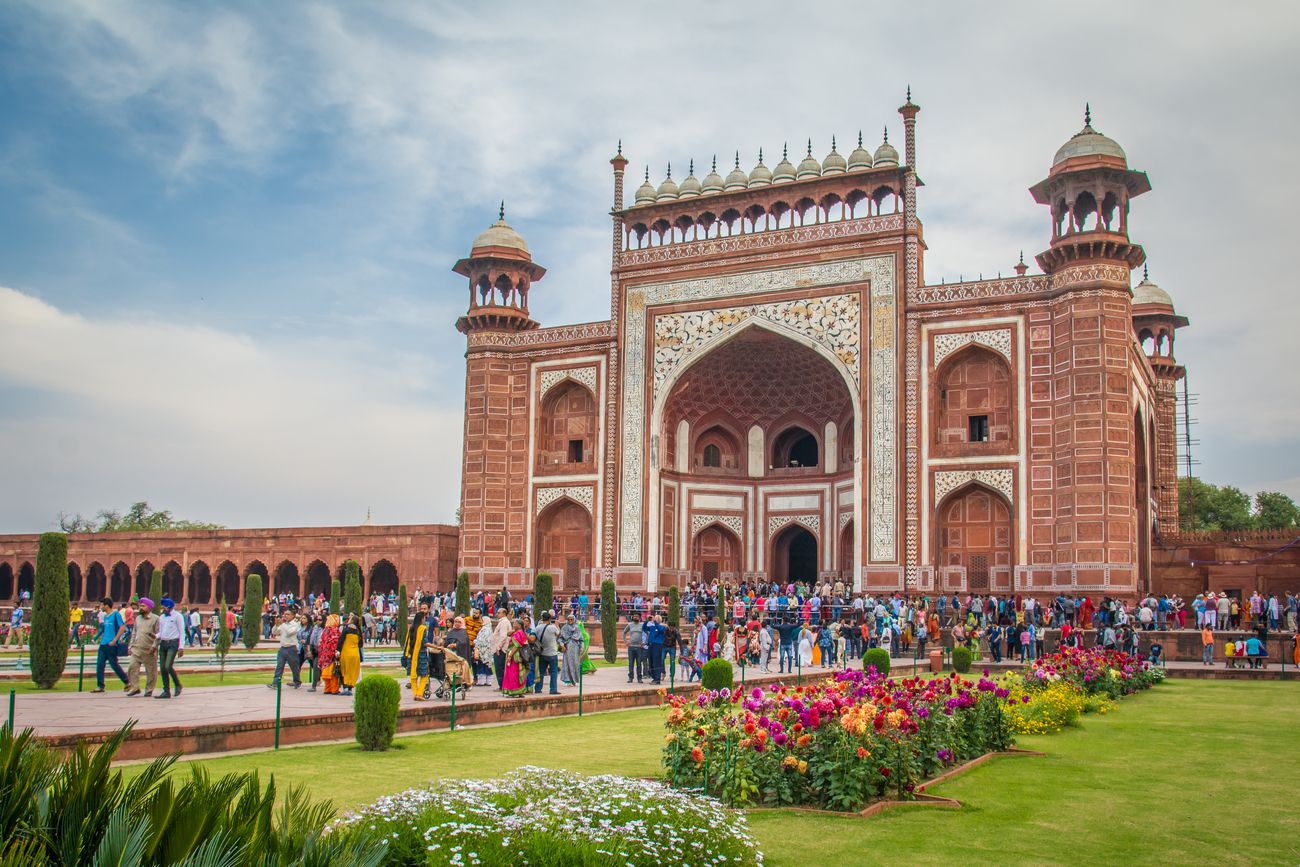
The massive entrance pishtaq (arch) rises proudly, crowned with eleven sandstone arches topped by eleven gleaming marble domes — a gateway of balance and majesty. © Emrah C. Adalioglu
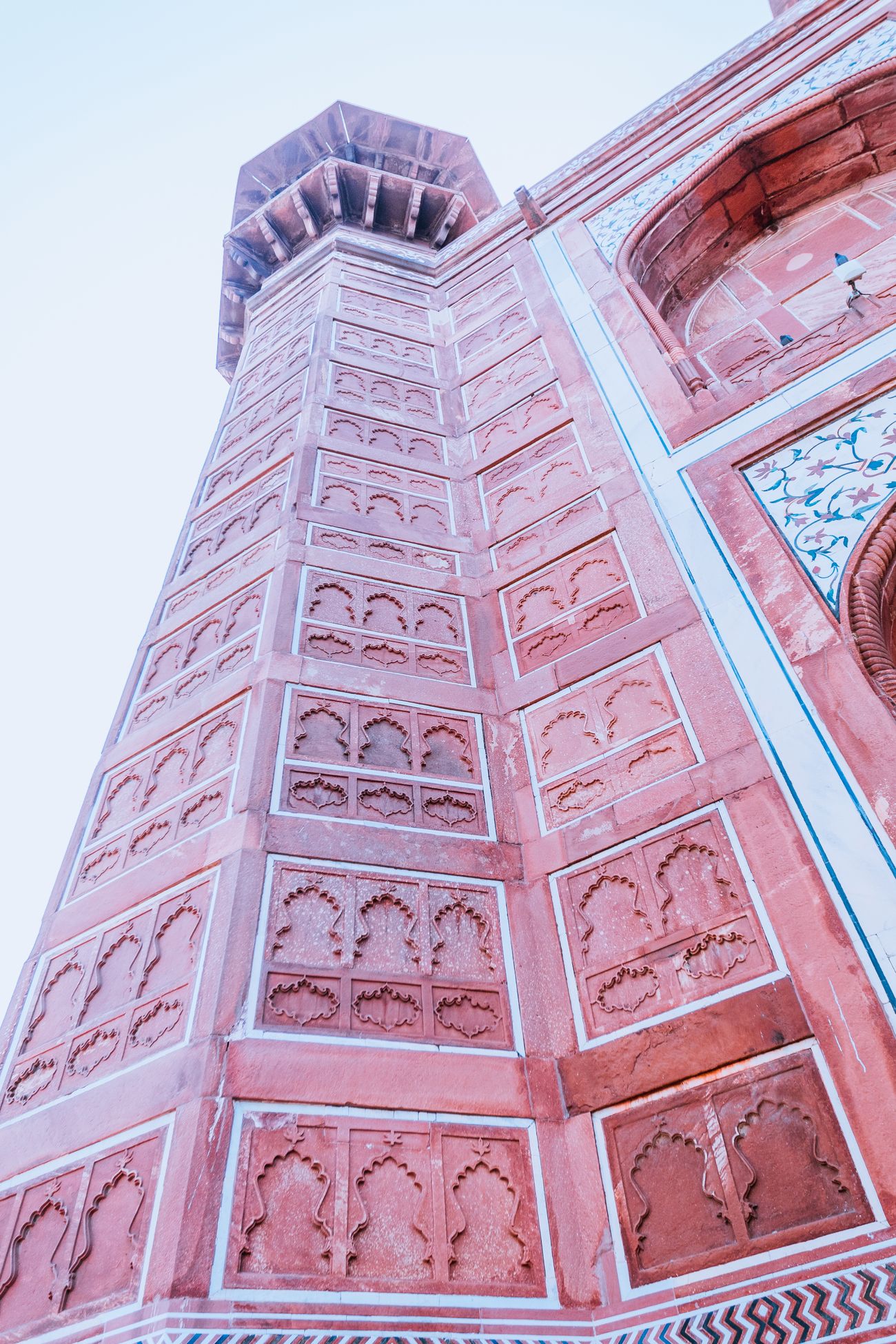
Each corner of the Great Gate features a minaret capped with a sandstone chhatri and a marble dome, adding elegance and symmetry to the structure. © Social Media Hub
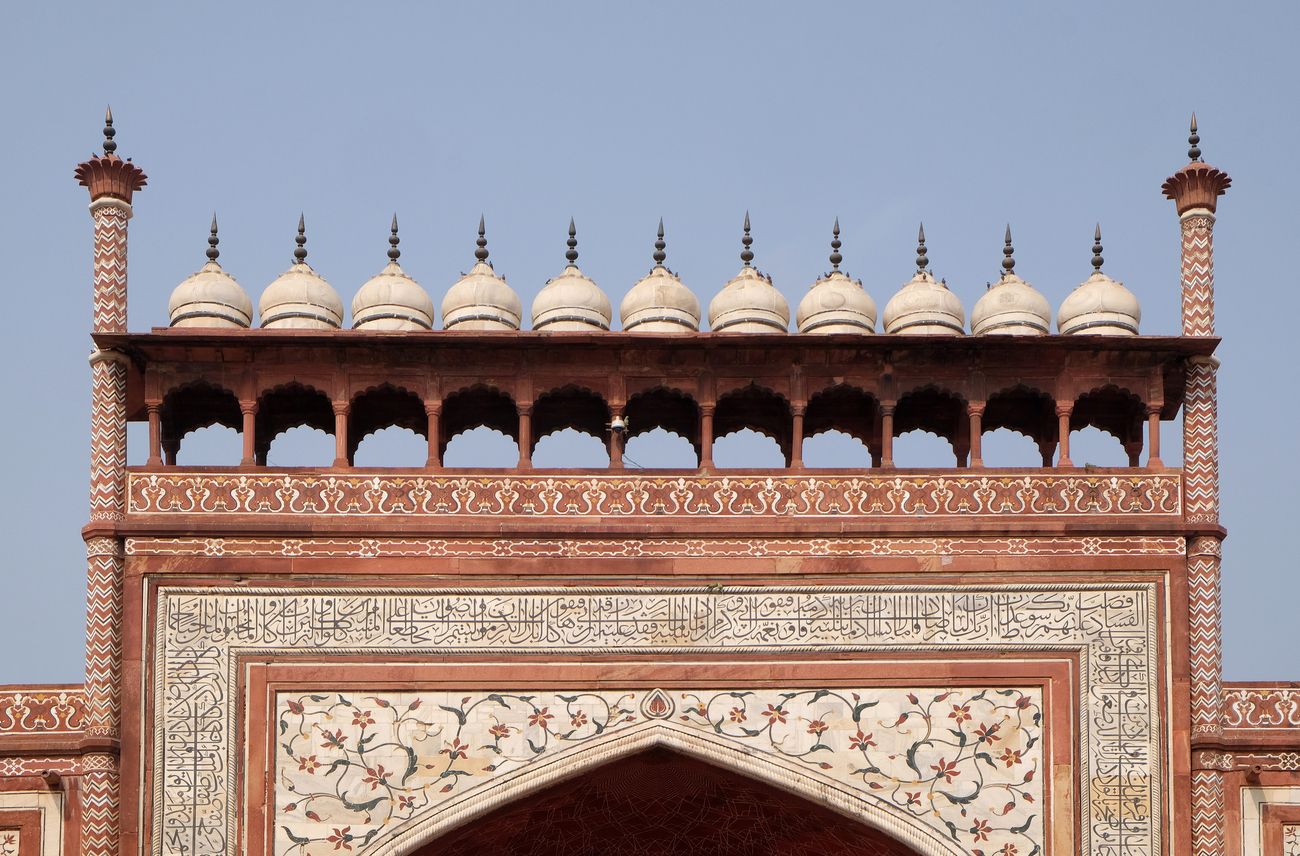
The Sura al-Fajr, or Daybreak Sura, is beautifully inscribed in exquisite calligraphy along the frame of the grand gateway. Throughout the Taj Mahal, ornate Quranic verses are masterfully etched into the marble, each stroke reflecting divine artistry. Notice how the letters on the upper panels appear larger than those below—an intentional optical illusion designed so the script looks perfectly uniform from the visitor’s viewpoint. © Zvonimir Atletic
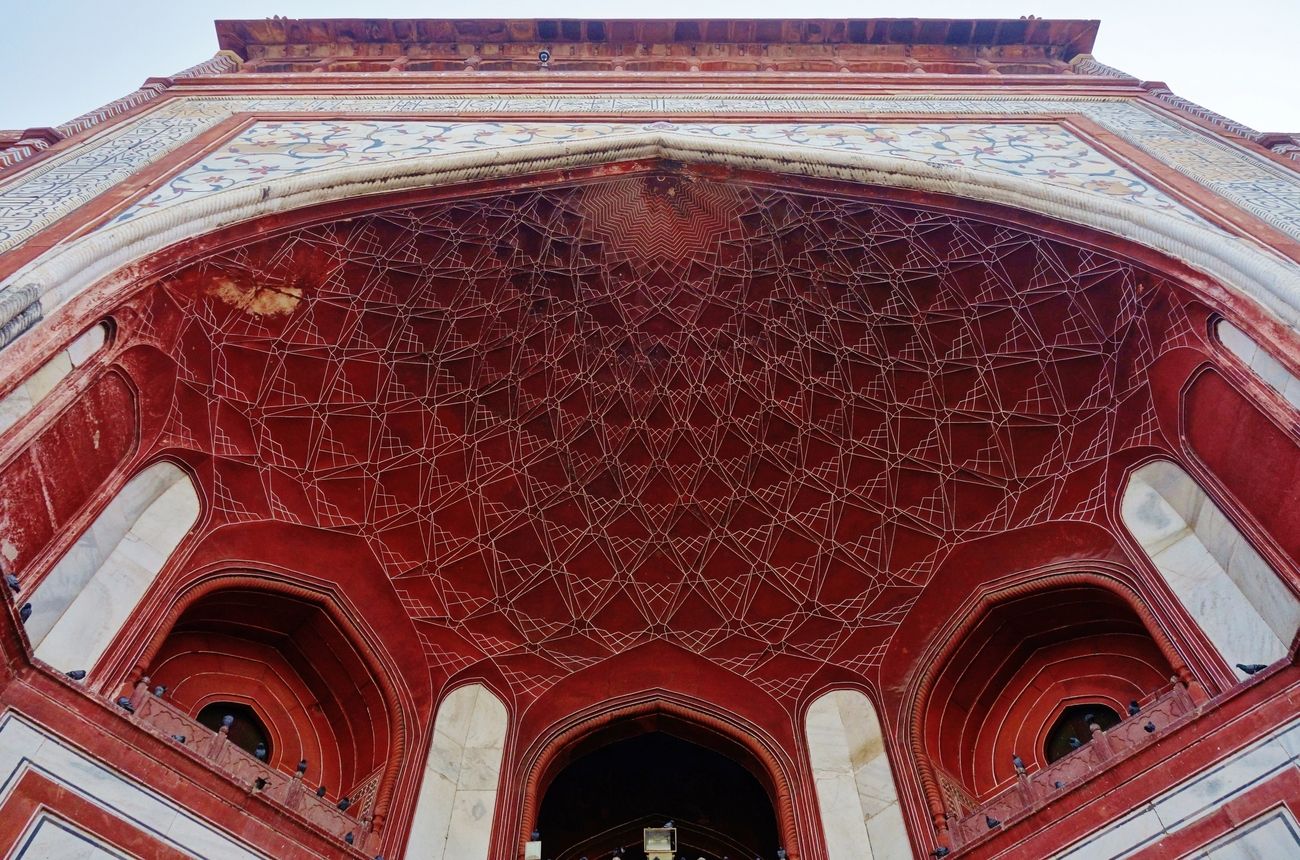
Look up inside the main entrance dome — its intricate geometry resembles a honeybee’s comb, a marvel of Mughal design. © EQRoy
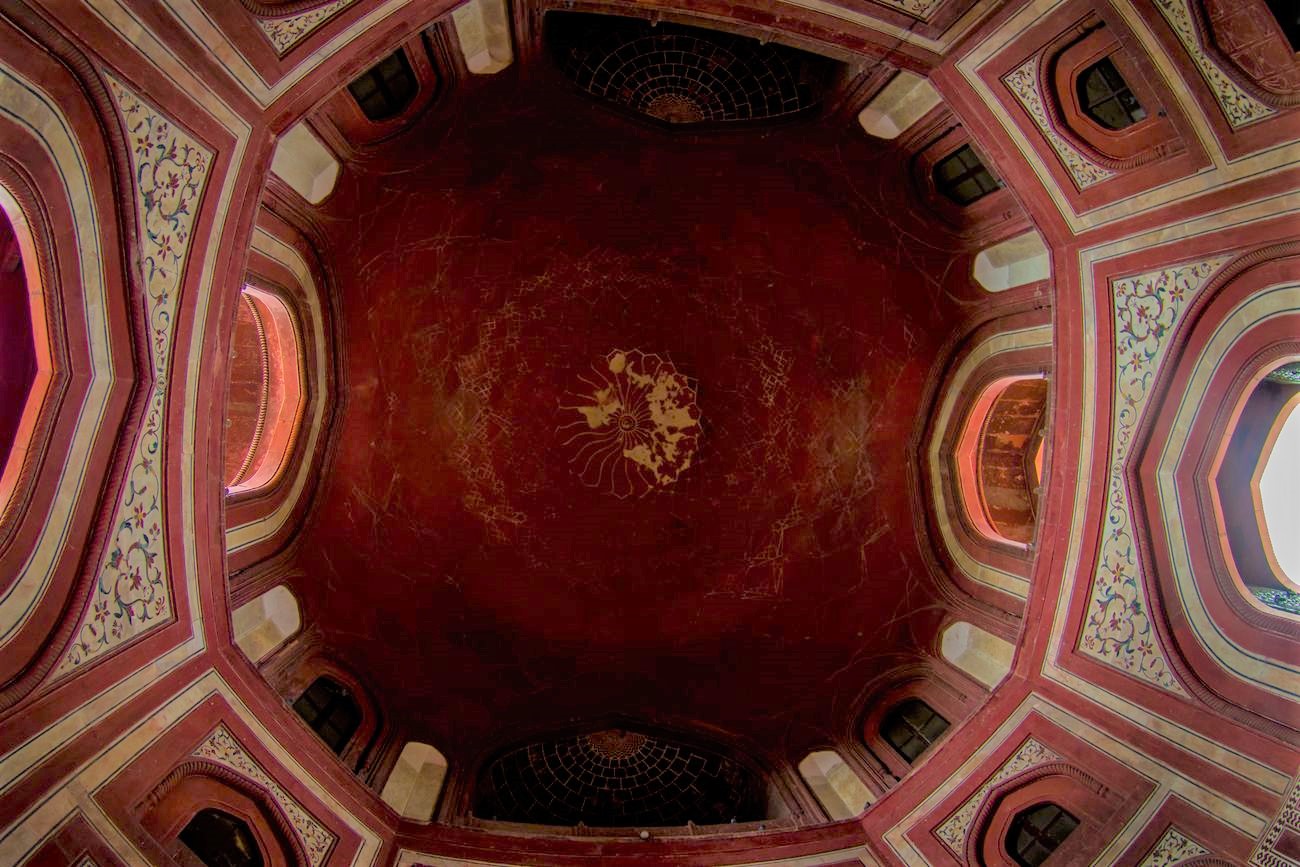
The main entrance ceiling displays flawless symmetry, blending red sandstone, marble, and semi-precious stone inlays into a harmonious tapestry of color and craft. © Pablo Hidalgo
Symmetry and Alignment
Shah Jahan was captivated by the beauty of perfect symmetry, and nowhere is this passion more flawlessly expressed than in the design of the Taj Mahal. From the moment you enter through the darwaza-i-rauza, the alignment is nothing short of breathtaking—the Great Gate frames the mausoleum and its minarets like a perfectly composed painting.
This harmony continues throughout the complex. The Taj and its four minarets appear in mirror symmetry when reflected in the still waters of the lotus pool, creating a dreamlike double image that has mesmerized visitors for centuries. The architectural balance is further enhanced by the four slender chhatris flanking the enormous central dome, their height carefully calculated to balance the dome’s massive scale.
A famous legend adds even more intrigue: Shah Jahan is said to have envisioned a second Taj Mahal across the Yamuna River—an identical structure made entirely of black marble, meant to be his own resting place. A bridge, according to the tale, would have connected the two mausoleums, uniting the white and black twins in a poetic reflection of love and eternity.
Whether myth or truth, the story only deepens the magic of the Taj—a monument where symmetry becomes spirituality, and architecture becomes art.
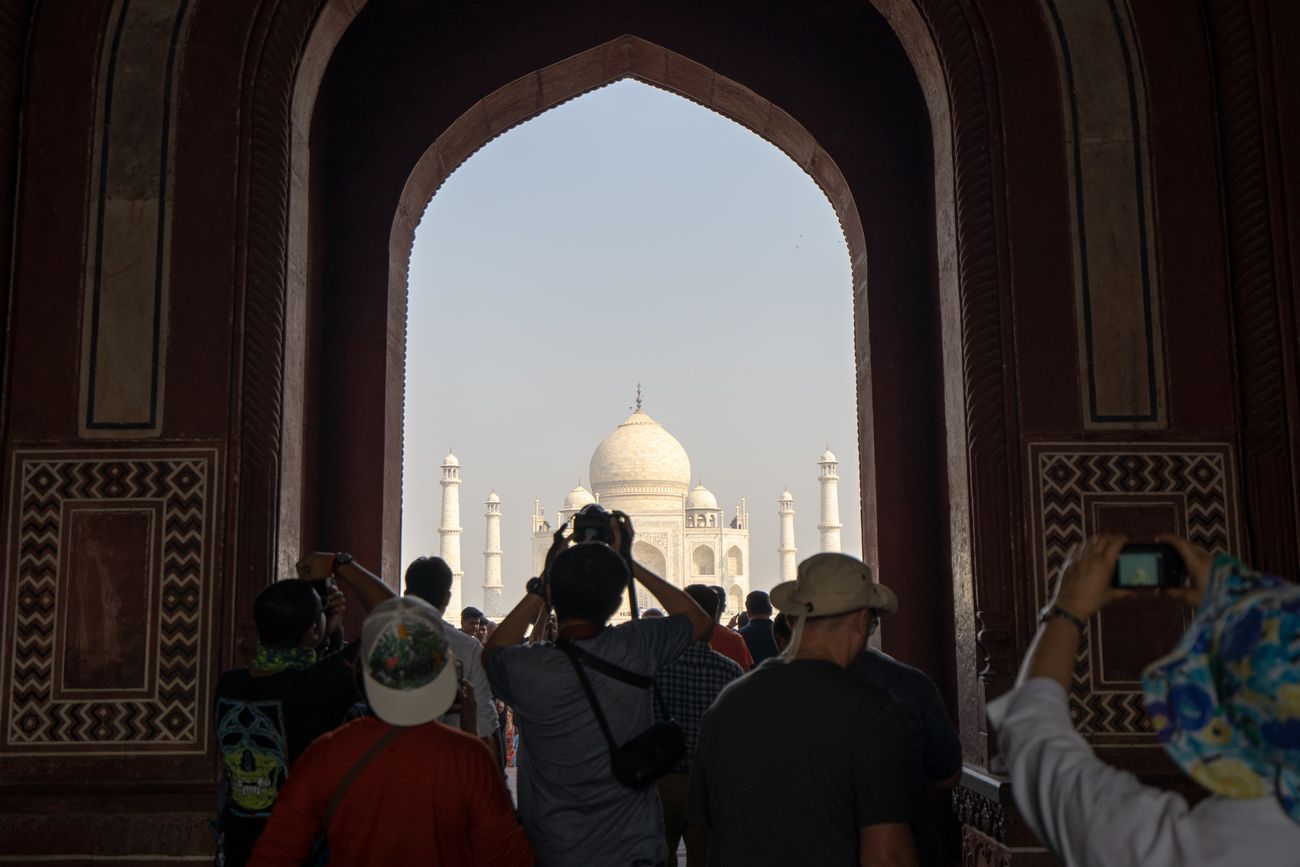
Framed by the Great Gate’s (Darwaza-i-rauza in persian) arch, the first view of the charbagh garden, minarets, and gleaming mausoleum of Mumtaz Mahal is a perfect, unforgettable introduction to the Taj. © ArtPanupat
Naubat Khana in Taj Mahal
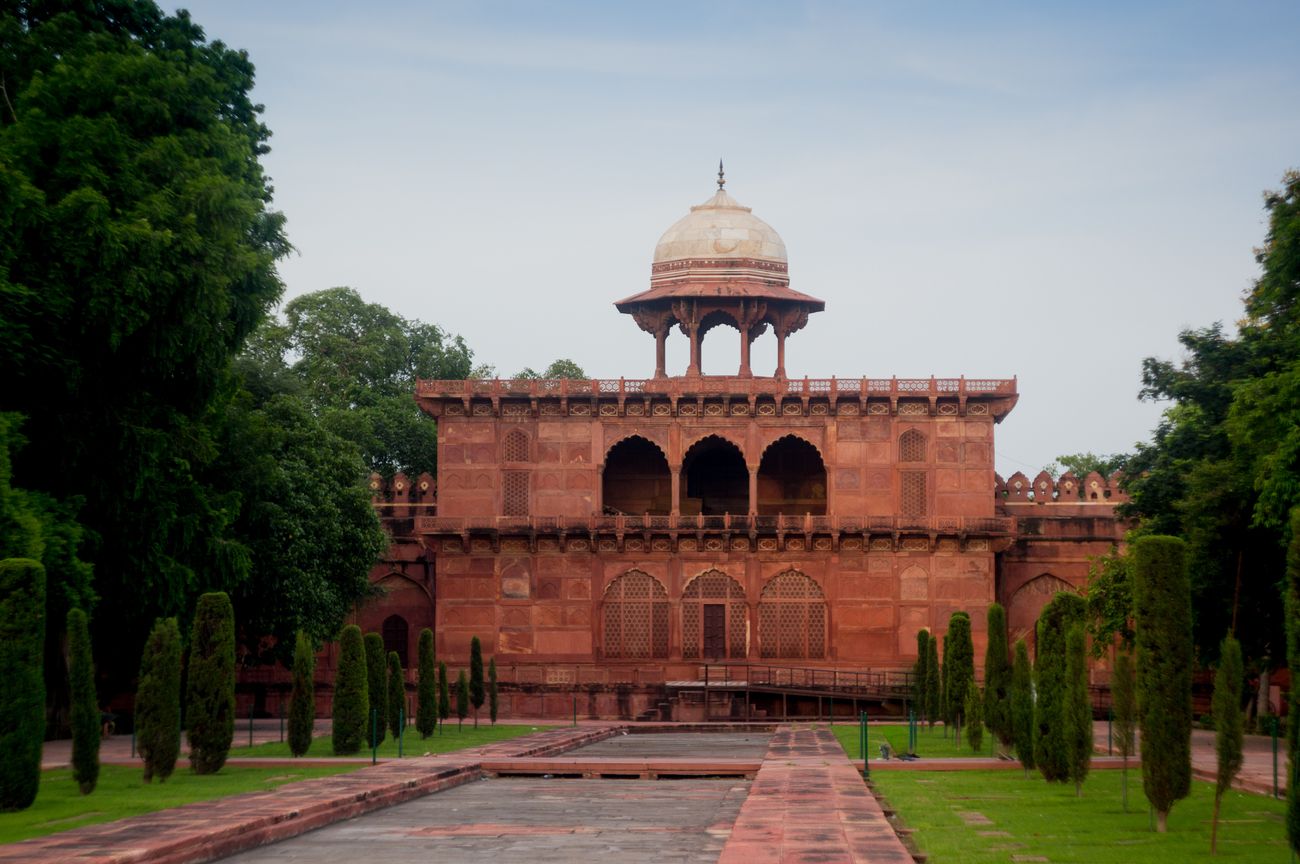
On either side of the entrance stand two graceful music galleries, or Naubat Khanas, seamlessly merging with the outer garden walls. In 1982, the left Naubat Khana was transformed into a fascinating museum with three galleries, displaying miniature paintings, government decrees, manuscripts, and remarkable examples of utensils, arms, and intricate calligraphy. © Amlan Mathur
The Layout of the Taj Mahal Complex
The Taj Mahal reveals its splendor in a beautifully choreographed sequence, unfolding like a story told in stone. Set along the banks of the Yamuna River, which flows silently behind it, the complex is approached with a sense of anticipation and awe.
Your journey begins beneath a smaller gate and continues toward the grand darwaza-i-rauza, the main entrance. Crossing its threshold is like stepping into another world. Immediately before you lies the serene charbagh, the classic Persian quadrilateral garden, perfectly aligned and centered around the shimmering lotus pool. This is where the Taj performs its first magic trick—its reflection floating dreamlike on the water.
Only after this calm, poetic pause does the Taj Mahal itself rise into view—regal, radiant, and seemingly suspended above the landscape. This reversal of the traditional mausoleum order, where the tomb stands at the rear rather than the center, sets the Taj apart from every other monument of its kind.
Inside and out, the structure is lavishly adorned with pietra dura (jeweled inlay), delicate relief carvings in marble and sandstone, and sweeping calligraphic inscriptions that add both beauty and meaning. At its heart lie the two exquisitely ornamented cenotaphs of Shah Jahan and Mumtaz Mahal, symbolic markers of their eternal union.
Flanking the mausoleum are two harmonious companions: the Masjid (mosque) on one side and the Mehman Khana (guest house) on the other, both resting on a base of warm red sandstone that beautifully offsets the glowing white marble of the Taj.
Every element of the complex—its symmetry, sequence, and symbolism—works together to create an experience that feels as majestic as it is timeless.
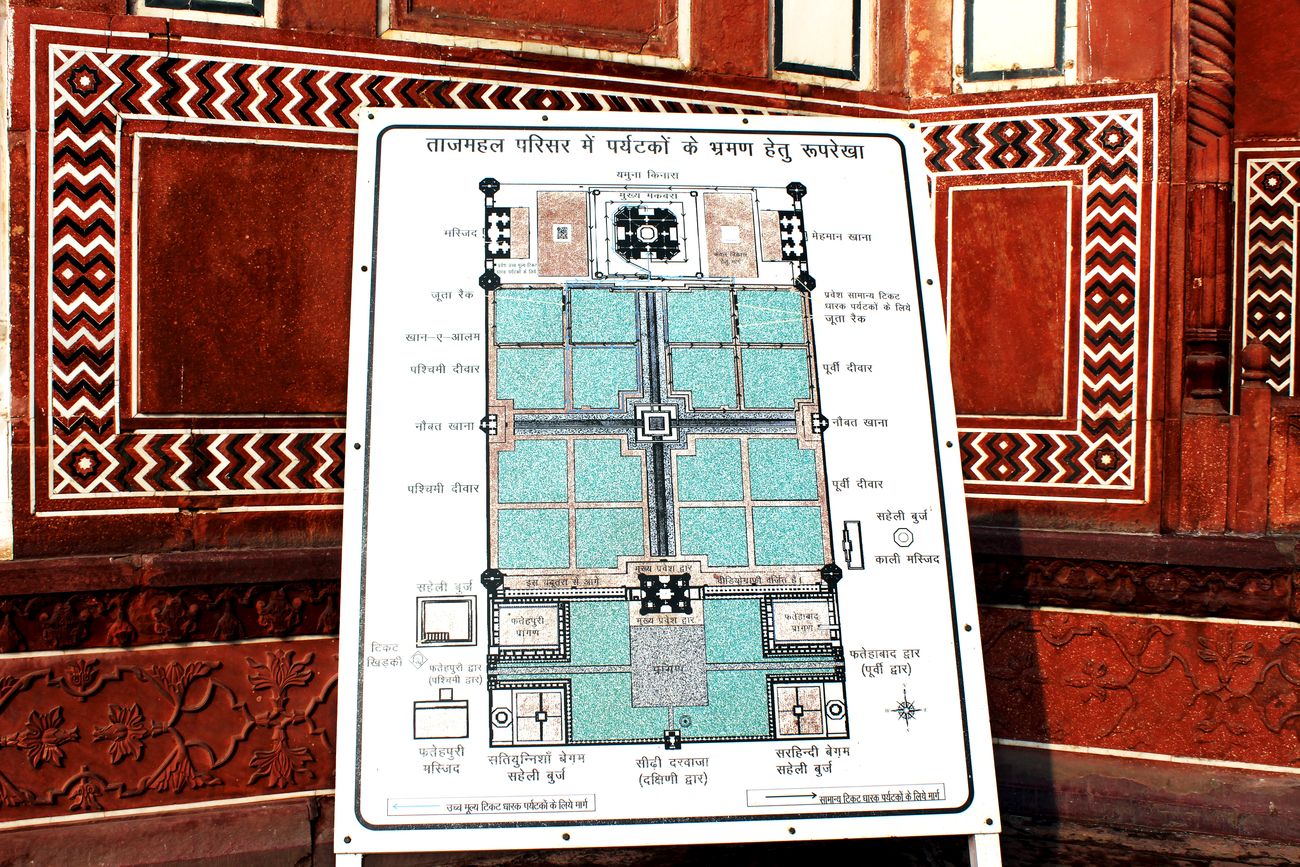
A detailed map shows the layout of the Taj Mahal complex, setting the scene for the architectural journey ahead. © Abbey Meprathu Philip
Octagonal Plan
The mausoleum follows the classic Mughal Hasht-behesht design, or ‘eight paradises,’ an architectural plan rooted in symmetry and spiritual symbolism. At its heart lies a grand octagonal central chamber, surrounded by a chamber on each of the four sides and an additional room in every corner—an elegant arrangement that perfectly embodies Mughal mastery of balance and beauty. © Yosanon Y
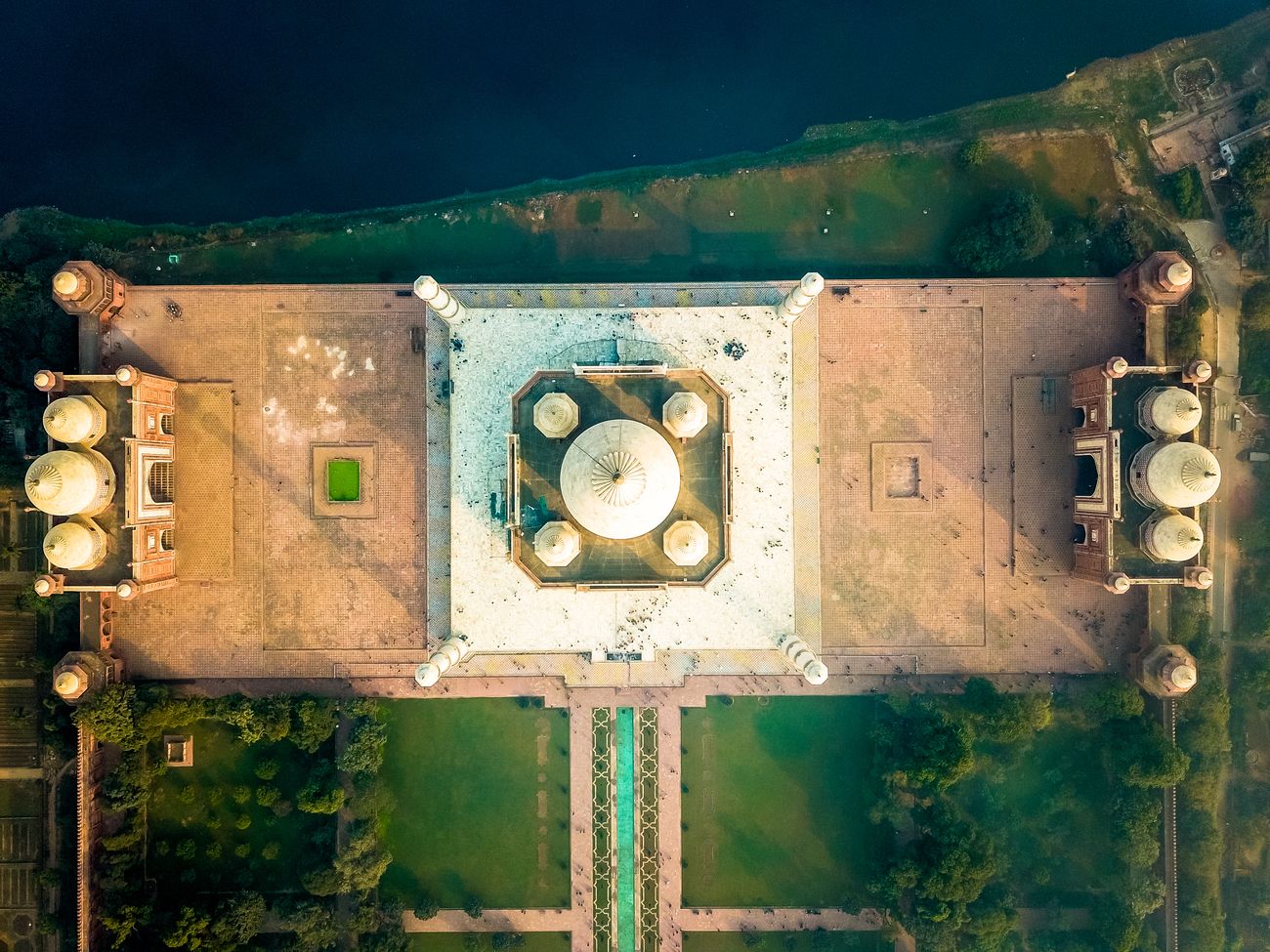
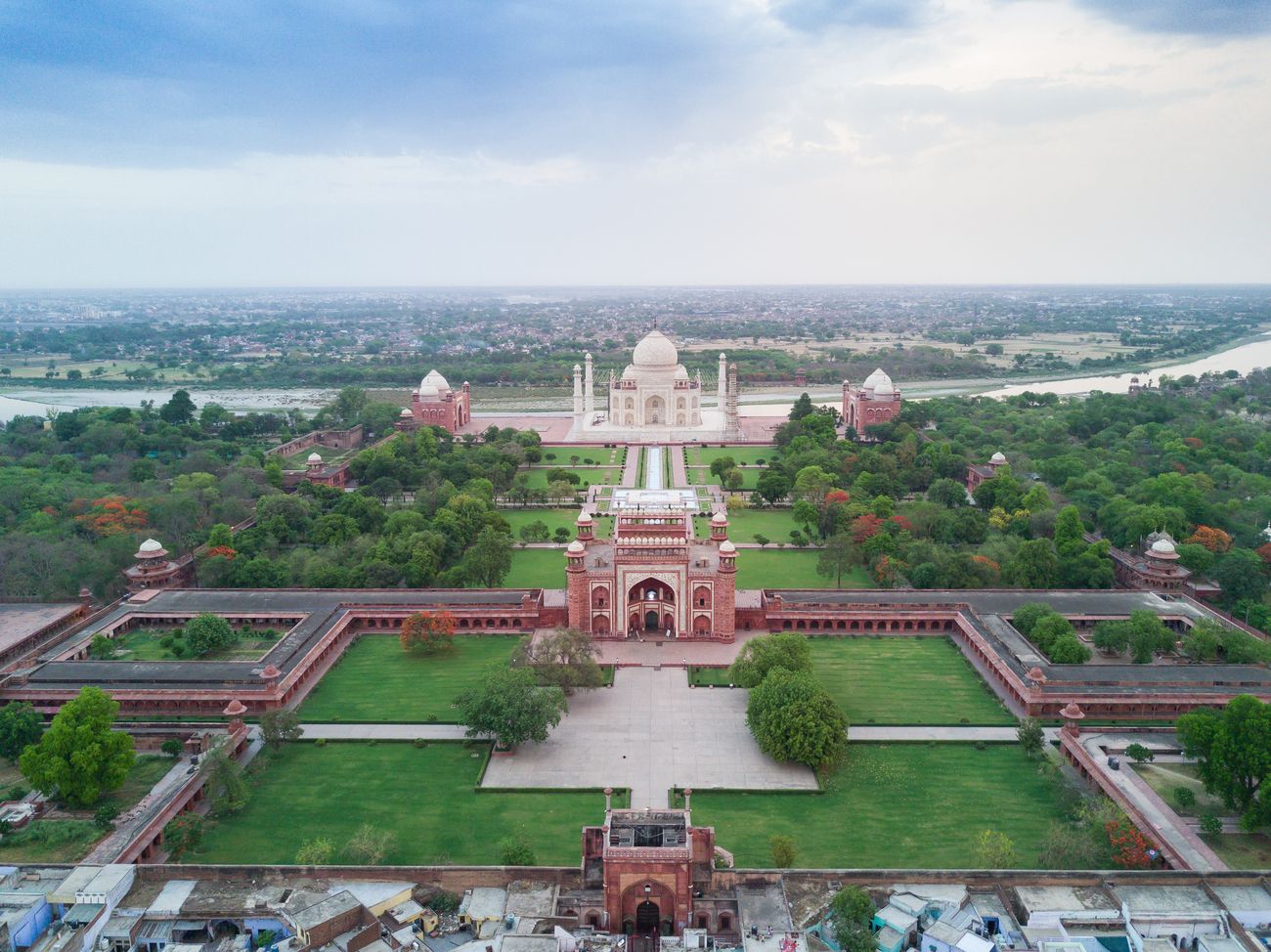
Bird’s eye view of the main mausoleum with the adjoining mosque to the east and the guest house on the west side © Uladzik Kryhin
Building Materials
The Taj Mahal is not just an architectural marvel—it is a masterpiece crafted from the finest materials gathered from across India and far beyond. Two primary mediums form its foundation. The first and most iconic is the gleaming white marble from the famous Makrana quarries of Nagaur in Rajasthan, renowned for its purity and luminosity. The second is red sandstone, sourced from Rupbas and Fatehpur Sikri near Agra, its hues ranging from warm yellowish-red to a richer, deeper tone.
For the Taj’s exquisite pietra dura inlay work, a dazzling palette of precious and semi-precious stones was collected from distant lands.
• Garnets arrived from Bundelkhand
• Jasper from Punjab
• Crystal and jade from China
• Amethyst and onyx from Persia
• Sapphire and lapis lazuli from Sri Lanka
• Cornelian and coral from Arabia
• And from Panna came the brilliant diamonds
Each gemstone found its place in intricate floral patterns and delicate motifs, transforming the marble into a glowing canvas of color. Together, these materials created a monument so breathtaking that it still feels like it belongs to another world.
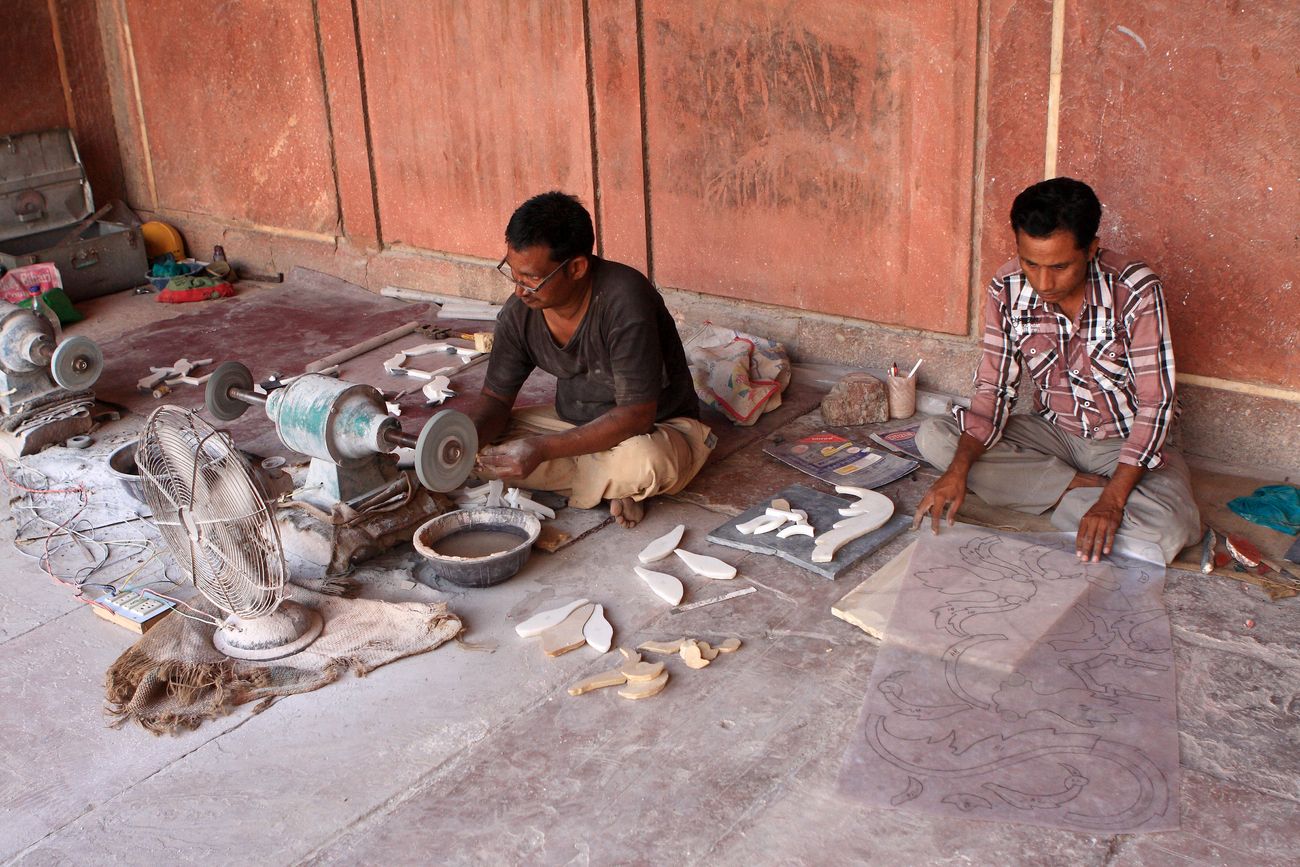
Restoration is constant at the Taj. Skilled artisans cut and prepare marble pieces by hand to preserve this 17th-century masterpiece. © Aodhain
Charbagh
In Islamic tradition, the number four carries deep spiritual meaning, symbolizing harmony, balance, and the divine order of the universe. It’s no surprise, then, that the Taj Mahal’s design is rooted in this sacred number—and nowhere is it more beautifully expressed than in its charbagh.
The word charbagh comes from Persian:
• char meaning four,
• bagh meaning garden.
This distinctive garden layout arrived in India with Babur, the first Mughal emperor, who adopted it from the grand Persian gardens he so admired. For the Mughals, the charbagh was more than landscape design—it was a symbolic recreation of the Garden of Eden, described in Islamic tradition as having four rivers flowing from a central point.
At the Taj Mahal, this vision comes to life with extraordinary precision. Two long waterways divide the vast garden into four equal quarters—one canal running north to south, the other stretching east to west. At their intersection lies the serene lotus pool, perfectly placed to reflect the shimmering marble mausoleum above it.
The result is a garden that is not only symmetrical and harmonious, but deeply symbolic—an earthly paradise leading your eyes and footsteps toward the monument of eternal love at its center.
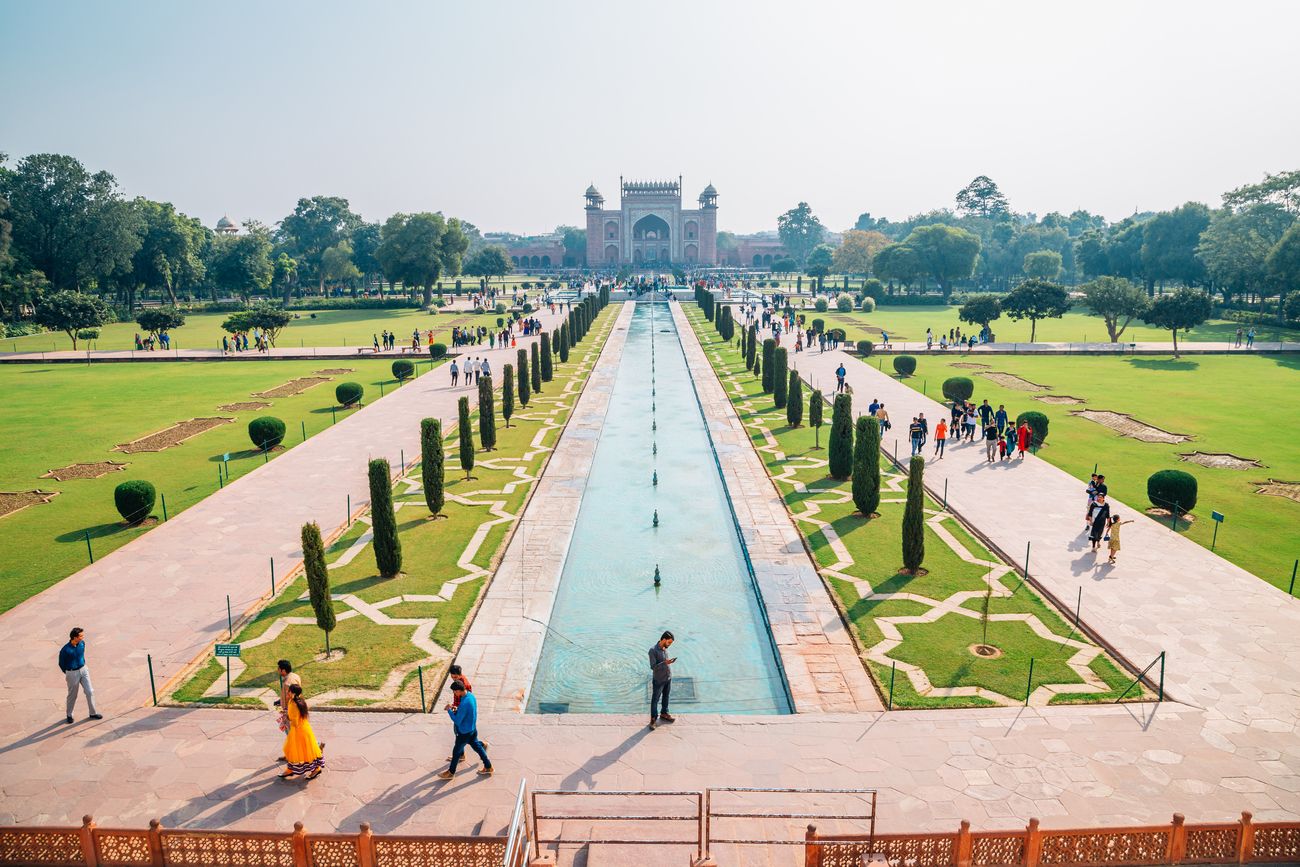
The lush charbagh gardens were once watered directly by the life-giving River Yamuna. © Sanga Park
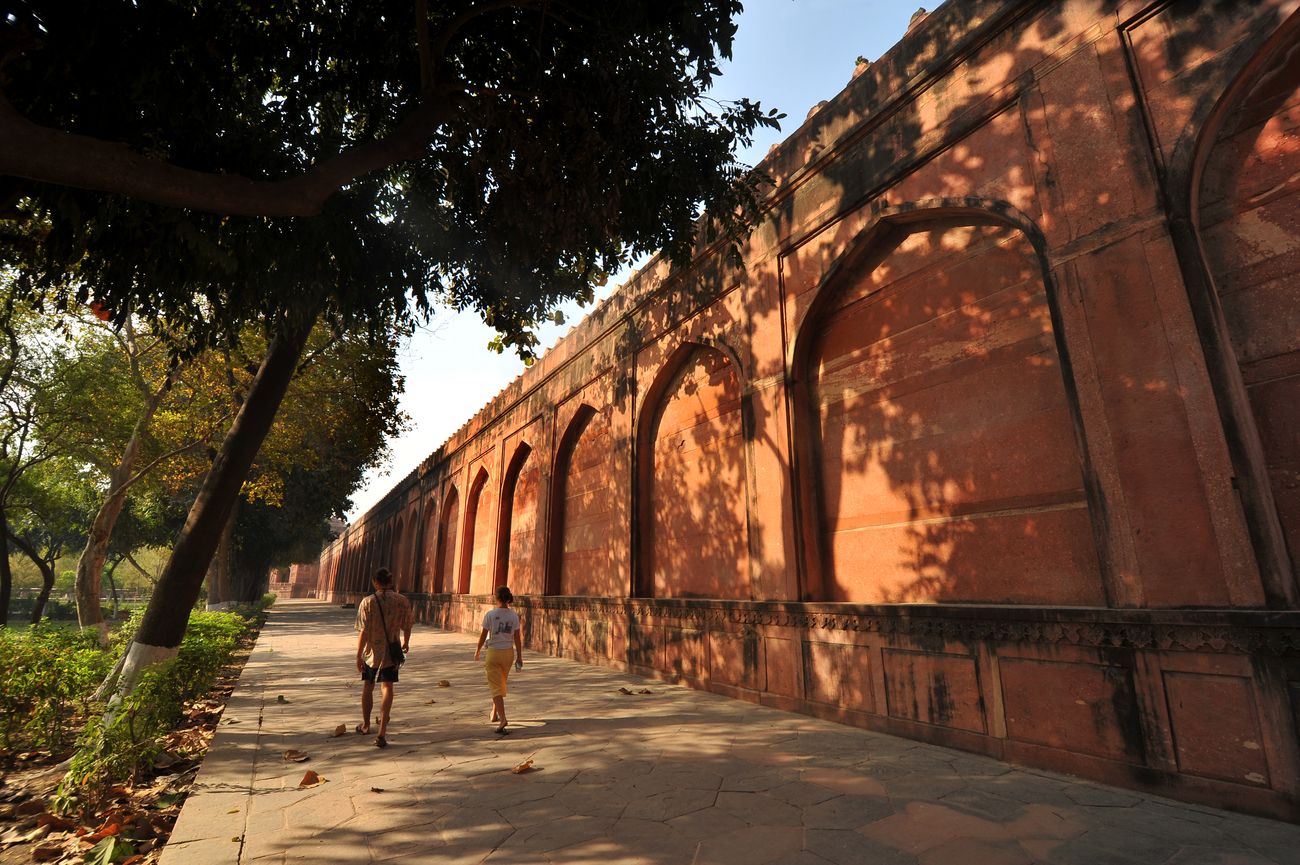
Even the trees tell a story: fruit trees symbolize life, while tall cypresses represent eternity and death — a poetic garden of meaning. © DH Saragih
Geometric Patterns
Geometry plays a quiet yet powerful role in the Taj Mahal’s beauty. Across the red sandstone base, along the pathways, on the marble floors of the mausoleum, and even on the ceilings, you’ll find mesmerizing tessellated designs—intricate mosaics that fit together perfectly without a single overlap or gap.
These repeating patterns often form stars, octagons, and interlocking shapes, each one symbolizing the harmony and precision prized in Islamic art. The designers extended this geometry into the landscaping too; look closely at the lawns beside the walkways, and you’ll notice they echo the same rhythmic patterns.
Every line, every tile, every mathematical flourish adds to the Taj’s sense of balance—proving that even the smallest details can elevate a monument into a masterpiece.
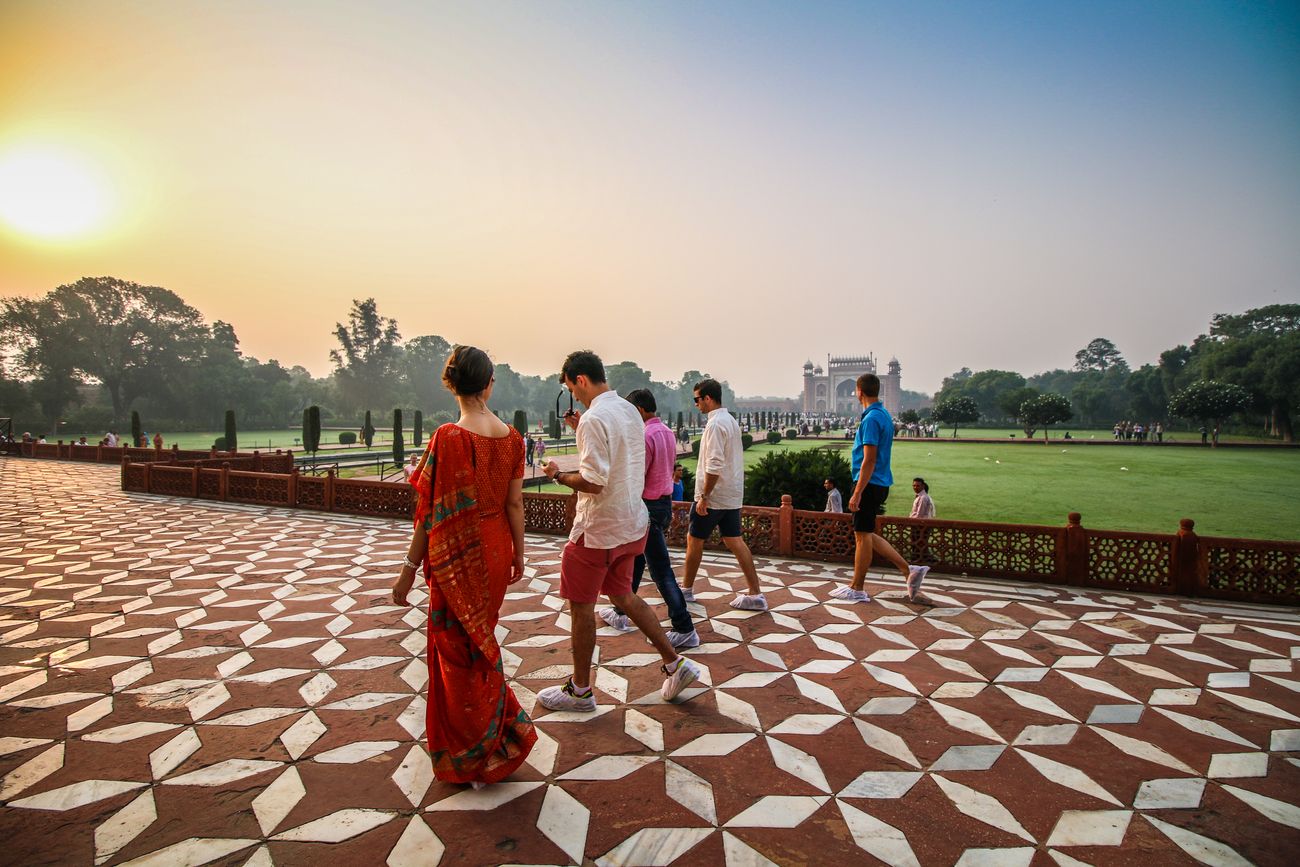
Black stone lines, marble inlays, and red sandstone together create refined contrasts in the tomb chamber’s elegant décor. © tscreationz
The Lotus Pool
At the heart of the garden lies the serene lotus pool, a mirror-like surface perfectly aligned with the Taj Mahal’s symmetry. Just like the charbagh around it, the pool is divided into four equal sections, achieved through a network of shallow canals running beside the wide walkways. Broader causeways further break the layout into graceful geometric quarters.
Water from the Yamuna River flows into the pool and canals through a system of copper pipes, which also control the pressure of the five elegant fountains at the pool’s center. Each corner is decorated with delicate floral motifs, echoing the Taj’s love for botanical beauty.
In 1907, during the British period, Lord Curzon added the now-iconic marble benches along the four sides of the pool. These benches quickly became a favorite spot for photographs—and even today, they frame the perfect view of the mausoleum rising in shimmering white marble behind the water’s reflection.
Calm, symmetrical, and poetic, the lotus pool transforms every visitor’s first glimpse of the Taj into an unforgettable moment.
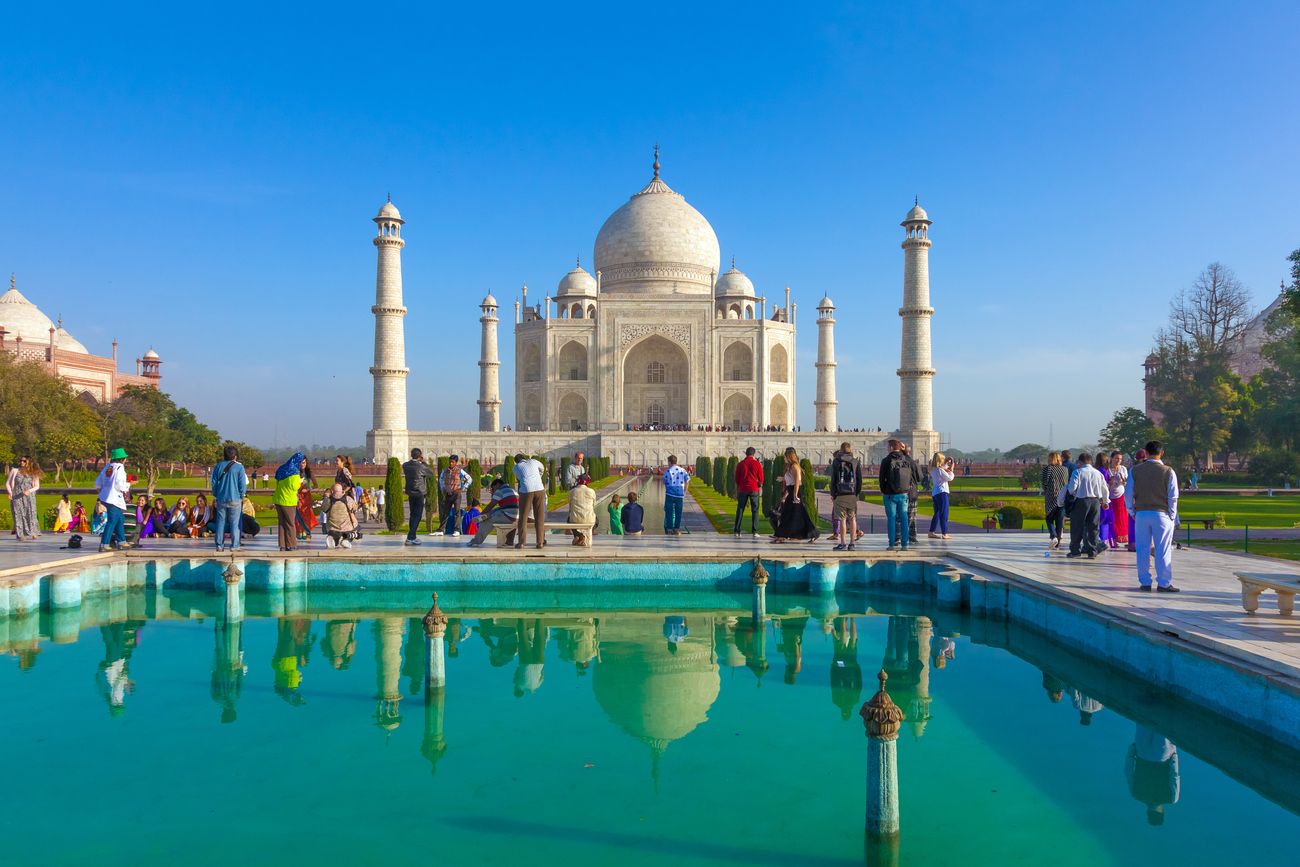
The marble bench at the Lotus Pool is one of the Taj Mahal’s most beloved photo spots. Here, the still, mirror-like water perfectly reflects the monument’s dazzling white beauty. The pool takes its name from the lotus-shaped fountain spouts, with copper mechanisms beneath that expertly regulate the water pressure of each fountain. © mammuth
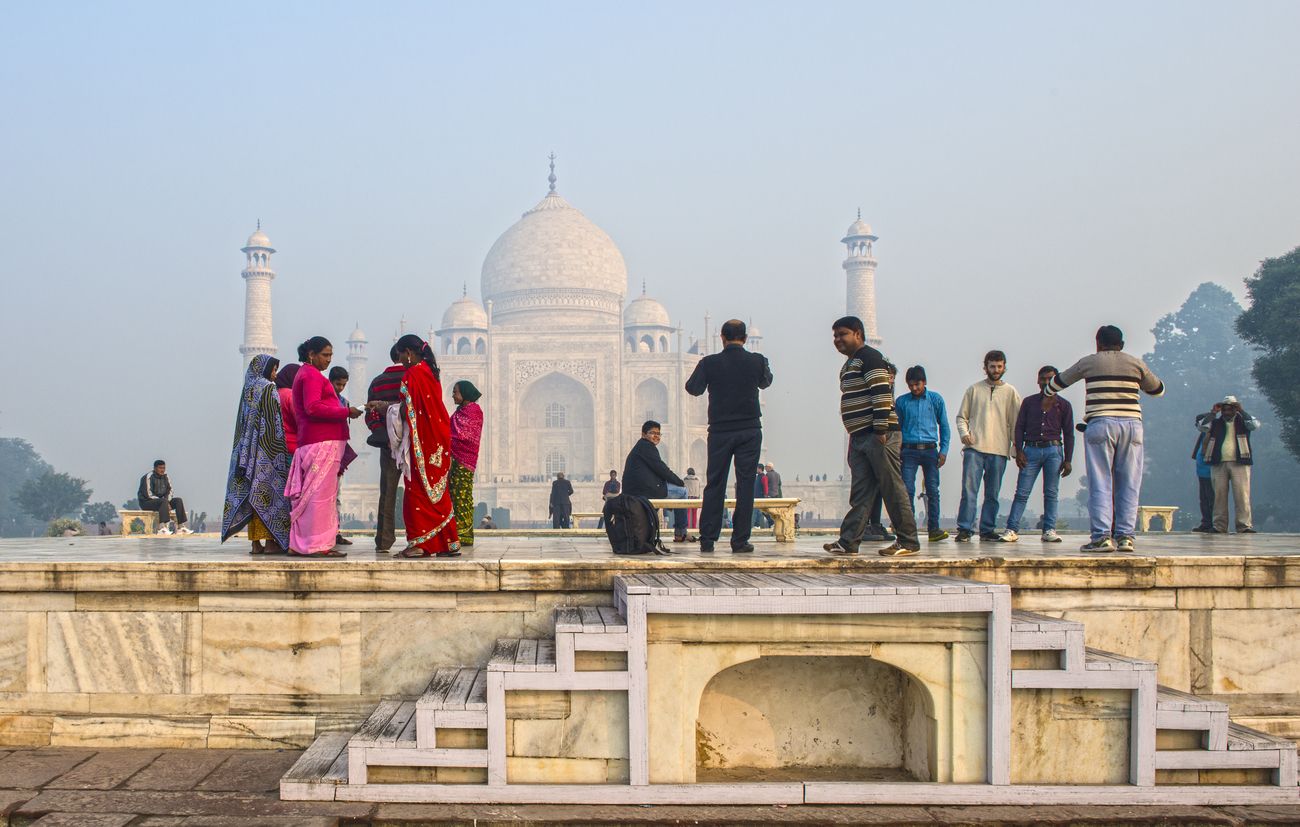
Steps leading down from the pool once carried the gentle overflow of water in the original Mughal design. © panoglobe
The Foundation and the Plinth
A monument as grand as the Taj Mahal needed a foundation worthy of its weight and majesty. To achieve this, craftsmen dug deep—right down to the water level of the Yamuna—and filled the vast pit with a strong mixture of stone and lime mortar. Only once this rock-solid base was in place did they begin constructing the enormous red sandstone platform.
This elevated plinth had an extraordinary responsibility: it had to support the full weight of the marble podium, the four towering minarets, the central mausoleum, and the two flanking structures—the Mehman Khana and the Masjid. Every element of the Taj, from its delicate inlay work to its soaring dome, ultimately depends on this powerful, unseen foundation.
It’s a remarkable reminder that even the world’s most graceful monument stands on strength, precision, and engineering brilliance hidden beneath the surface.
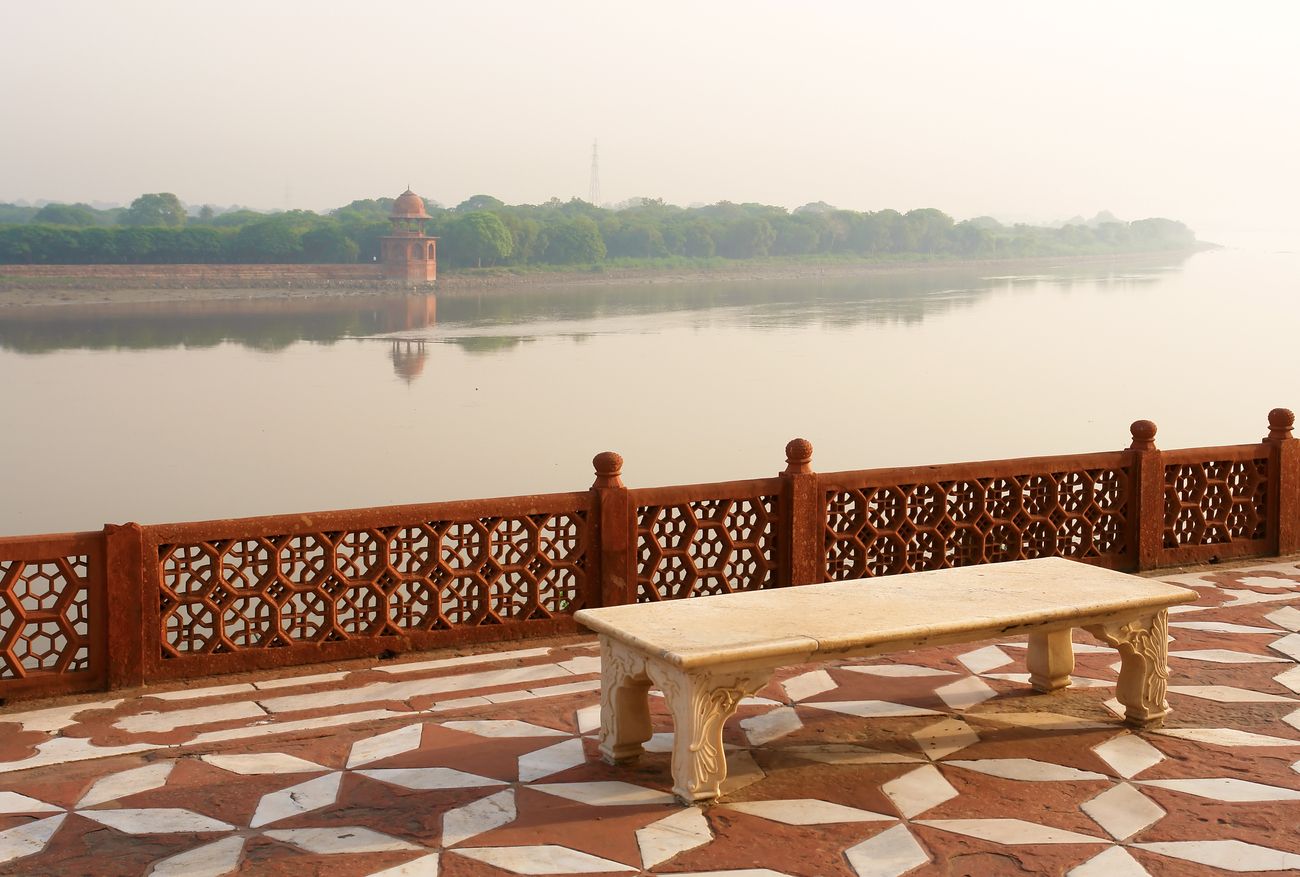
The red sandstone terrace features delicate marble jaali work and geometric inlays on the flooring — all overlooking the peaceful Yamuna River. © Carlos Neto
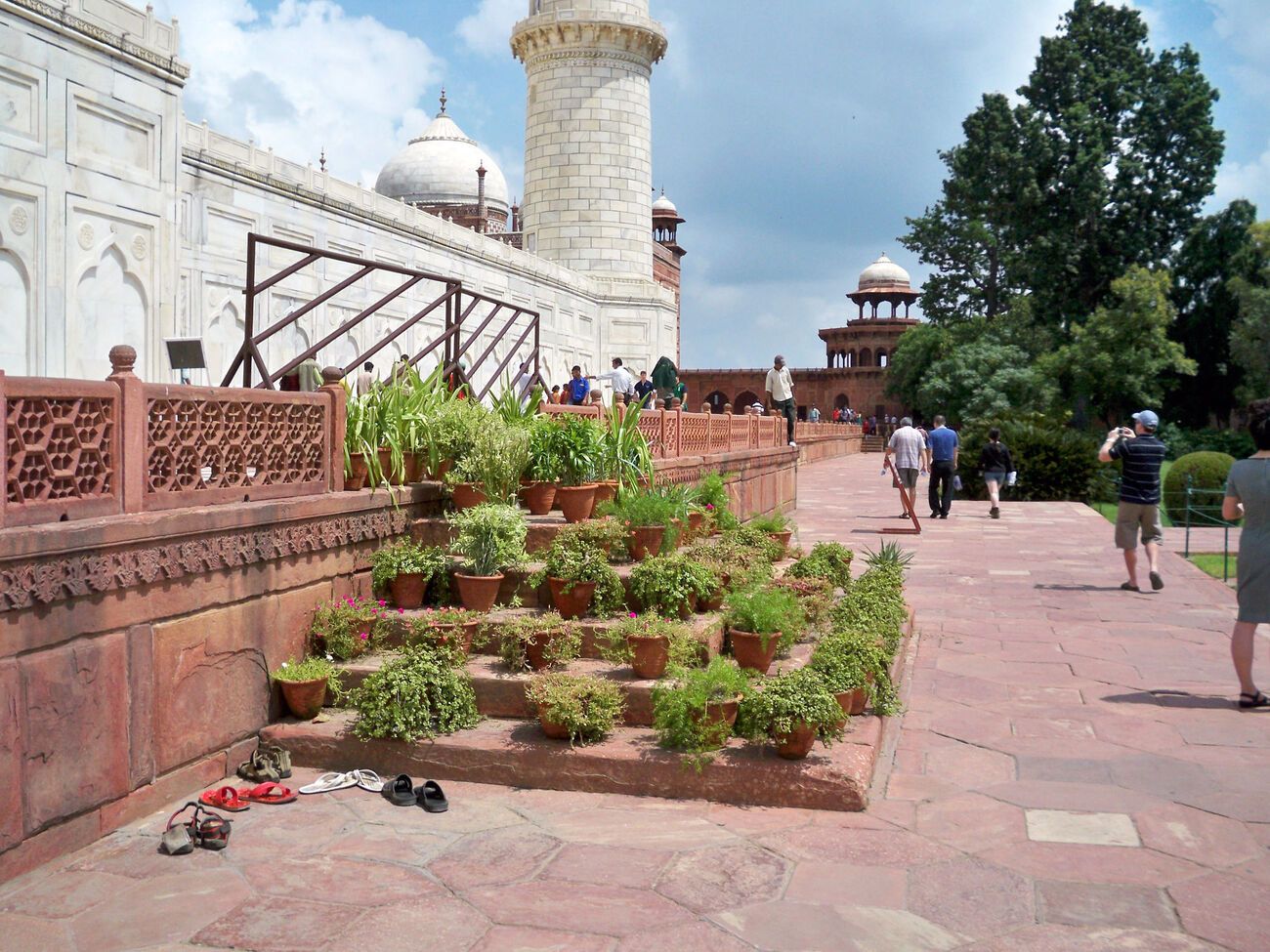
Pot plants adorn the steps ascending to the marble plinth, adding charm to the grand approach. © Hailshadow
The Marble Plinth and Cladding
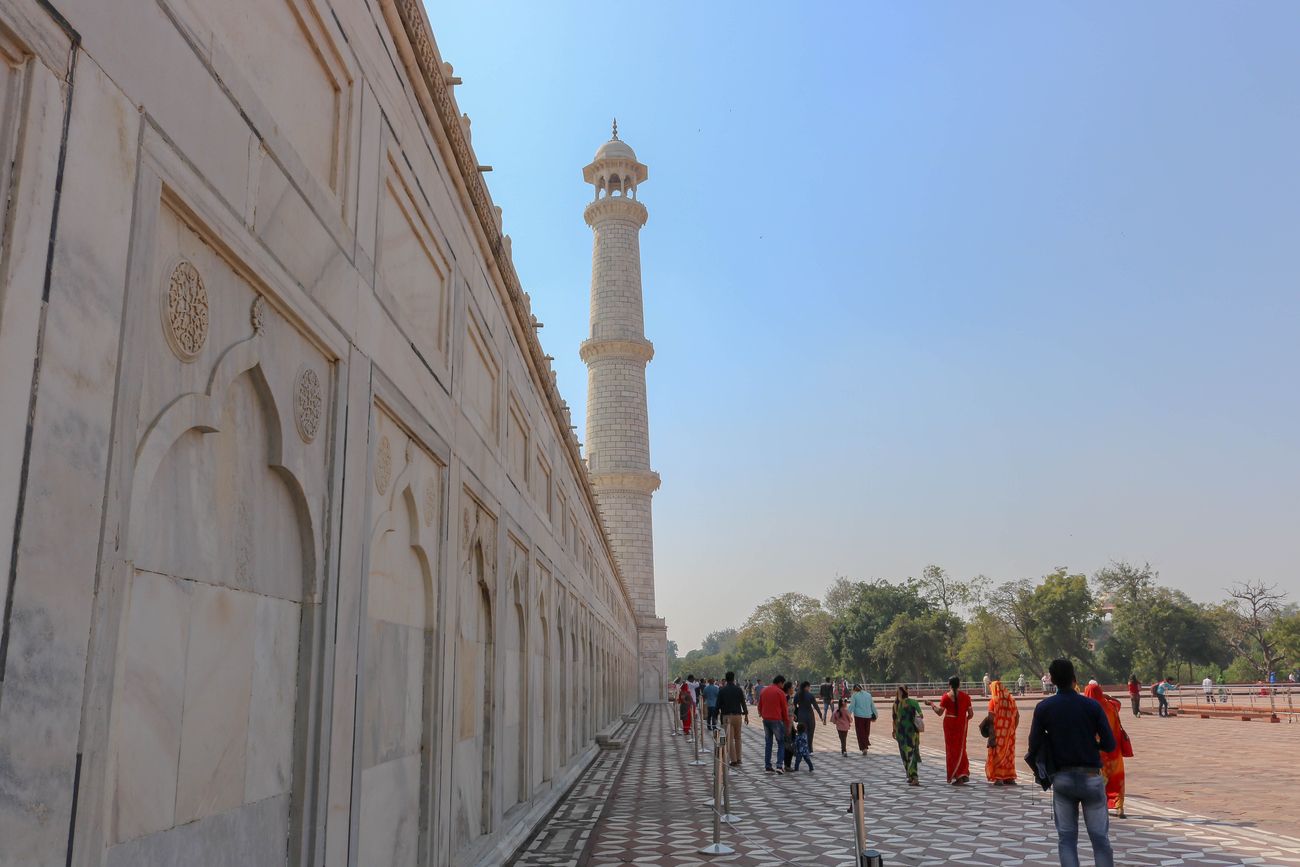
Rising above the red sandstone base, the 300-foot square secondary plinth stands entirely sheathed in luminous white marble, forming the grand platform for the Taj Mahal’s minarets and mausoleum. Its decoration is understated yet refined—delicate floral carvings echo those found on the mausoleum’s marble cladding, adding a quiet elegance to this monumental foundation. © prashantkrsahu
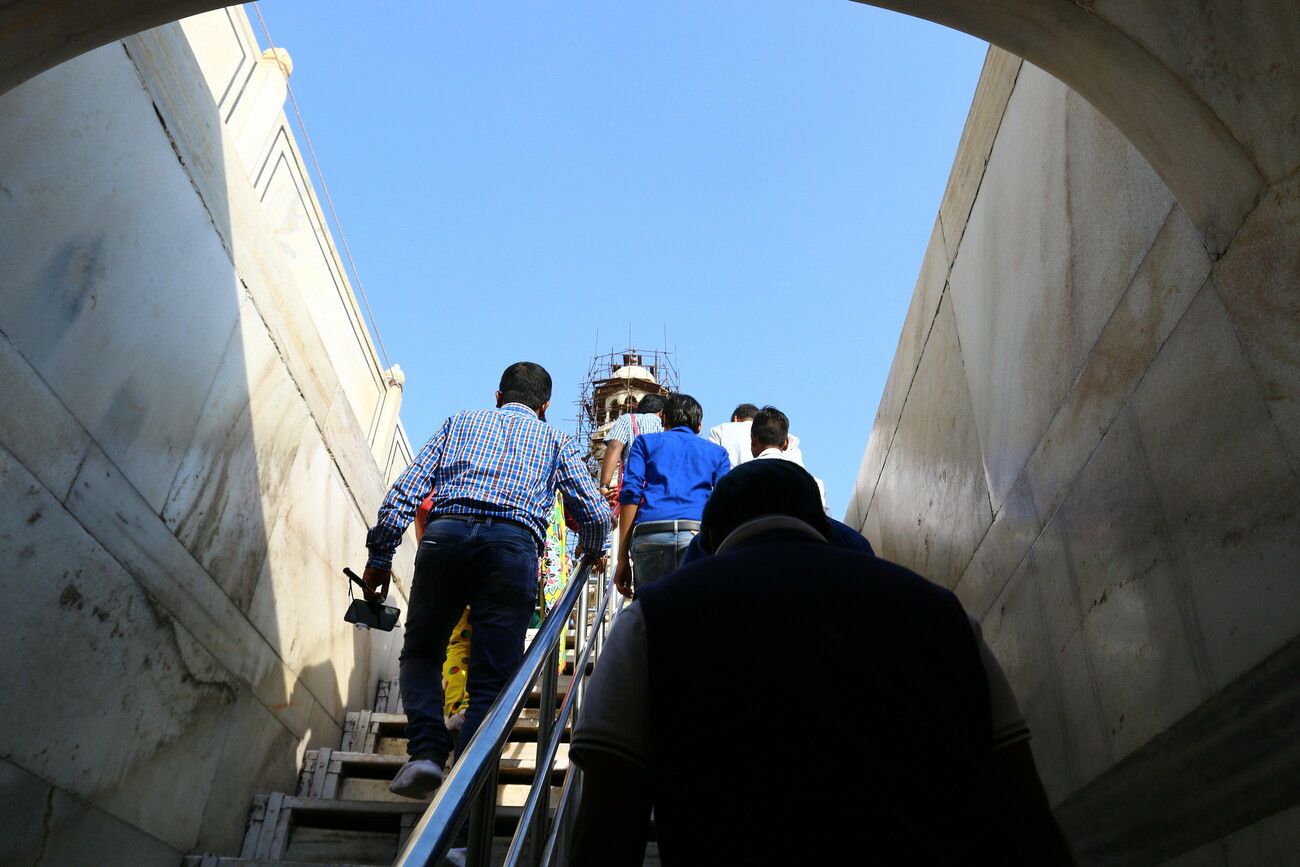
A hidden internal stairway leads visitors up onto the gleaming marble plinth. © Shimon Bar
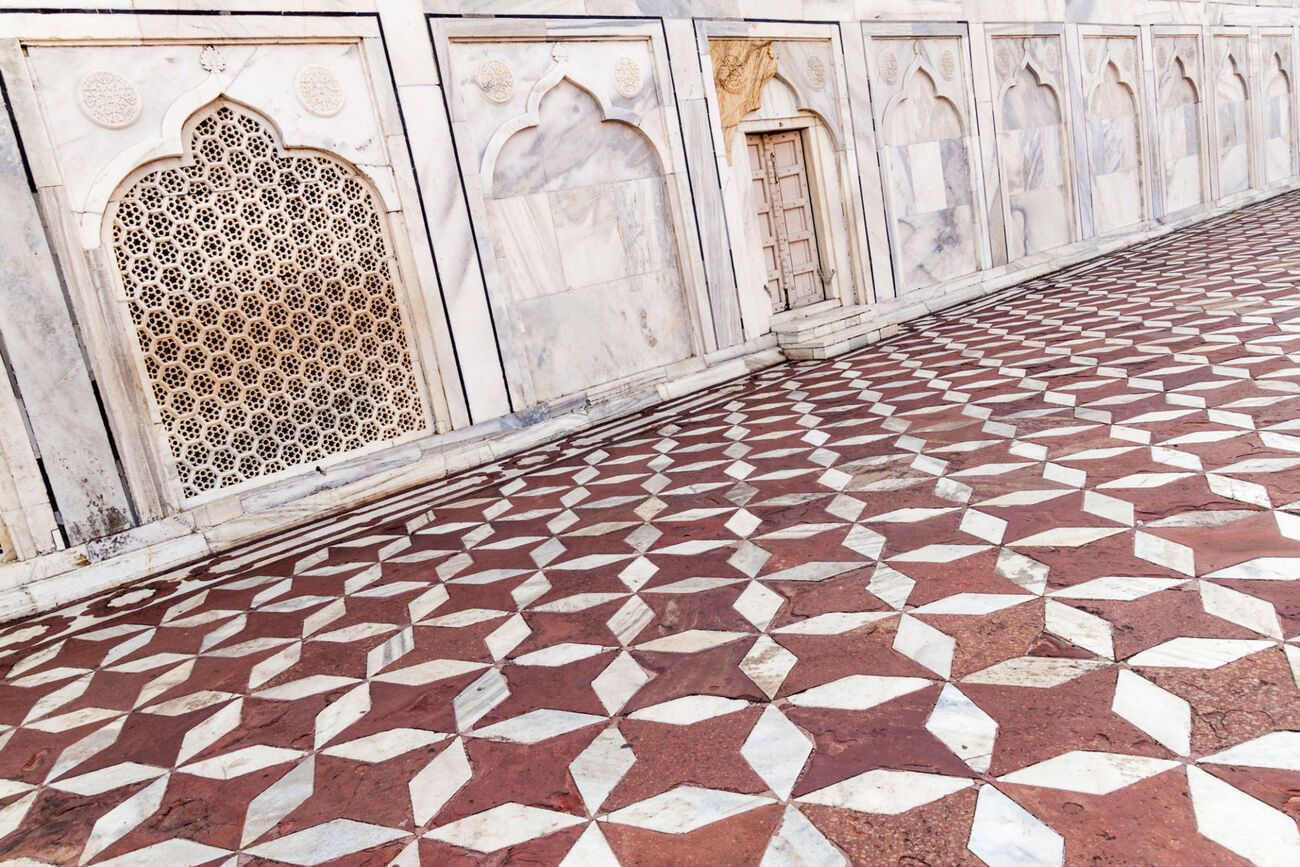
Latticed marble screens (jaalis) decorate the plinth walls, allowing soft sunlight and fresh air into the chambers below. © mathess
The Central Doorway
The Taj Mahal’s central doorway—its grand pishtaq—is a masterpiece of harmony and ornamentation. This towering arched entrance is framed with elegant lines of thuluth script, a flowing Islamic calligraphy style used here to display verses from the Quran, giving the façade both spiritual depth and artistic beauty.
Along the curve of the pointed arch are two perfectly mirrored triangular panels, each adorned with intricate pietra dura inlay work. Their symmetry is so precise that they appear like reflections of one another. Surrounding the arch is a bold, rope-like molding that adds texture and frames the entrance with striking clarity.
At the arch’s highest point, delicate linear floral designs, also crafted in pietra dura, stretch gracefully toward the flanking pilasters, tying every detail together. This interplay of geometry, symmetry, and craftsmanship exemplifies one of the Taj’s most defining characteristics: the repeated use of pointed arches enclosed within rectangular frames.
Through this doorway, the monument reveals its soul—a perfect fusion of structure, art, and spirituality.
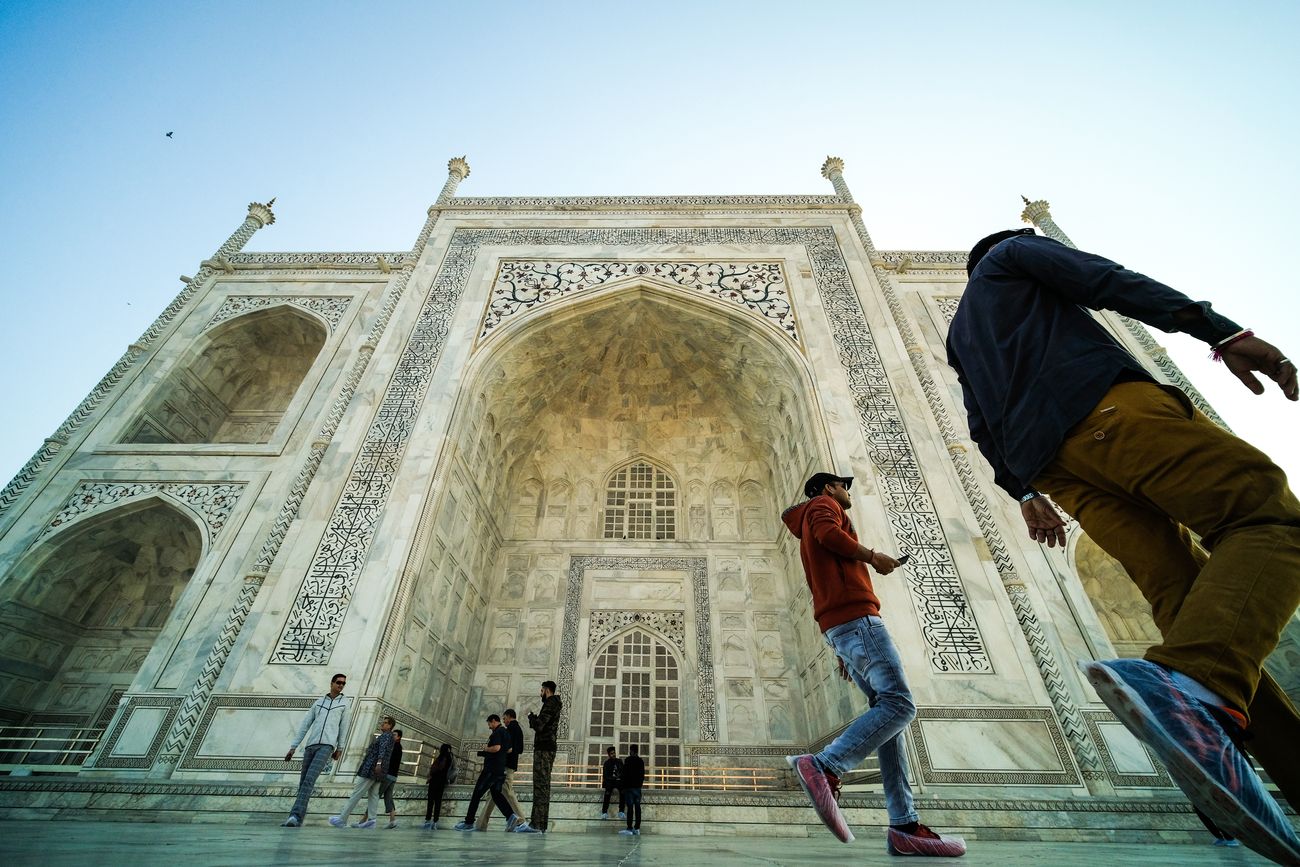
The magnificent pishtaq, or central arched doorway, is adorned with exquisite detailing. These towering arched recesses—set into all four sides of the Taj—add depth and dimension to the structure, while their central latticed marble screens filter patterned light into the mausoleum’s interior, creating an atmosphere of serene radiance. © analoger
Pietra Dura
One of the Taj Mahal’s most enchanting details is its stunning pietra dura—a technique that originated in Florence, Italy, where master artisans perfected the art of setting colored stones into marble like pieces of a jewel. The Mughals embraced this craft and elevated it to extraordinary heights.
To decorate the Taj, craftsmen used 28 varieties of precious and semi-precious stones sourced from across the world. In some floral motifs, as many as sixty tiny stone pieces come together to form a single delicate blossom. Rubies, lapis lazuli, jade, and turquoise were cut, shaped, and fitted with incredible precision into the glowing white marble.
The result is nothing short of magical: flowers that never fade, vines that seem to shimmer when the sunlight touches them, and patterns so intricate they appear almost painted rather than carved.
Pietra dura is the Taj Mahal’s jewelry—timeless, intricate, and breathtaking.
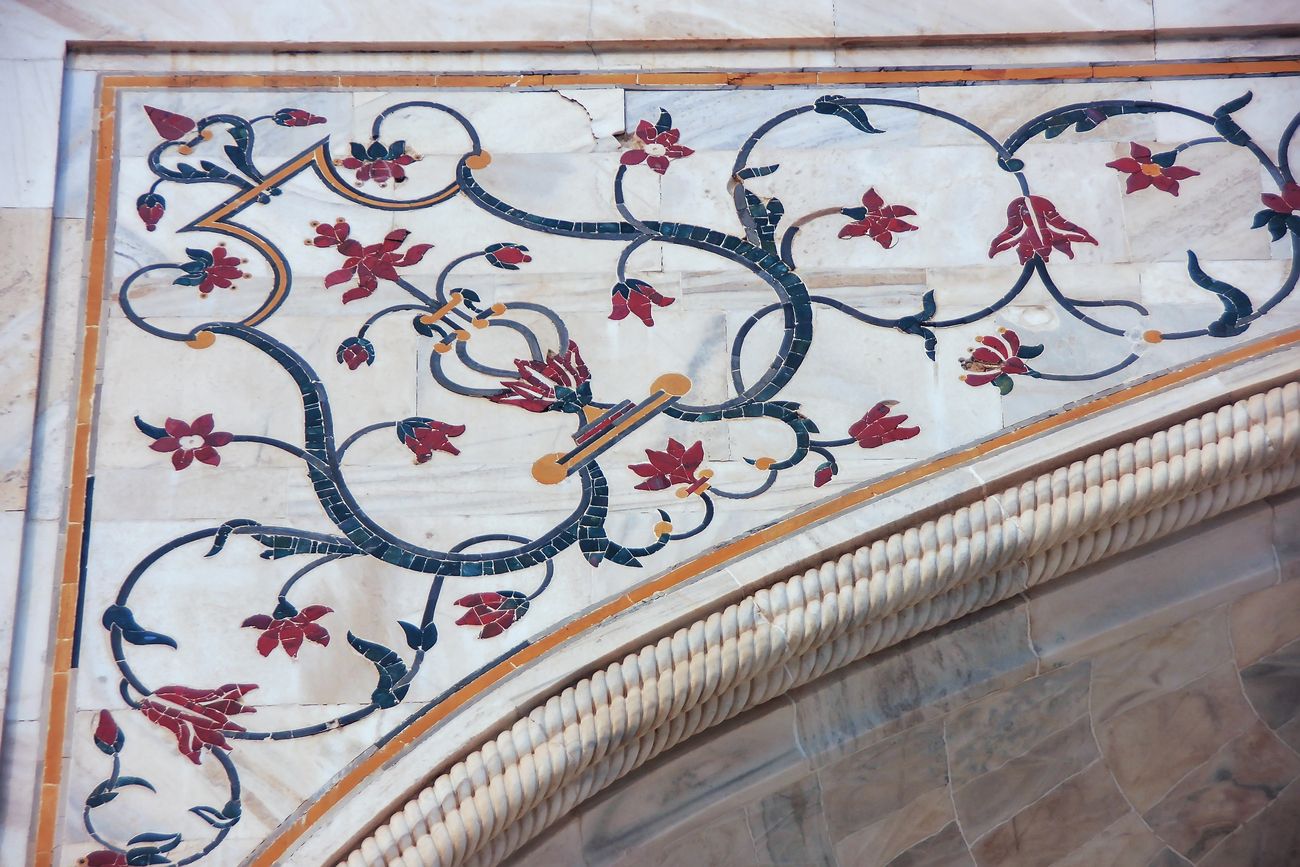
In the Quran and Persian poetry, flowers are said to bloom from the waters of paradise—and that heavenly imagery comes alive on the Taj Mahal. Finely crafted floral motifs and semi-precious stone inlays soften the pure marble surface, transforming it into a jewel-like tapestry of delicate beauty. © Don Mammoser
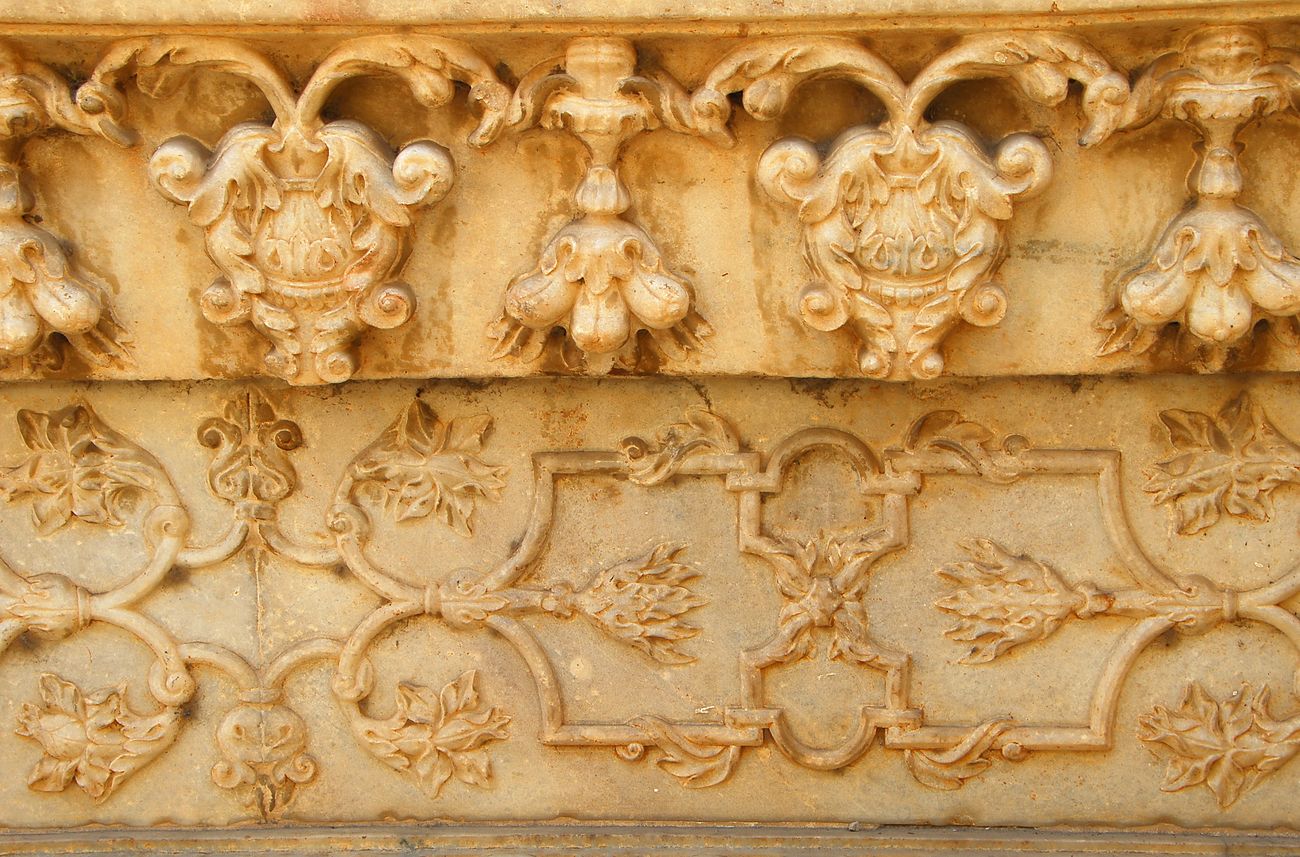
Carved marble reliefs of flowering plants—symbolic visions of paradise—adorn the decorative panels throughout the mausoleum. Each blossom is sculpted with remarkable finesse, giving the white marble an almost living quality. © dashingstock
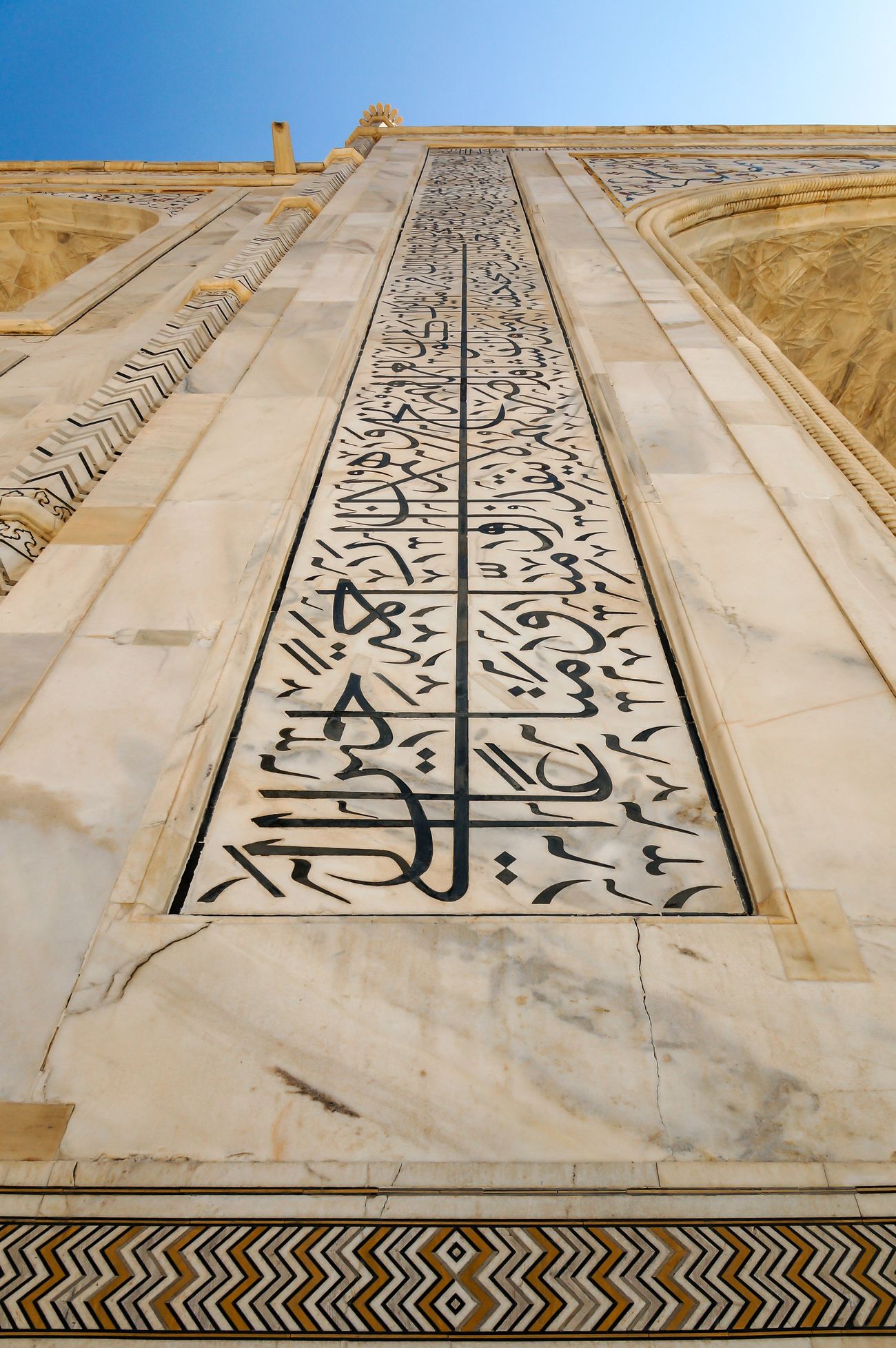
The script panels inlaid with verses from the Quran grow larger as they ascend, creating a brilliant optical illusion: from the ground, every line of calligraphy appears uniform in size. This clever design showcases the Mughal mastery of perspective. © Photo_works
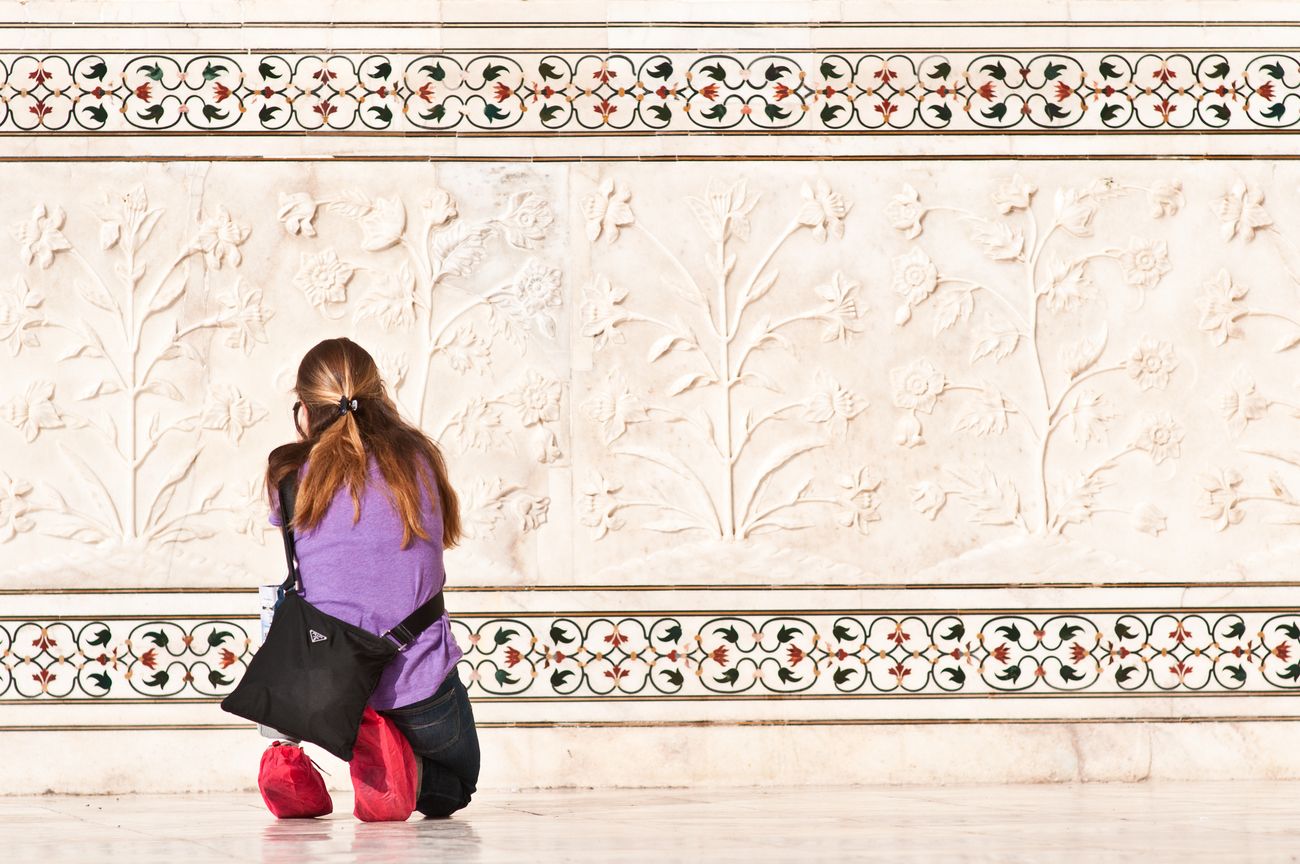
Along the lower tomb walls, delicate bas-relief carvings of flowers emerge from the white marble, adding grace and texture to the mausoleum’s serene interior. © Aodhain
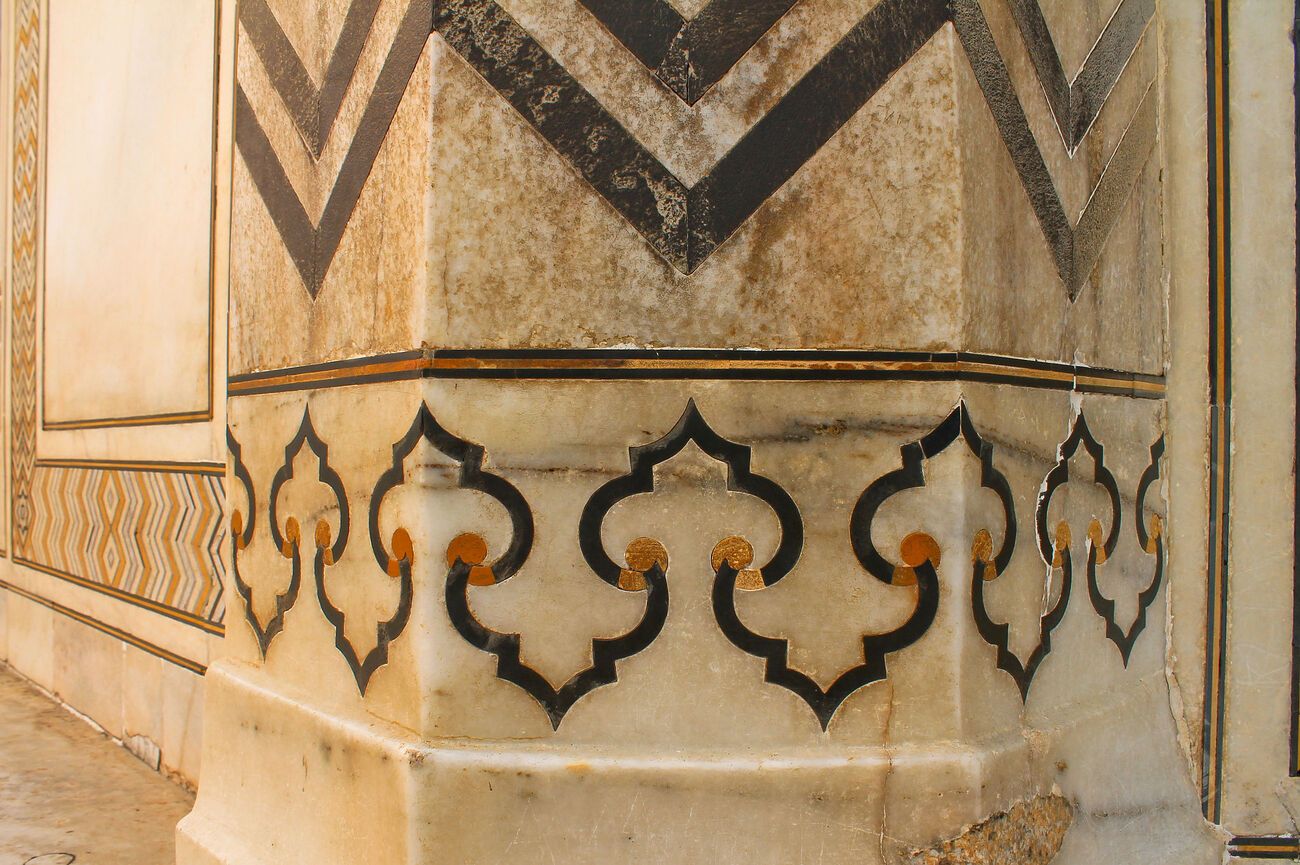
The mausoleum’s outer walls are embellished with striking zigzag and geometric motifs crafted in yellow and black sandstone. These patterns lend visual rhythm to the Taj’s gleaming white façade. © Tairalist
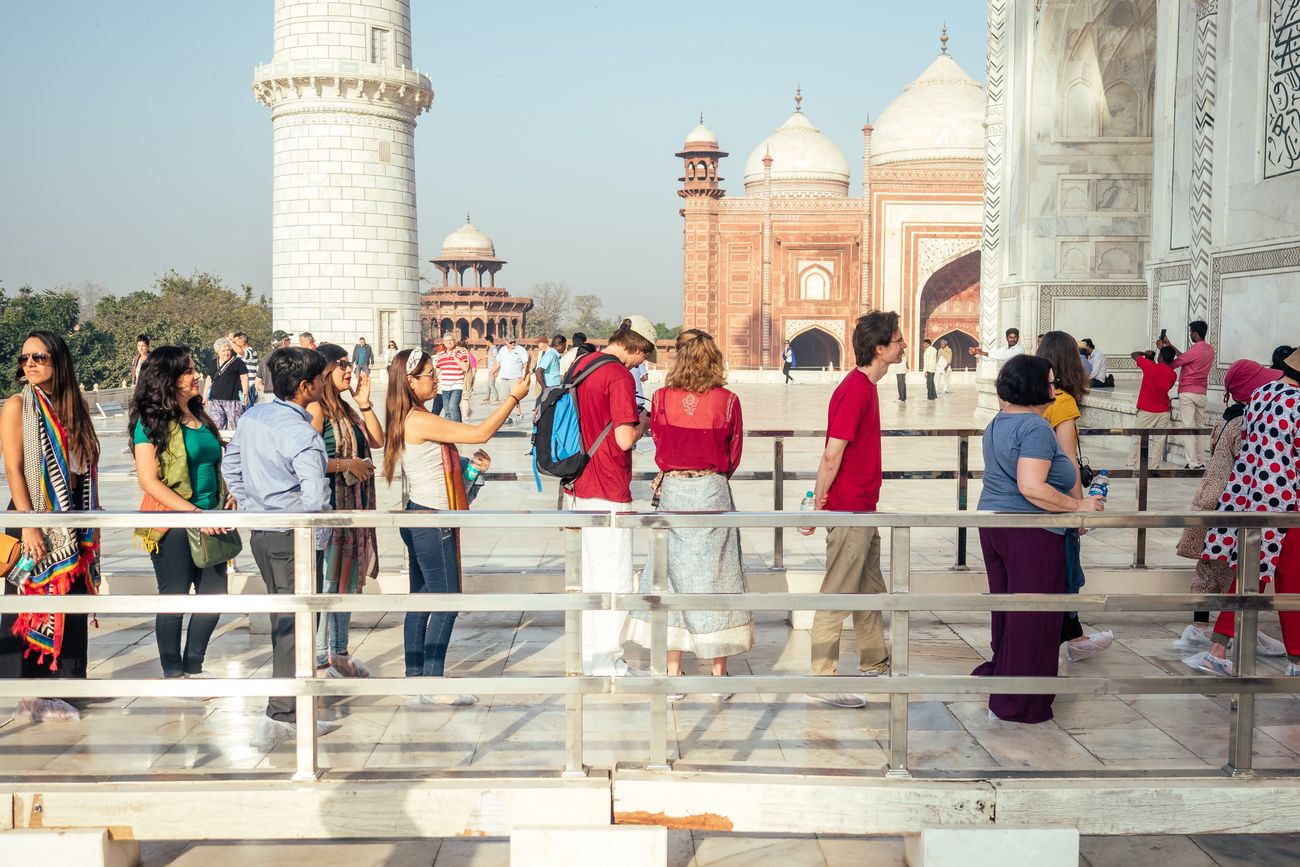
Visitors queue patiently to enter the Taj Mahal’s sacred tomb chamber. Photography is strictly prohibited inside, preserving the sanctity and solemn beauty of this revered space. © yurakrasil
The Smaller Pishtaqs
Framing the grand central arch of the Taj Mahal are a series of smaller pishtaqs, each designed with remarkable precision to enhance the monument’s symmetry and visual depth. These secondary arches might seem understated at first glance, but they play a crucial role in the Taj’s architectural harmony.
At the tomb’s four corners, the vaulted alcoves are crafted in a semi-octagonal shape, while those on the main façade take on a rectangular form. This clever variety in shapes isn’t just decorative—it allows the alcoves to remain visible from multiple angles, creating an illusion of layered depth and ensuring that the structure appears equally stunning from every viewpoint.
Each section of the massive façade is framed by shallow rectangular pilasters, gently projecting from the surface. These pilasters are adorned with elegant V-shaped chevron patterns, adding rhythm and refinement to the otherwise smooth expanse of marble.
Together, these smaller pishtaqs and decorative borders create a façade that is not only grand but also intricately balanced—an architectural symphony where every arch and alcove plays its part.
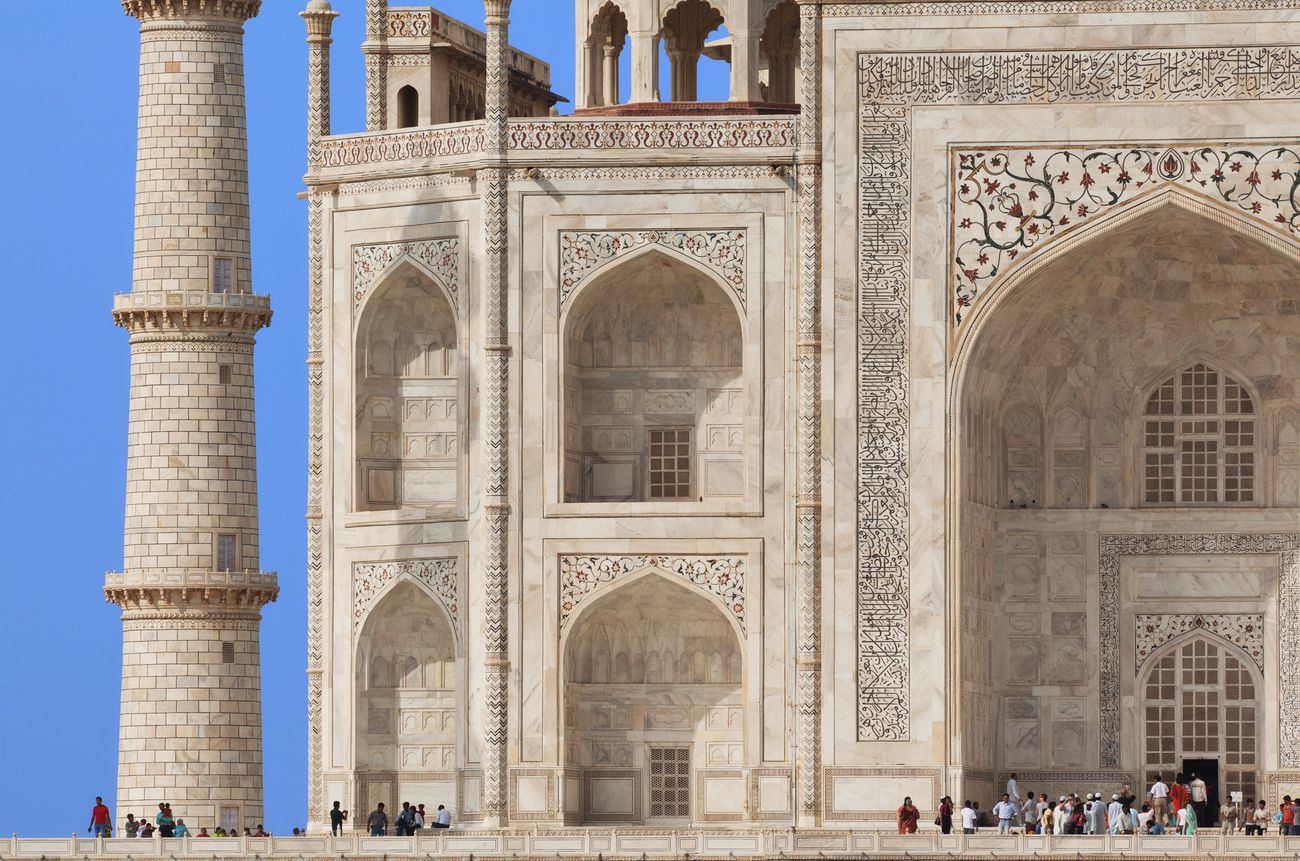
Recessed pishtaq arches create sculptural depth along the Taj’s exterior walls. Their inlaid panels add bursts of color and geometry, turning the pristine marble into a work of jeweled artistry. © cinoby
The Majestic Dome
The Taj Mahal’s great dome—its most iconic feature—rises like a luminous pearl against the sky. Its form draws inspiration from both Persian Timurid architecture and Hindu temple design, creating a captivating fusion that defines the monument’s silhouette.
Set atop a strong cylindrical drum, the dome’s shape is beautifully emphasized. Around its base, vibrant pietra dura inlays glow with color, their intricate patterns standing out against the pure white marble. From this richly decorated base, the dome swells into a full, graceful curve before narrowing elegantly toward its crowning element: the finial.
Originally crafted from gold, this finial is now made of gilded bronze, yet it still retains its brilliance. It combines artistic influences from both Hindu and Persian traditions, reflecting the cultural harmony at the heart of Mughal architecture.
Although the dome reaches an impressive 150 feet, visitors standing inside the mausoleum cannot perceive its true height. This is because the structure is ingeniously built with a double shell—the inner shell forming the interior ceiling, while the outer one creates the magnificent profile seen from outside.
Majestic, refined, and meticulously designed, the dome is the jewel of the Taj Mahal—its crown, its identity, and its eternal signature against the Indian sky.
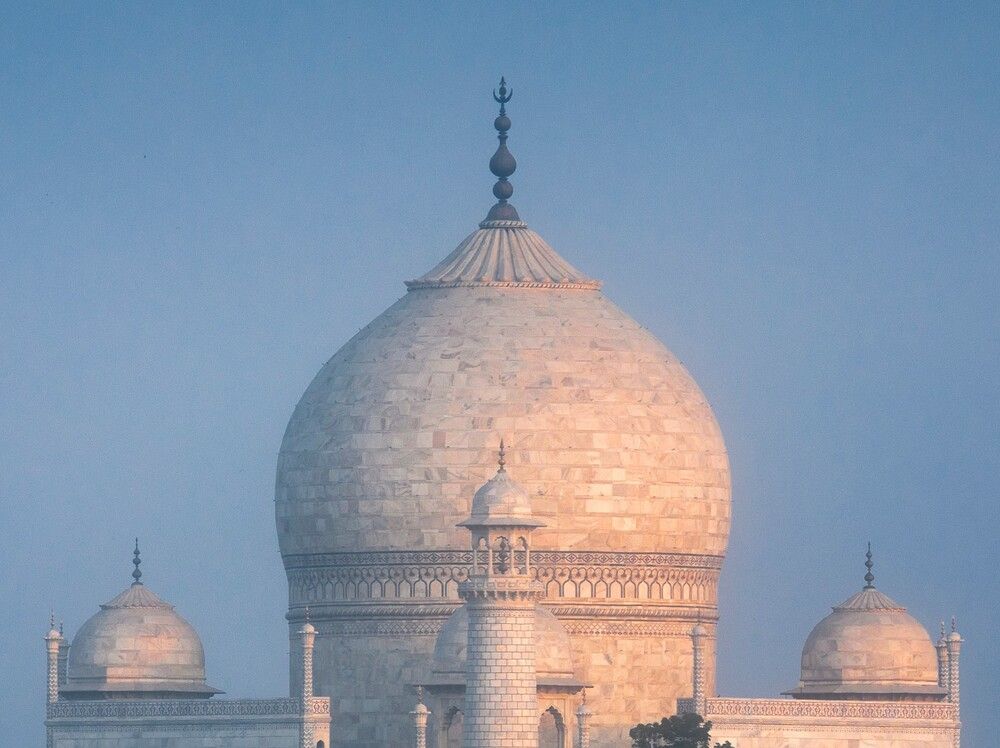
The Taj Mahal’s iconic double dome—44 meters (144 feet) high—is crowned with a gleaming finial. Symbolizing the vault of heaven, the great onion-shaped dome contrasts beautifully with the square base, representing the earthly world below.
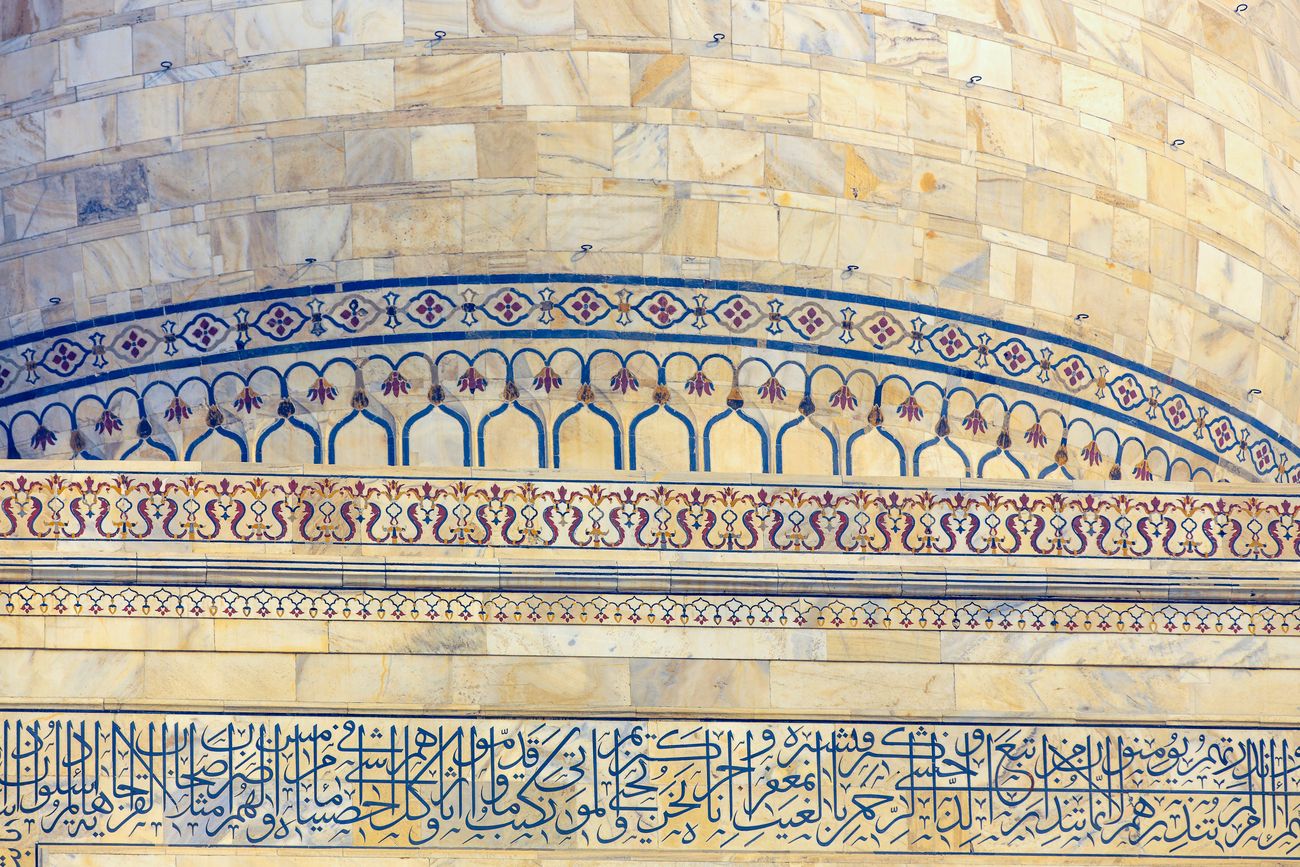
A close-up view of the Taj’s dome reveals intricate floral pietra dura inlays made of semi-precious stones—yet another testament to the monument’s exquisite craftsmanship. © Tawatchaiwanasri
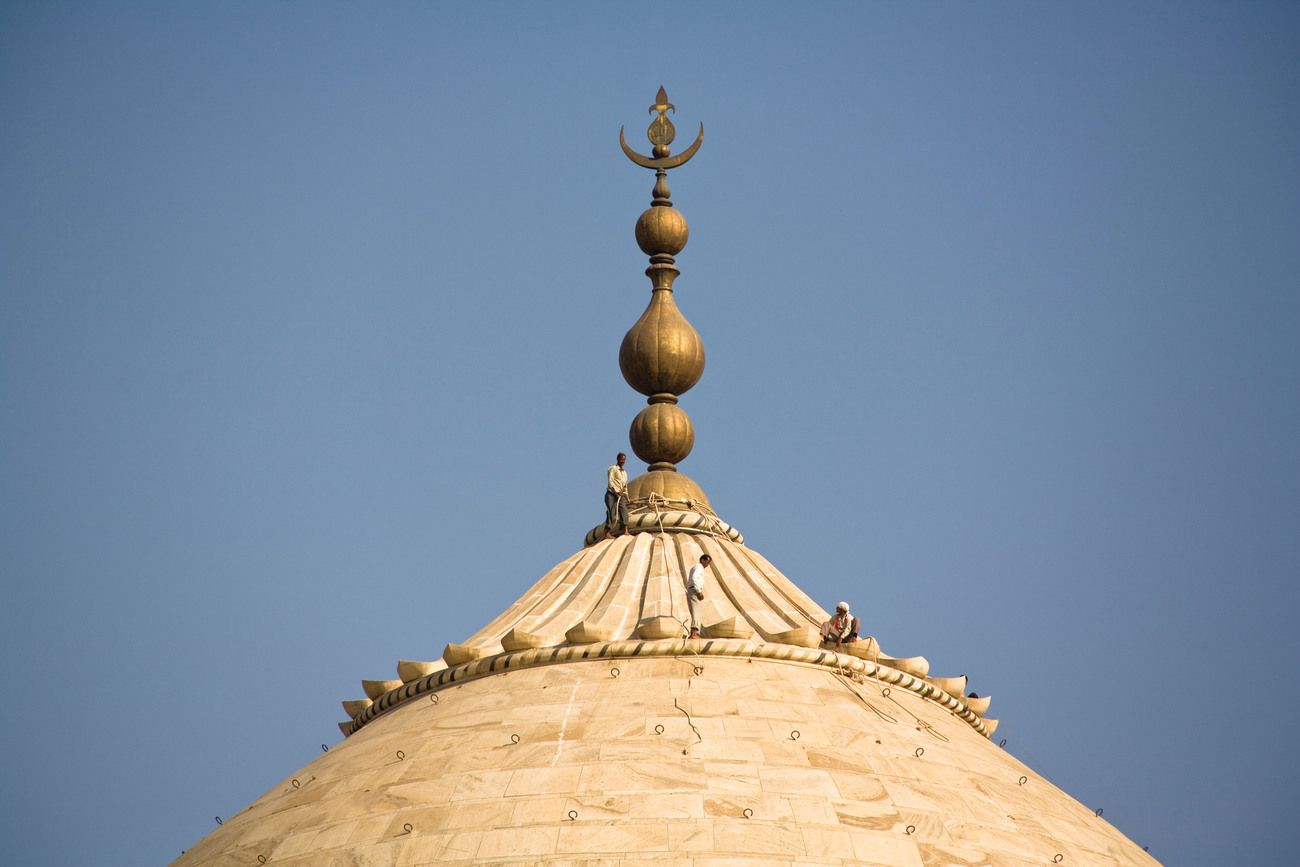
The brass finial atop the dome combines Islamic and Hindu symbolism: a crescent paired with a kalash-like motif. The word “Allah” is etched in Urdu. Workers suspended high above the dome perform vital maintenance—an incredible feat of skill and courage. / Photo by Melvyn Longhurst / Alamy Images
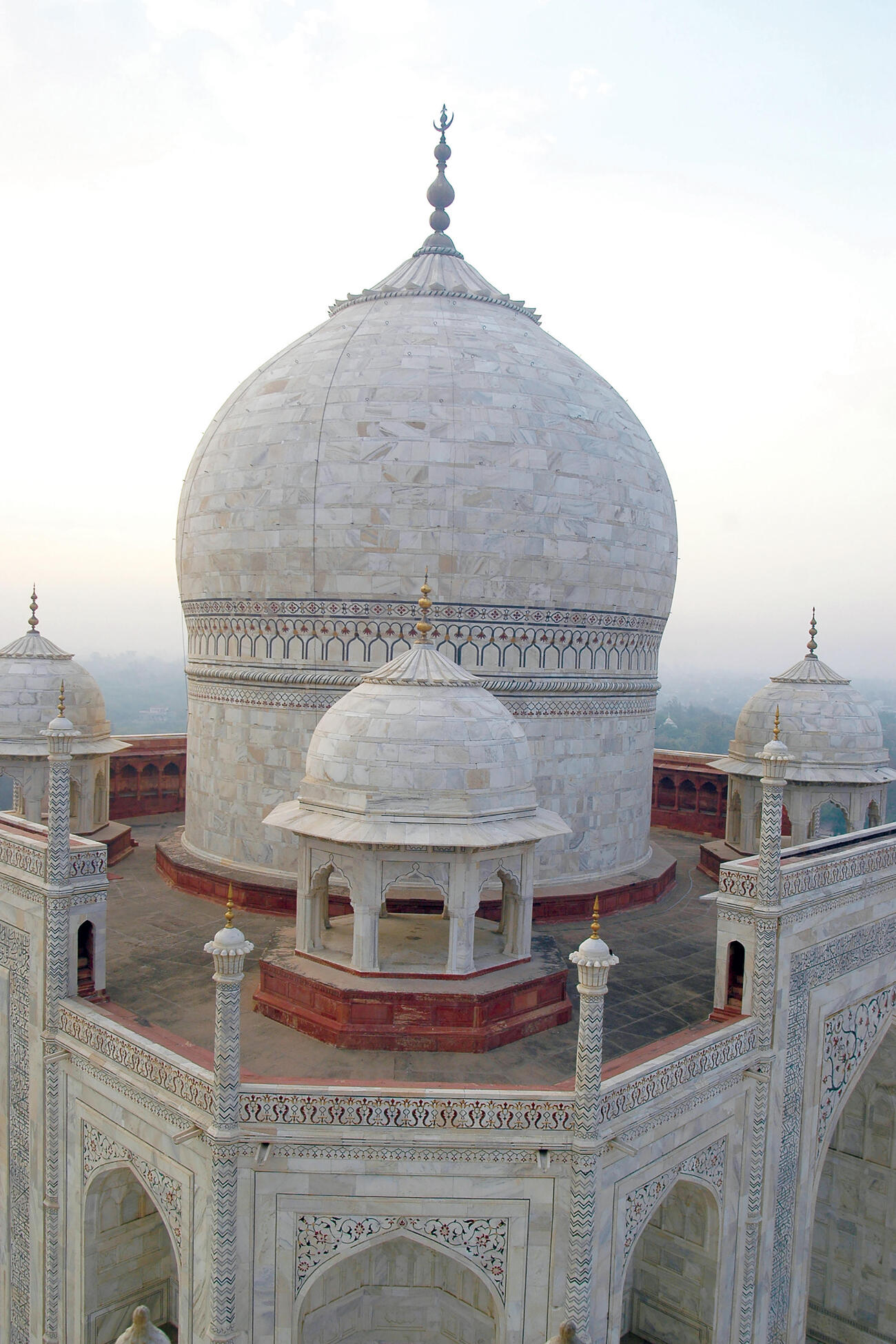
The Taj Mahal’s ingenious double dome design creates a majestic outer silhouette while keeping the inner chamber’s proportions harmonious for visitors. The inner dome is smaller, tucked beneath the grand outer shell. / Alamy Images
The Chhatri
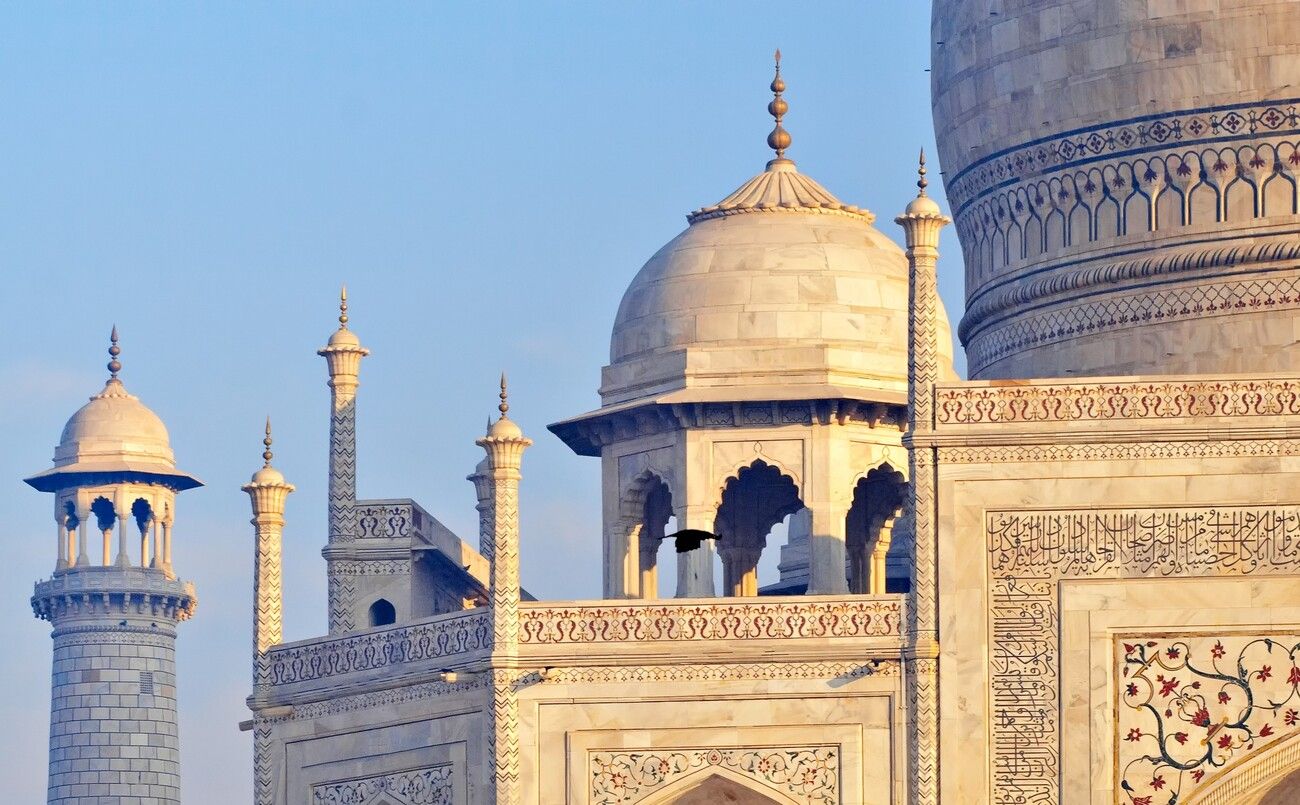
Hindu influences—especially Rajasthani—shine clearly in Mughal architecture through the elegant use of chhatris, the small domed pavilions. At the Taj Mahal, four chhatris sit diagonally around the grand central dome, mirroring its lotus motifs and gilded finials. Their graceful columns and arches rise through the dome’s roof, allowing streams of fresh air and soft daylight to filter into the space below. © Aleynikov Pavel
The Pilasters
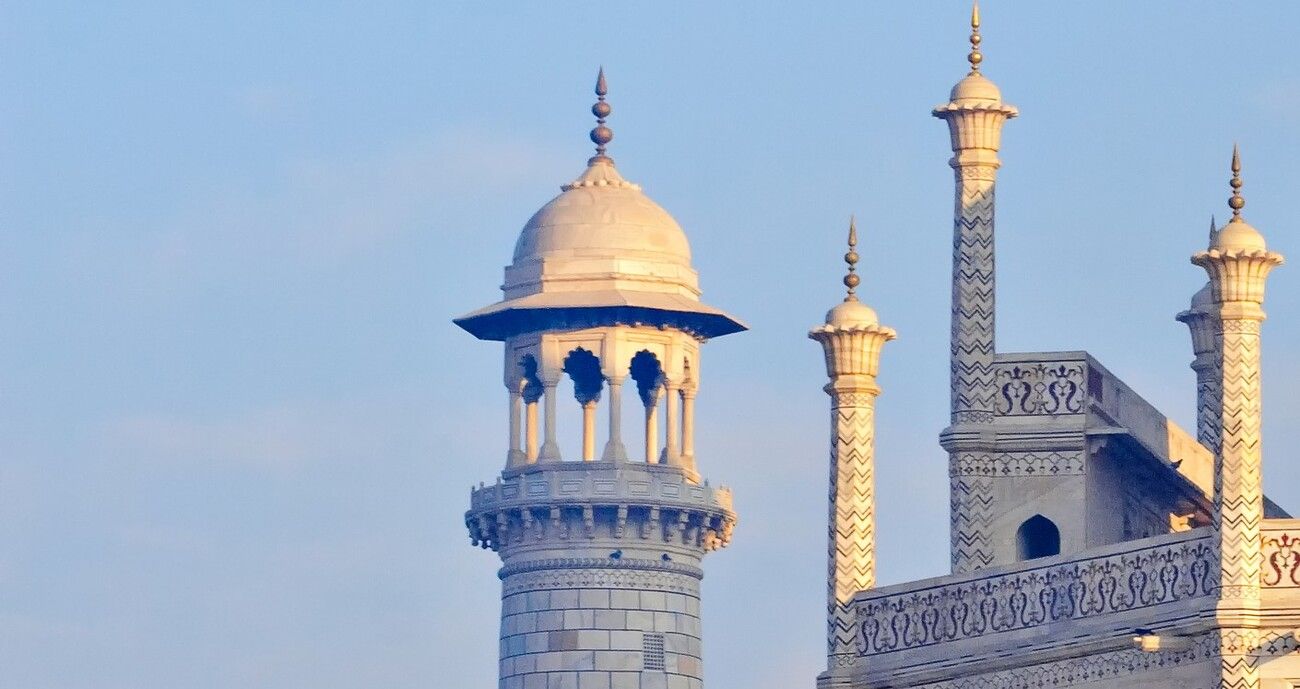
Every pishtaq (arch) in the Taj Mahal complex is framed by tall, slender pilasters rising gracefully from its base. Each pilaster is adorned with striking black-and-white marble herringbone patterns and topped with a delicate marble bouquet known as a guldasta, crowned by a bronze finial. Standing even taller than the pishtaqs themselves, these elegant pillars draw the eye upward and dramatically enhance the soaring majesty of the mausoleum’s great dome. © Aleynikov Pavel
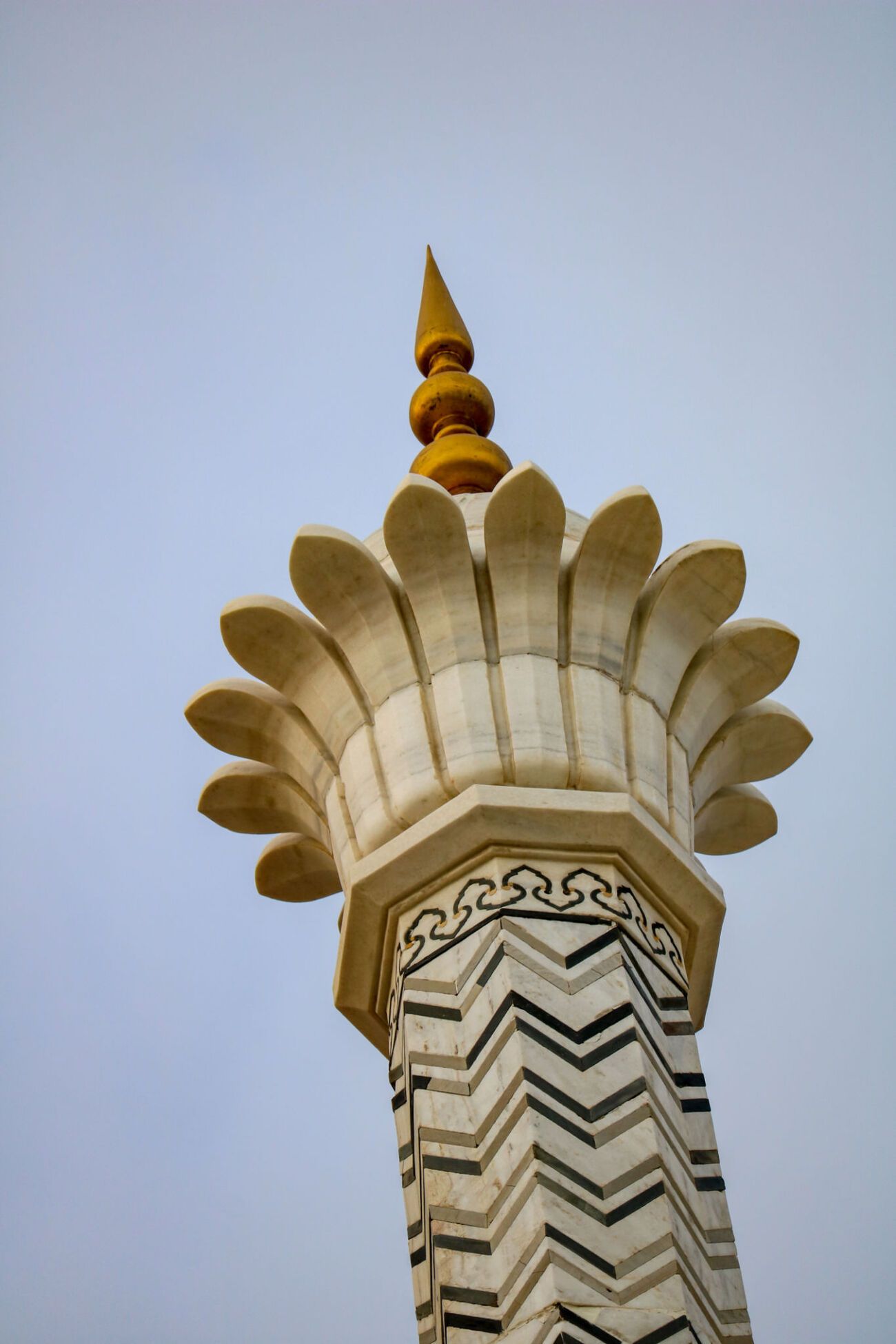
A close-up of a pilaster reveals its intricate herringbone pattern, crowned by a marble guldasta blooming like a sculpted bouquet, finished with a bronze finial. © Miriam Gimbel
The Minarets
Gracefully framing the Taj Mahal, the four slender minarets stand like silent sentinels at each corner of the marble platform. Their placement is no accident—these perfectly positioned towers amplify the flawless symmetry that defines the entire complex.
Each minaret rises to a height of 154 feet, divided into three equal sections by two beautifully carved encircling balconies. At the top sits a delicate chhatri, supported by eight slender pillars and crowned by pointed arches—an architectural flourish that reflects both refinement and purpose.
Inside, spiral staircases once allowed access to the balconies and chhatris, though these passages are now closed to visitors. In traditional Islamic architecture, minarets played a central role—the mu’addin would climb up to call the faithful to prayer. Interestingly, minarets only became a signature feature of Mughal architecture in the seventeenth century, making their inclusion here a symbol of evolving design.
Together, these four towers do more than balance the Taj—they complete it. They stand guard, enhance its harmony, and elevate its presence, ensuring that the mausoleum appears perfectly framed from every angle.
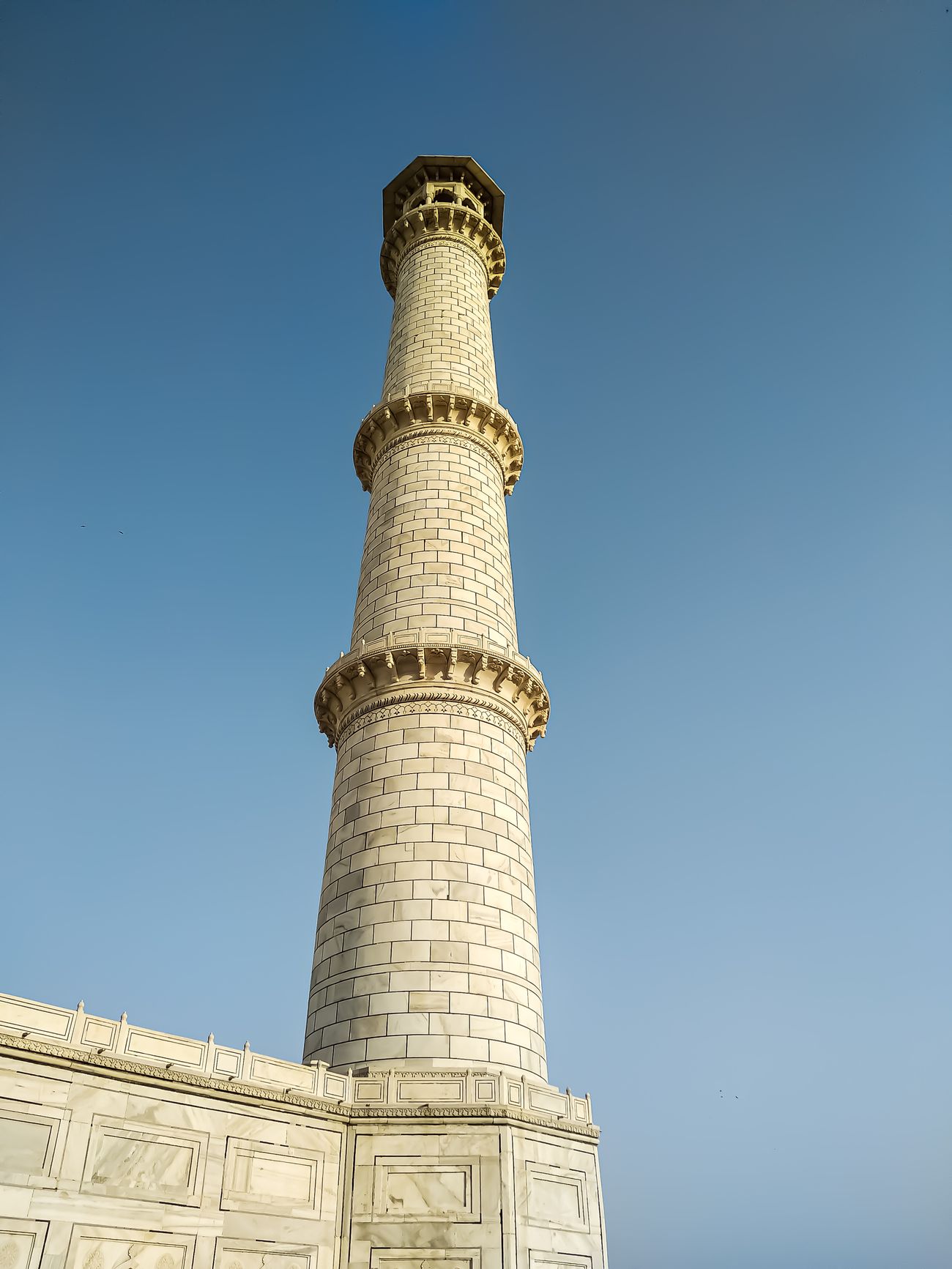
Shah Jahan was the first Mughal emperor to introduce minarets into palace and tomb architecture, and the Taj Mahal’s four soaring 40-m (133-ft) minarets proudly showcase this innovation. Placed at each corner of the mausoleum’s marble plinth, they emphasize its perfect symmetry and lend the entire structure an enchanting sense of lightness and upward lift. Each minaret is crowned with an elegant eight-columned chhatri, and all four subtly lean outward—an intentional engineering marvel designed so that, in the unlikely event of collapse, they would fall away from the mausoleum and never damage the immortal monument to love. © Ranadip Dey
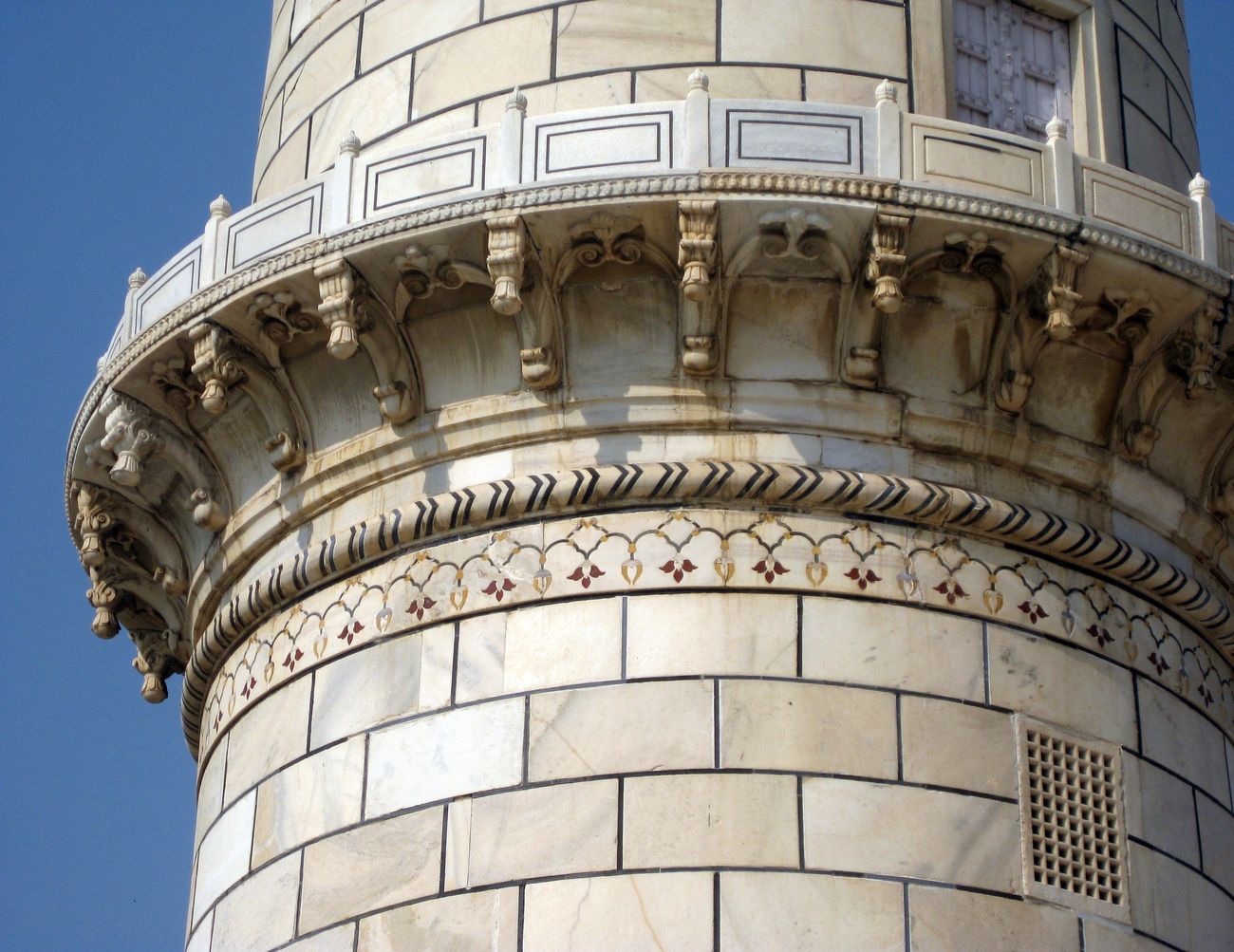
This detailed minaret view showcases delicate pietra dura floral designs and ornate marble carvings beneath each balcony—Mughal artistry at its finest. © Fabio Imhoff
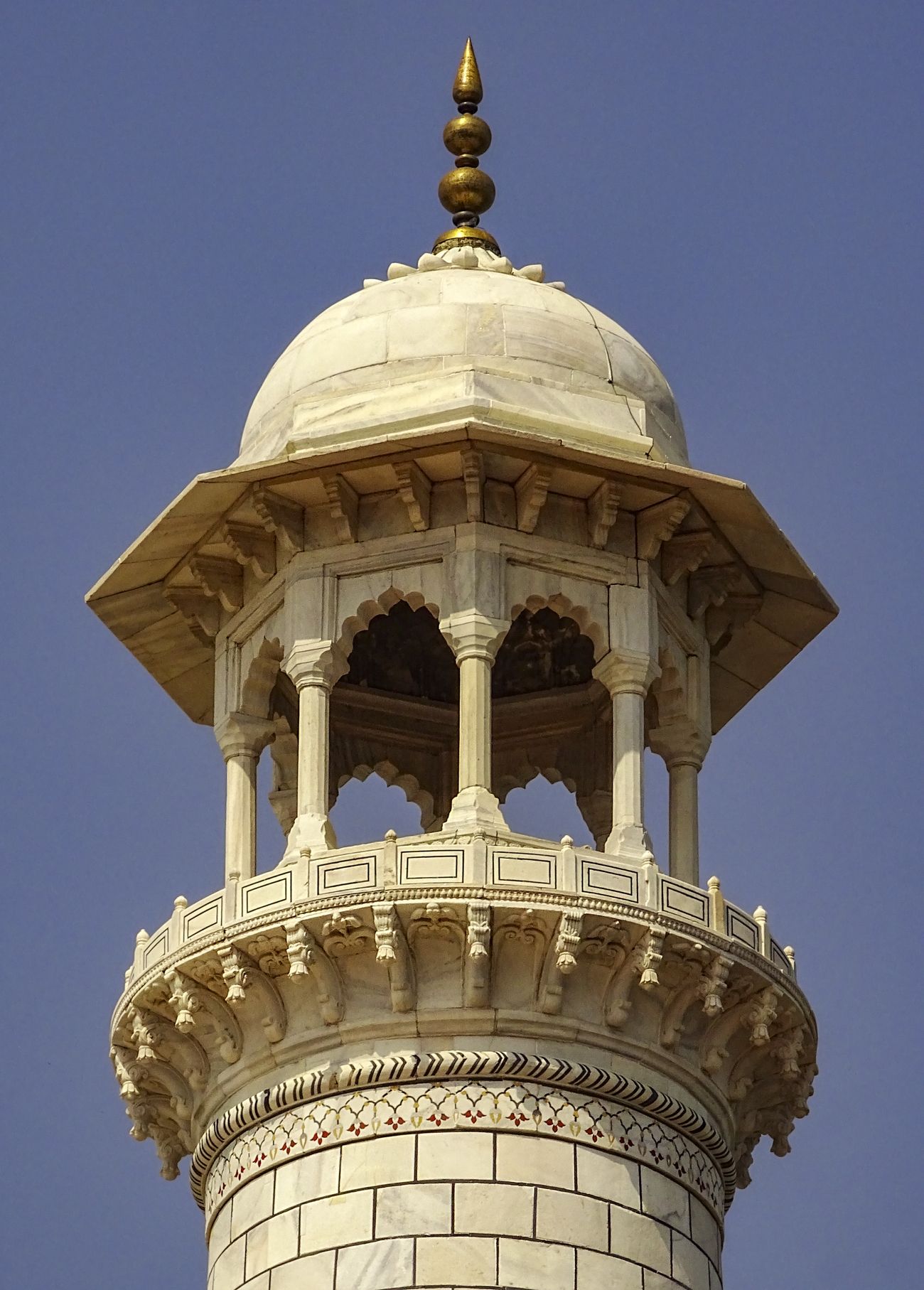
The minaret’s top storey reveals elegant craftsmanship and beautiful decorative details that crown this iconic architectural element. © Ankit M
The Funerary Chamber
At the very heart of the Taj Mahal lies its soul—the serene octagonal funerary chamber, where the beautifully carved marble cenotaphs of Shah Jahan and Mumtaz Mahal stand side by side. These are symbolic tombs; their actual resting places lie in the crypt below, a quiet, shadowed space that remains closed to visitors.
Look upward, and the chamber’s curved ceiling glows with intricate pietra dura inlay work, each stone catching the light like a tiny jewel. Soft daylight filters through the delicate jaali screens carved into the outer walls, filling the chamber with a gentle golden sheen. The play of warm light against the cool, luminous marble creates an atmosphere of profound calm—almost otherworldly in its tranquility.
The walls are adorned with elegant calligraphy, subtle bas-relief carvings, and exquisite inlay work studded with precious stones, mirroring the floral and geometric motifs that grace the monument’s exterior. From the main chamber, four smaller octagonal rooms extend outward from each corner, enhancing the space with symmetry and balance.
Standing here, surrounded by artistry and silence, one can feel the depth of the love story that inspired this masterpiece—a sanctuary where devotion has been etched forever in marble and light.
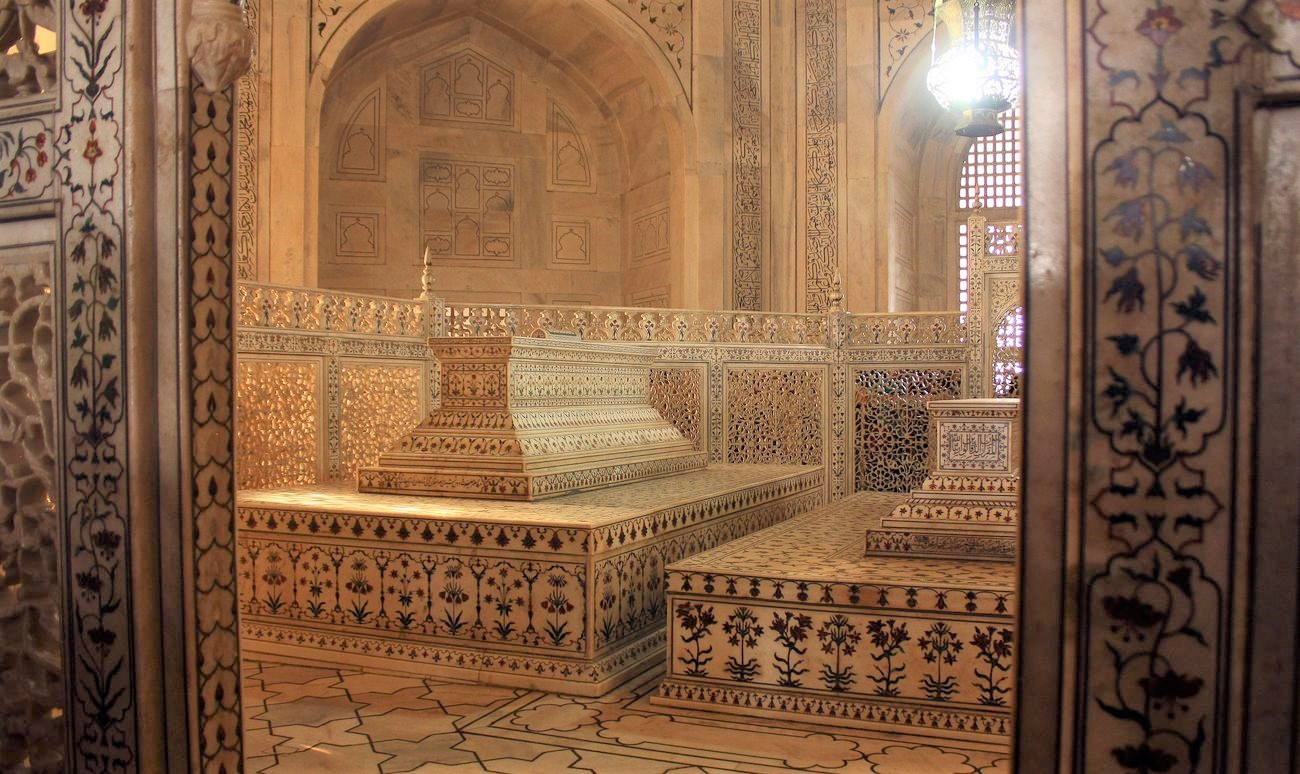
The two exquisitely decorated cenotaphs inside the Taj Mahal are symbolic masterpieces—beautiful markers rather than the true resting places of Shah Jahan and Mumtaz Mahal. Their actual sarcophagi lie in a simpler chamber below, at garden level. In Mughal times, these cenotaphs shimmered with unimaginable luxury: Mumtaz Mahal’s was draped with a pearl chadar, a blanket entirely woven of pearls, while Shah Jahan’s was adorned with precious stones. Although many of these treasures were looted during post-Mughal invasions, the cenotaphs still radiate the elegance and devotion crafted into them centuries ago. © IVANVIEITO
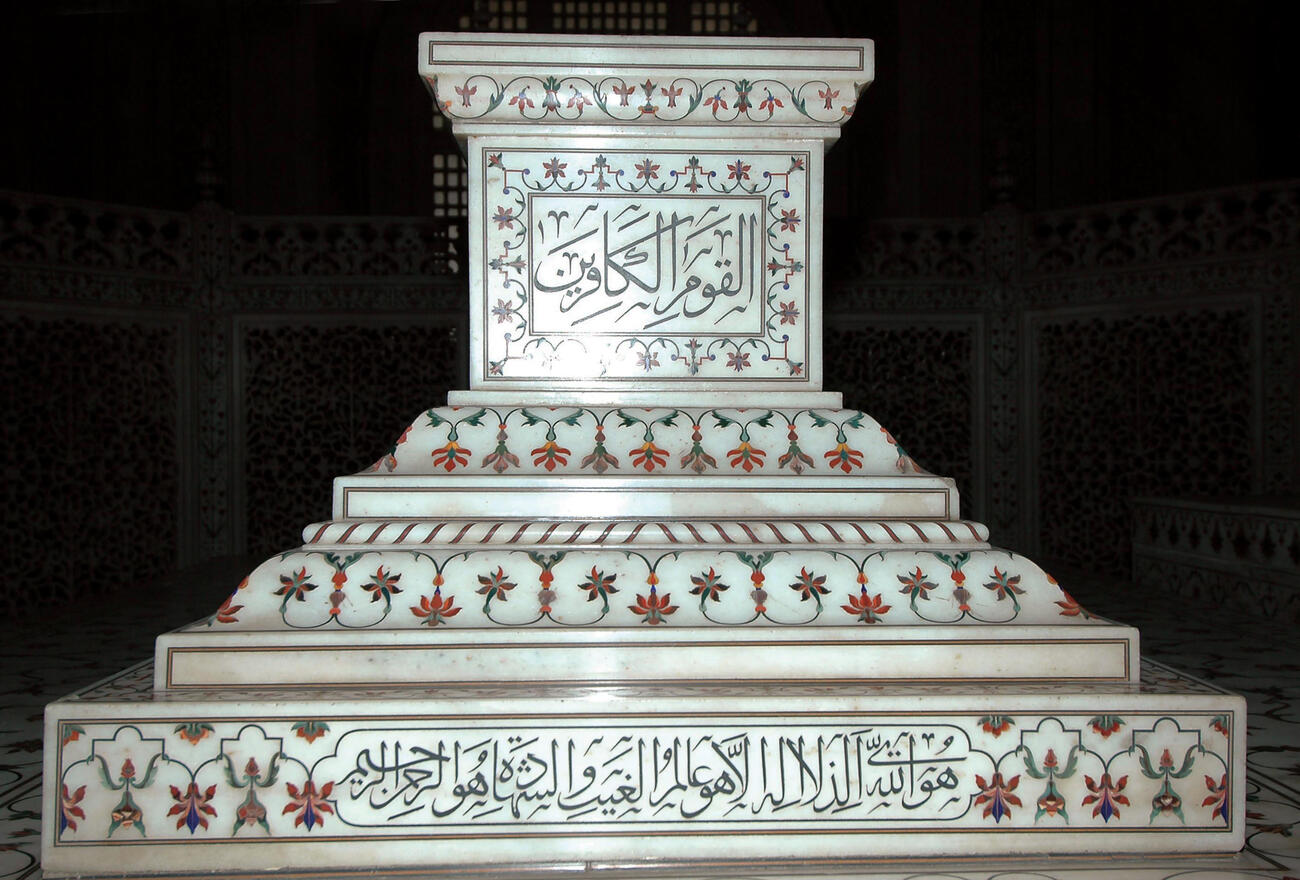
Mumtaz Mahal’s cenotaph is delicately inscribed with eloquent verses from the Quran, reflecting her honored status in Mughal memory. / Alamy Images
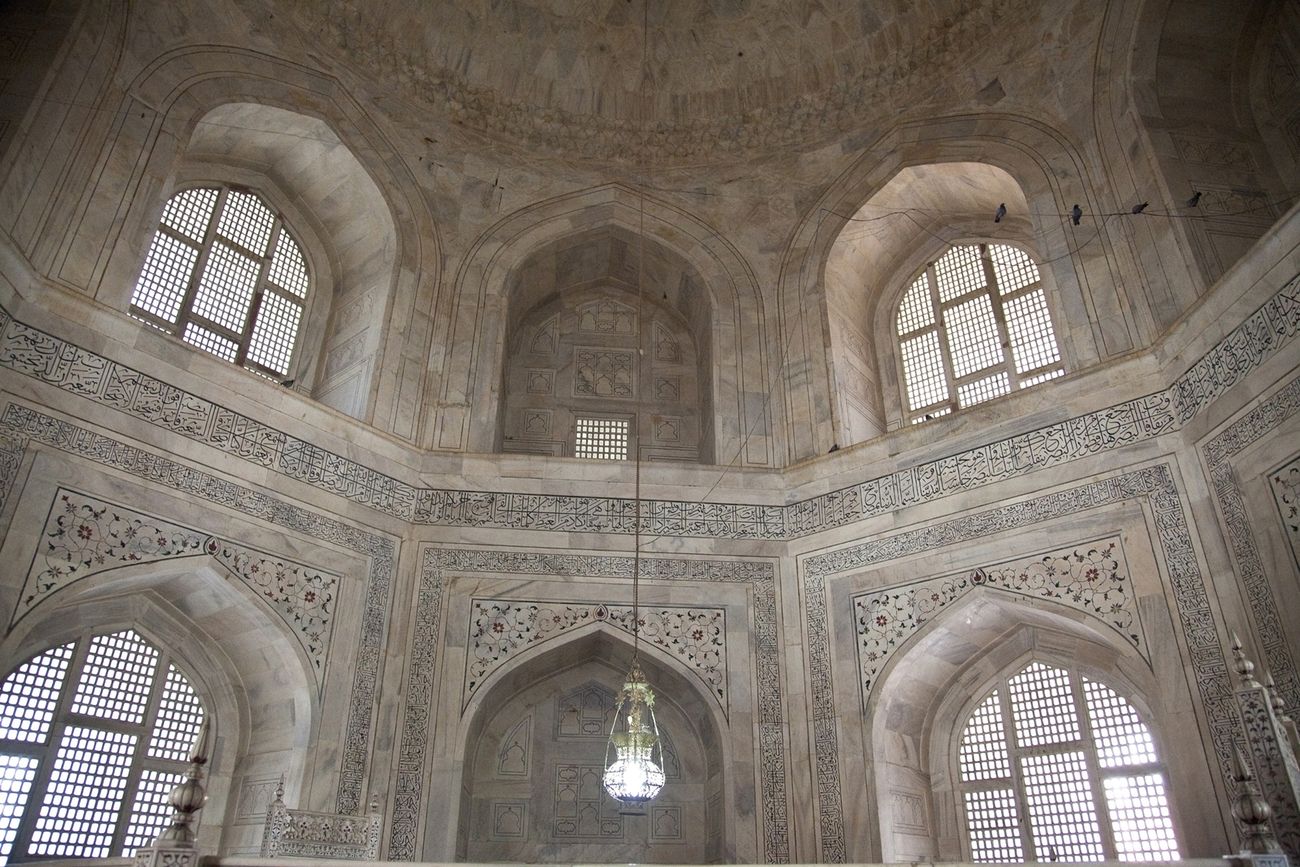
In 1909, Lord Curzon donated a majestic bronze lamp modeled after one in a Cairo mosque. Today it hangs above the main tomb chamber, casting a serene glow over the marble interior. © GregD
The Screen
The cenotaphs of Shah Jahan and Mumtaz Mahal were once enclosed by a shimmering gold-enamelled screen, but in 1643 it was replaced with the exquisitely crafted marble screen that surrounds them today. This masterpiece, carved with extraordinary precision, forms an octagonal enclosure, with each of its eight sides divided into three graceful panels.
Only one of these panels serves as the entrance to the tombs, preserving a sense of sanctity and intimacy. Each panel is a work of art in itself—adorned with delicate pietra dura inlays of semi-precious stones and sculpted with intricate carvings that form flowing vines, flowers, and fruits. The craftsmanship is so fine that the marble seems almost lace-like, glowing softly as light filters through.
The screen not only protects the cenotaphs—it elevates them, creating a serene, sacred space that feels suspended between earth and eternity.
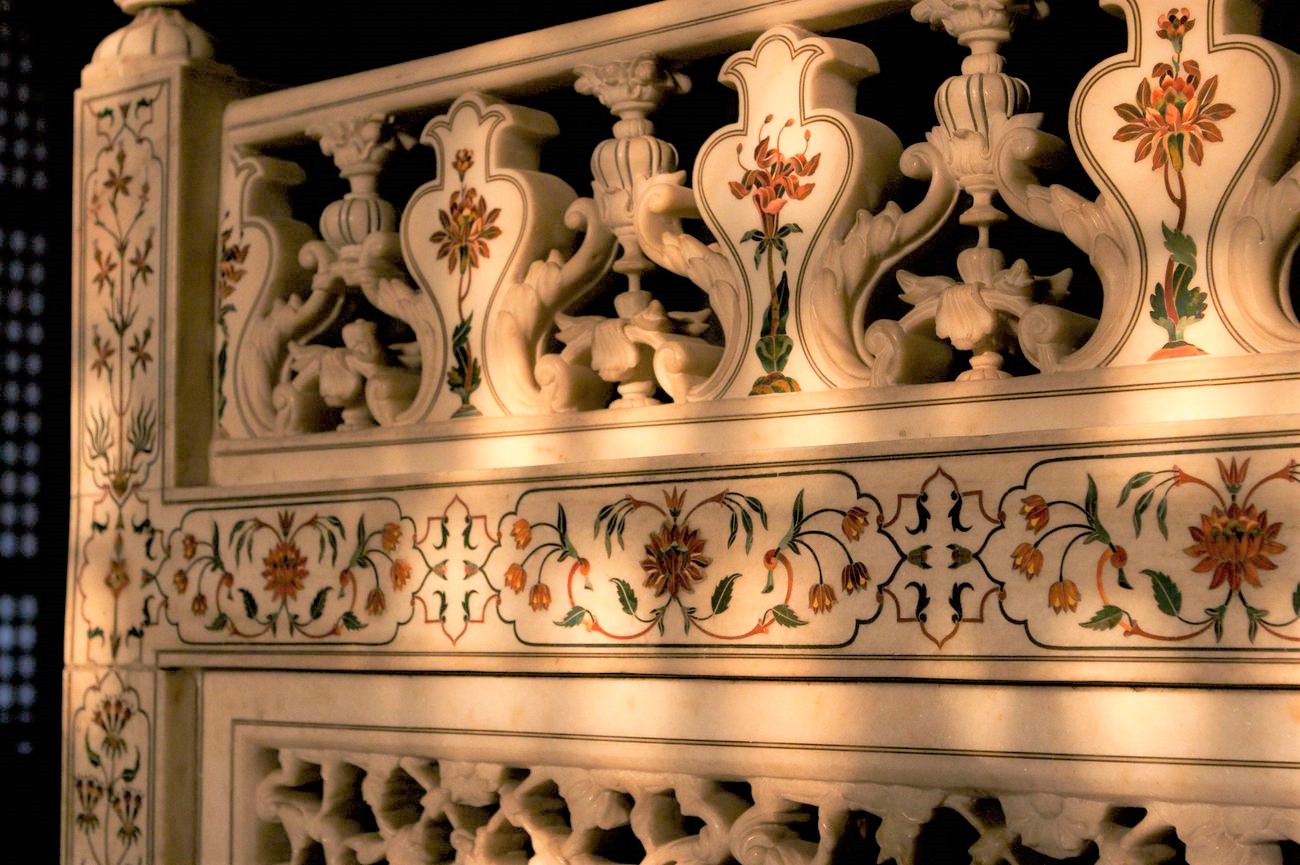
The crescent-shaped marble screen circling the royal tombs is a breathtaking example of Mughal artistry, shimmering with delicate gold inlay. Every inch of this masterpiece is alive with intricately engraved semi-precious stones—carnelian, lapis lazuli, mother-of-pearl, and dozens more. In fact, artisans used 35 different precious and semi-precious stones to create the Taj Mahal’s celebrated pietra dura inlay work. Floral motifs bloom across the marble like a garden in stone. Tip: Bring a small torch—when light passes through the translucent marble and gemstones, the entire screen glows as if lit from within. © Sandra_San
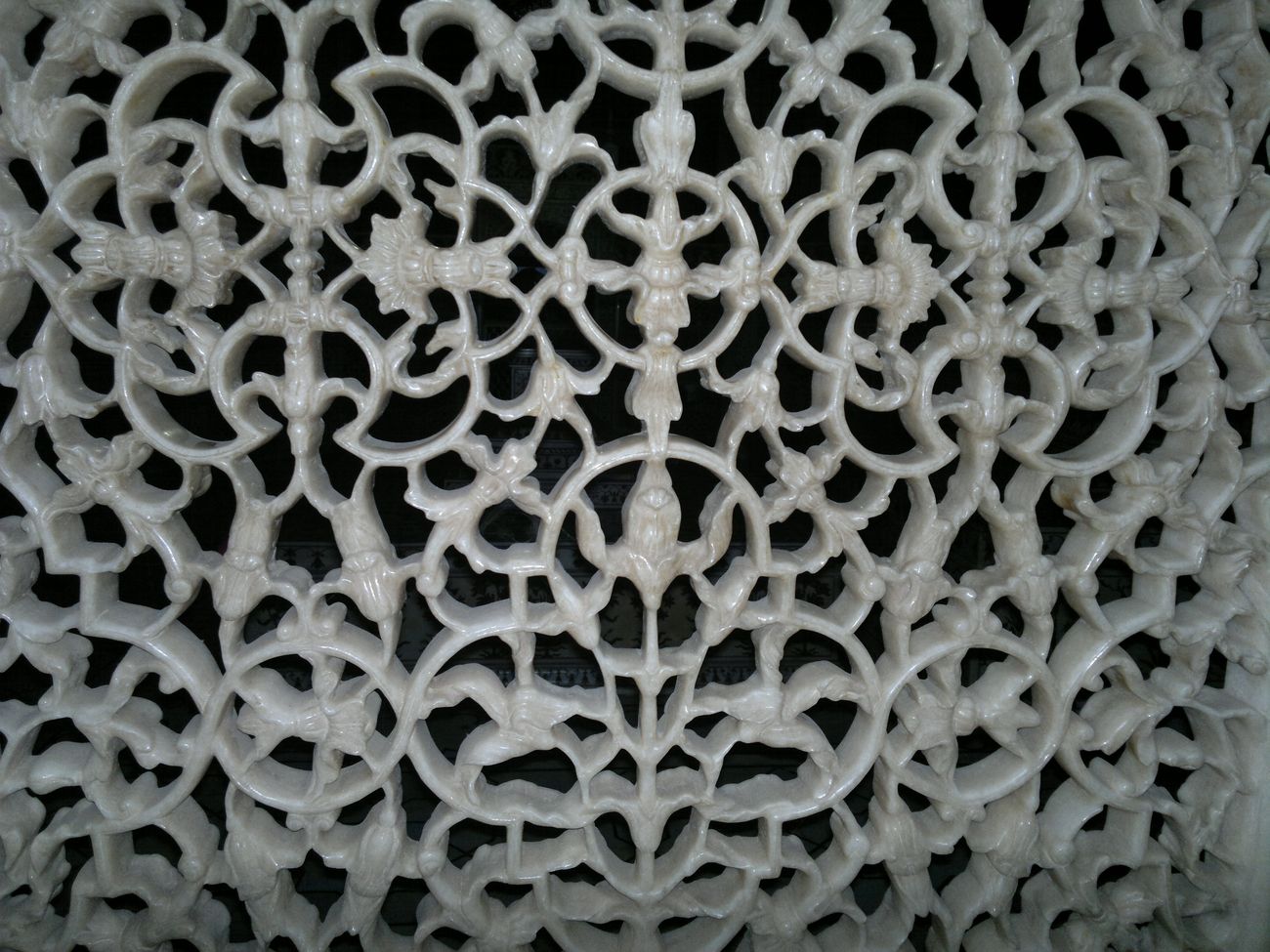
This marble filigree screen is nothing short of astonishing—a single slab of marble transformed over ten painstaking years into an exquisite lace-like lattice. The delicate jali shields the royal cenotaphs while allowing soft, patterned light to filter through, casting ethereal shadows across the chamber. It stands as a testament to the unmatched skill and patience of Mughal craftsmen. © NAIK86
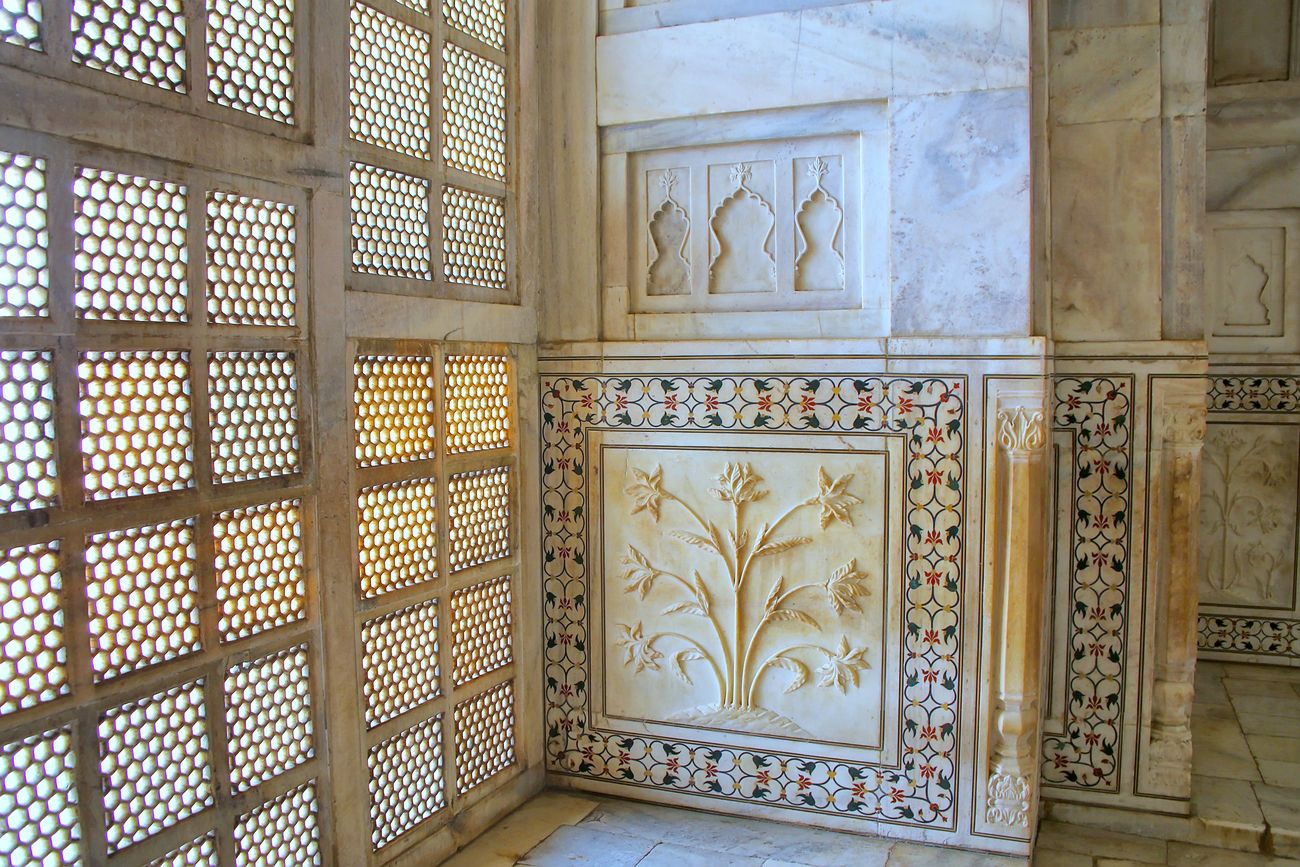
Jali lattice screens on the walls of the surrounding octagonal rooms allow sunlight to pour into the burial chamber, illuminating the floral marble inlay and semi-precious stone engravings. © Don Mammoser
The Crypt
Beneath the richly ornamented cenotaphs lies the Taj Mahal’s most intimate and sacred space—the crypt, where the actual graves of Shah Jahan and Mumtaz Mahal rest. Unlike the elaborate chamber above, this underground room reflects the simplicity prescribed by Muslim tradition, which discourages decoration on true burial sites.
Here, the emperor and his beloved queen are interred with their heads facing Mecca, honoring Islamic burial customs. The chamber is lined with plain marble, its ceiling left unadorned, creating a stark yet peaceful contrast to the ornate beauty above.
In this quiet, unembellished space, the focus shifts from grandeur to pure devotion. The simplicity of the crypt underscores the humility of death—and deepens the emotional impact of the magnificent mausoleum built to honor a love that endures across centuries.
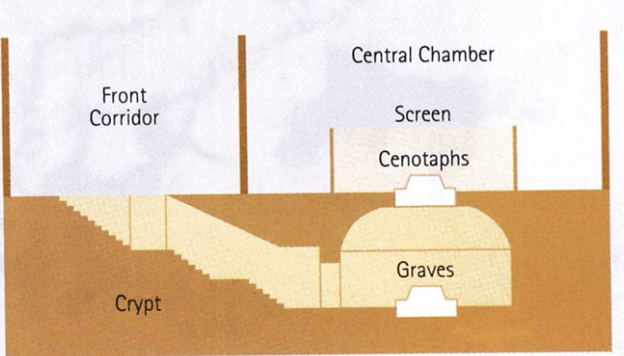
A staircase on the southern side leads down to the crypt, where the true graves lie—an area not open to visitors.
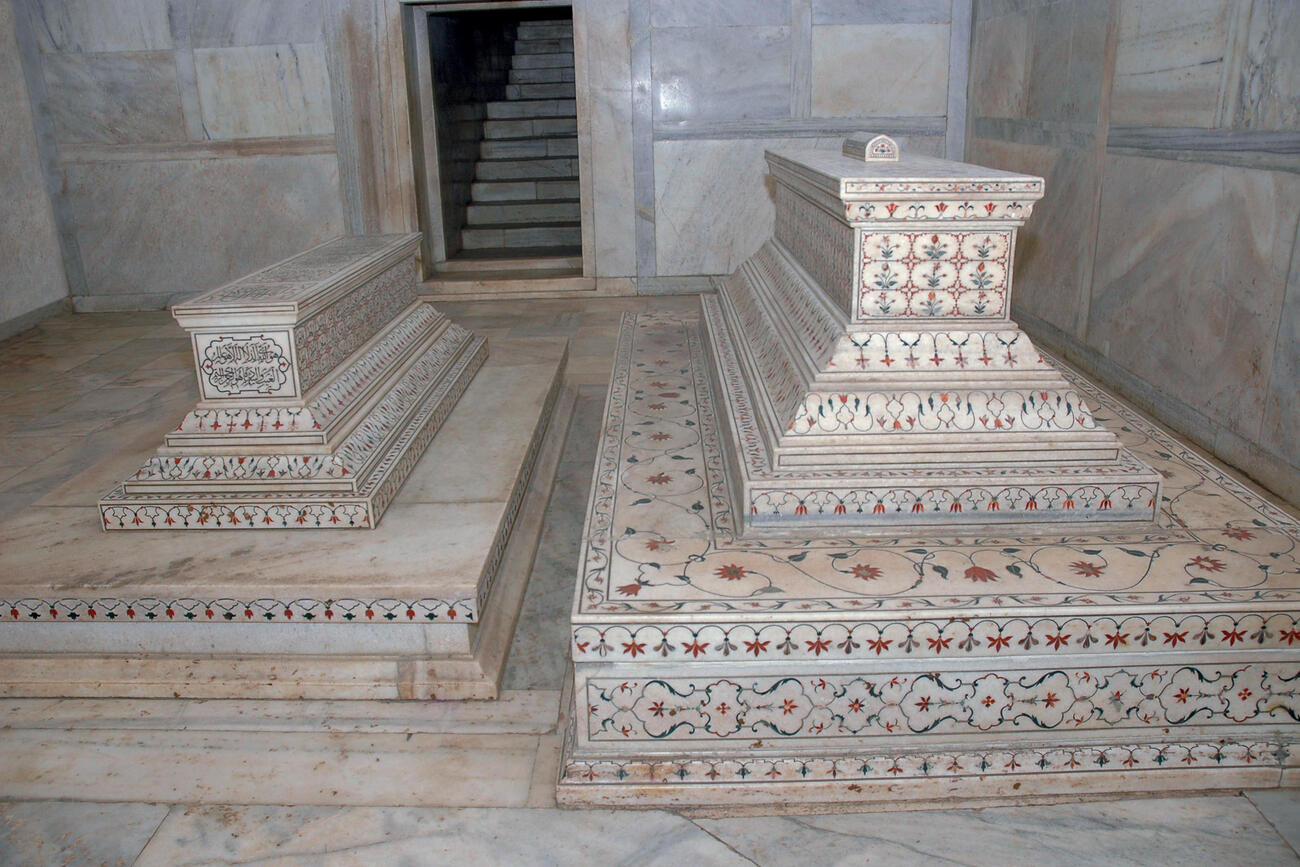
The True Graves of Shah Jahan and Mumtaz Mahal: Directly beneath the grandeur of the tomb chamber lies the true resting place of the emperor and his beloved queen. Mumtaz Mahal’s actual grave rests at the exact center of the funerary chamber, with Shah Jahan’s placed beside hers—reunited here 35 years after her death. This sacred underground chamber opens only once a year, from February 27 to March 1, during Shah Jahan’s Urs (the annual commemoration of his death). For these three days, entry to the Taj Mahal is free for all—including foreign visitors—offering a rare chance to witness the heart of this timeless monument. / Alamy Images
The Mosque
To the left of the Taj Mahal, set upon a warm sandstone plinth, stands the elegant mosque, or Masjid—a structure as serene as it is architecturally rich. Its three domes rise gracefully above the courtyard, the central dome being the largest. Each rests on a cylindrical base intricately decorated with alternating patterns of red sandstone and white marble, creating a striking visual rhythm.
A unique feature of the mosque is its use of sgraffito, a technique whose name literally means “to scratch.” Artisans carved delicate, plant-like designs into the upper red layer to reveal the white stone beneath, resulting in beautifully textured motifs that seem both subtle and alive.
Inside, the floor is marked with black marble outlines representing about 570 prayer mats, guiding worshippers toward the sacred direction. The wall facing Mecca, known as the qiblah wall, features the traditional mihrab, a prayer niche that signals the direction for offering prayers.
The mosque’s design reflects Shah Jahan’s architectural signature—its layout and detailing echo the same harmonious style seen in his other mosques, including the grand Jama Masjid of Delhi.
Quiet, contemplative, and beautifully crafted, this mosque completes the Taj Mahal complex with spiritual grace and timeless artistry.
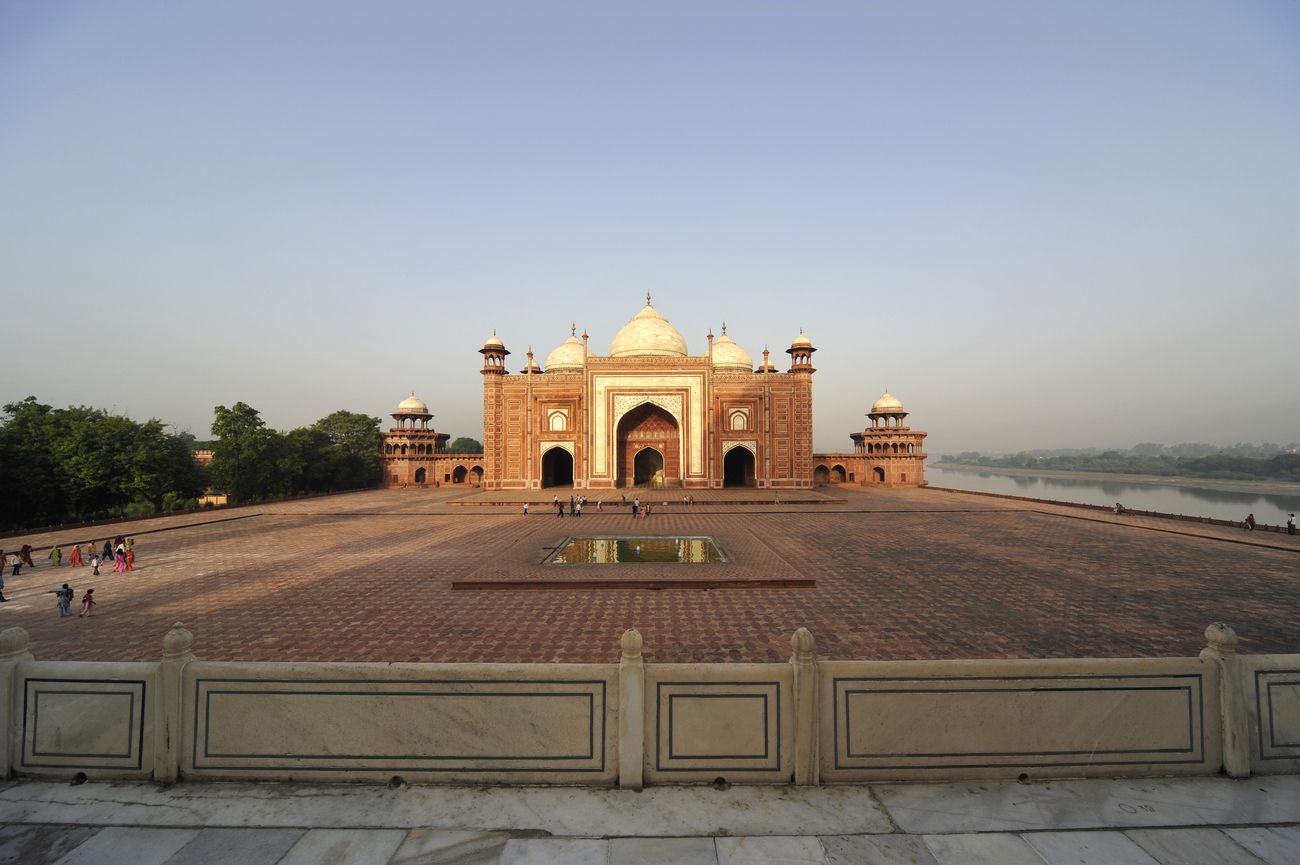
The mosque on the west side of the Taj Mahal showcases alternating red and white façade panels, pietra dura embellishments, and blind arches flanking its grand central pishtaq. © Vitor costa
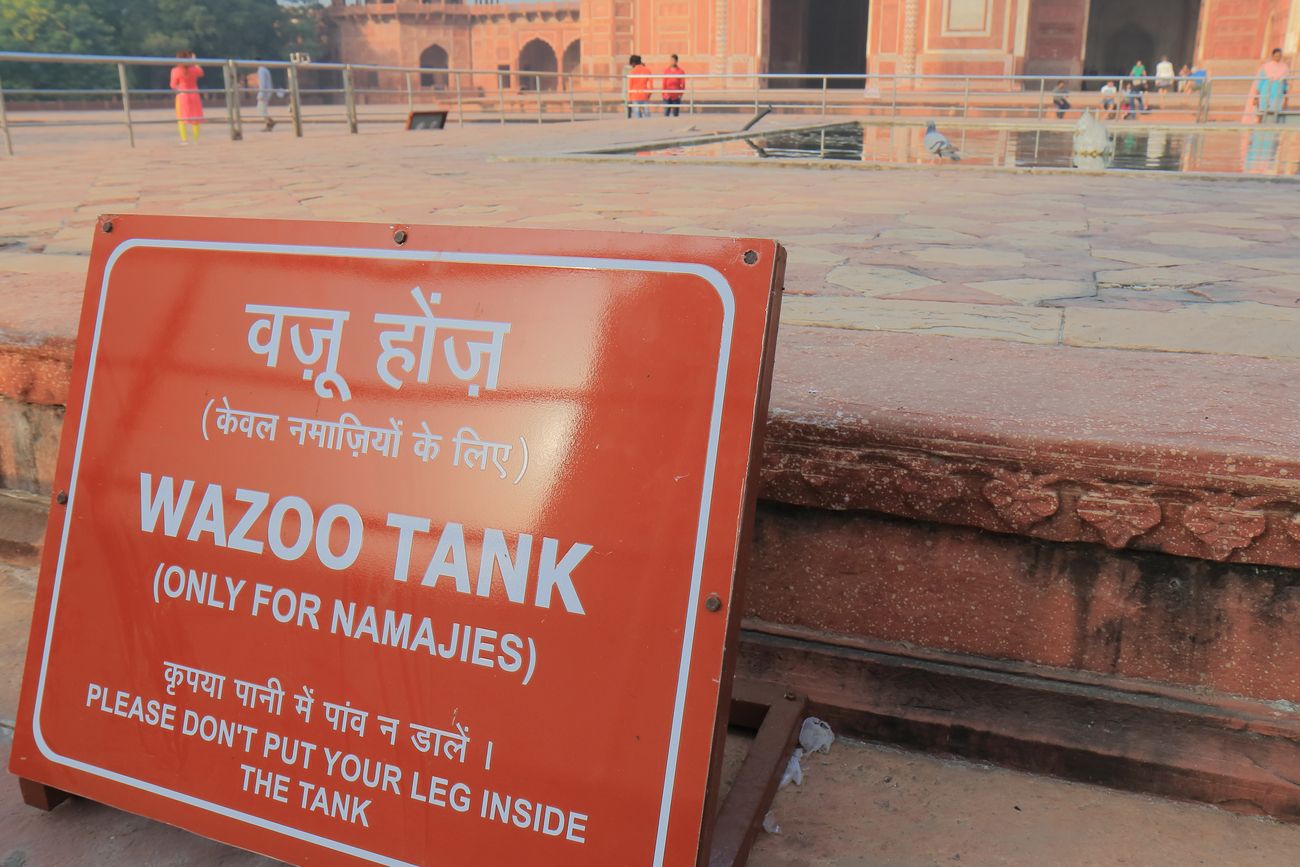
Every mosque has an ablution area; here, a serene water tank stands before the Taj Mahal’s mosque, used by worshippers for ritual cleansing. © TK Kurikawa
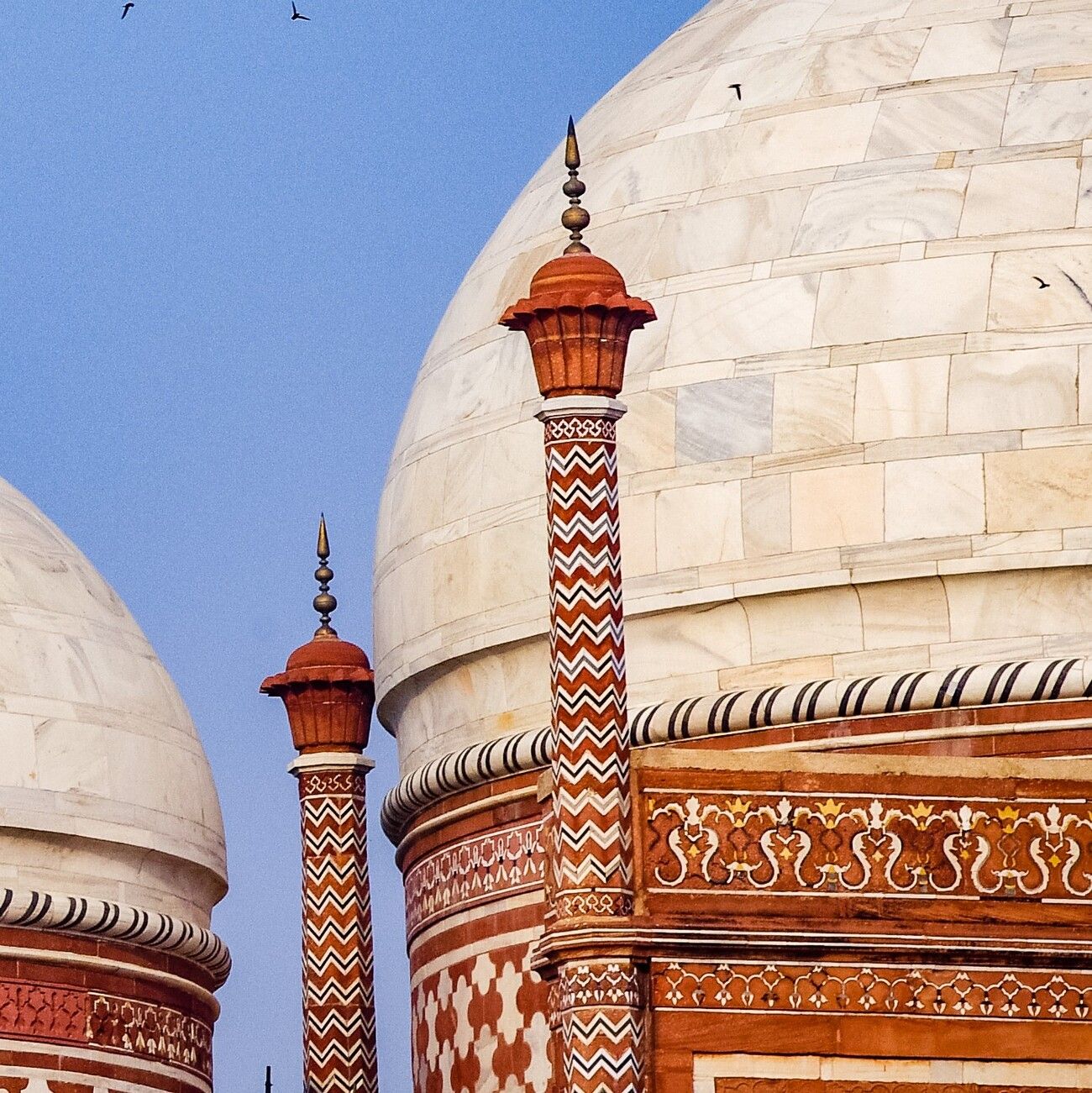
Clever geometric patterns on the pilasters create an optical illusion that makes them appear flat-sided—a testament to Mughal mastery of design.
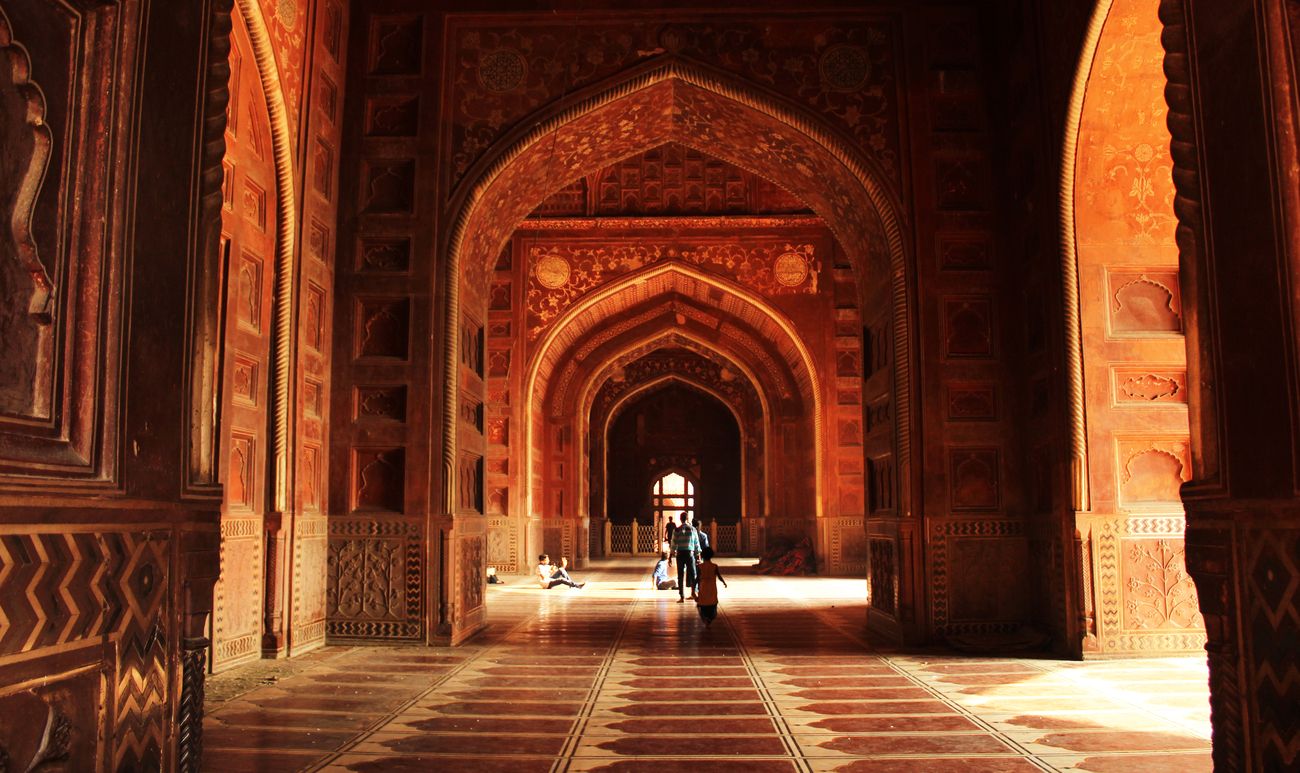
Inside the mosque, the floors resemble rows of prayer mats, while the ceilings bloom with floral sgraffito designs—an elegant fusion of art and spirituality. © Shankhanil Ghosh
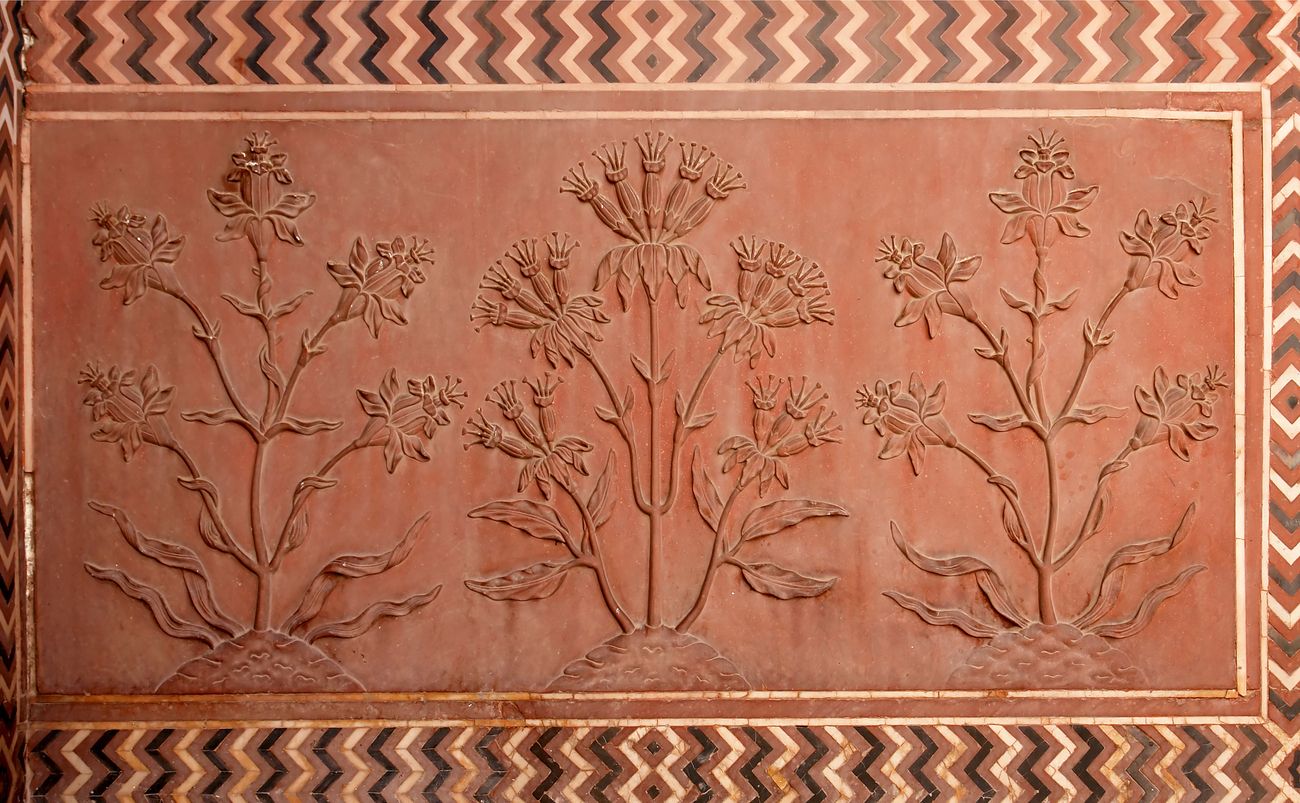
In the mosque’s red sandstone walls, richly carved decorative panels add warmth and intricacy to the architectural harmony. © Carlos Neto
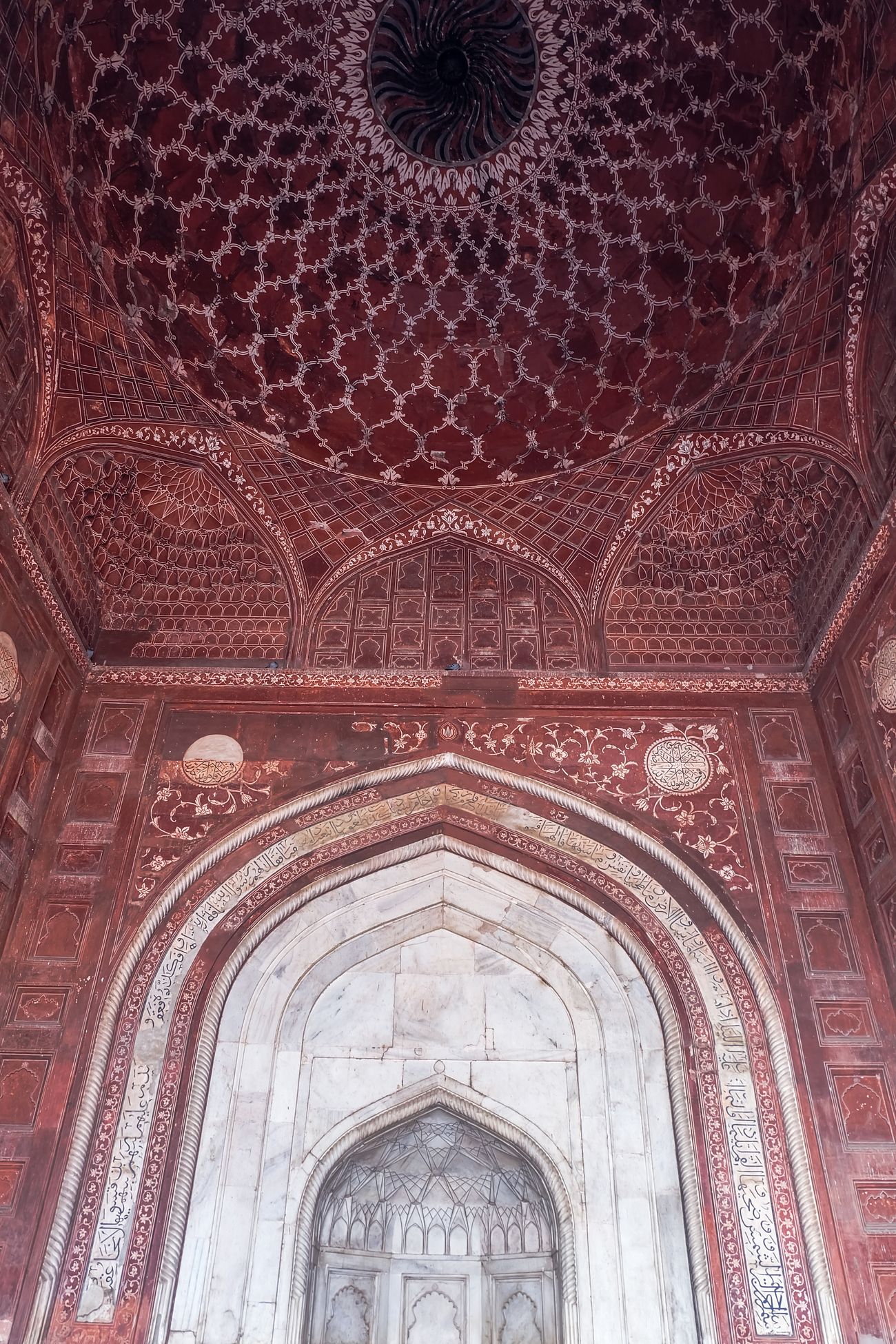
The sun emblem on the mosque ceiling shines above a simple prayer altar—a beautiful blend of cosmic symbolism and devotional space. © Mister_Knight
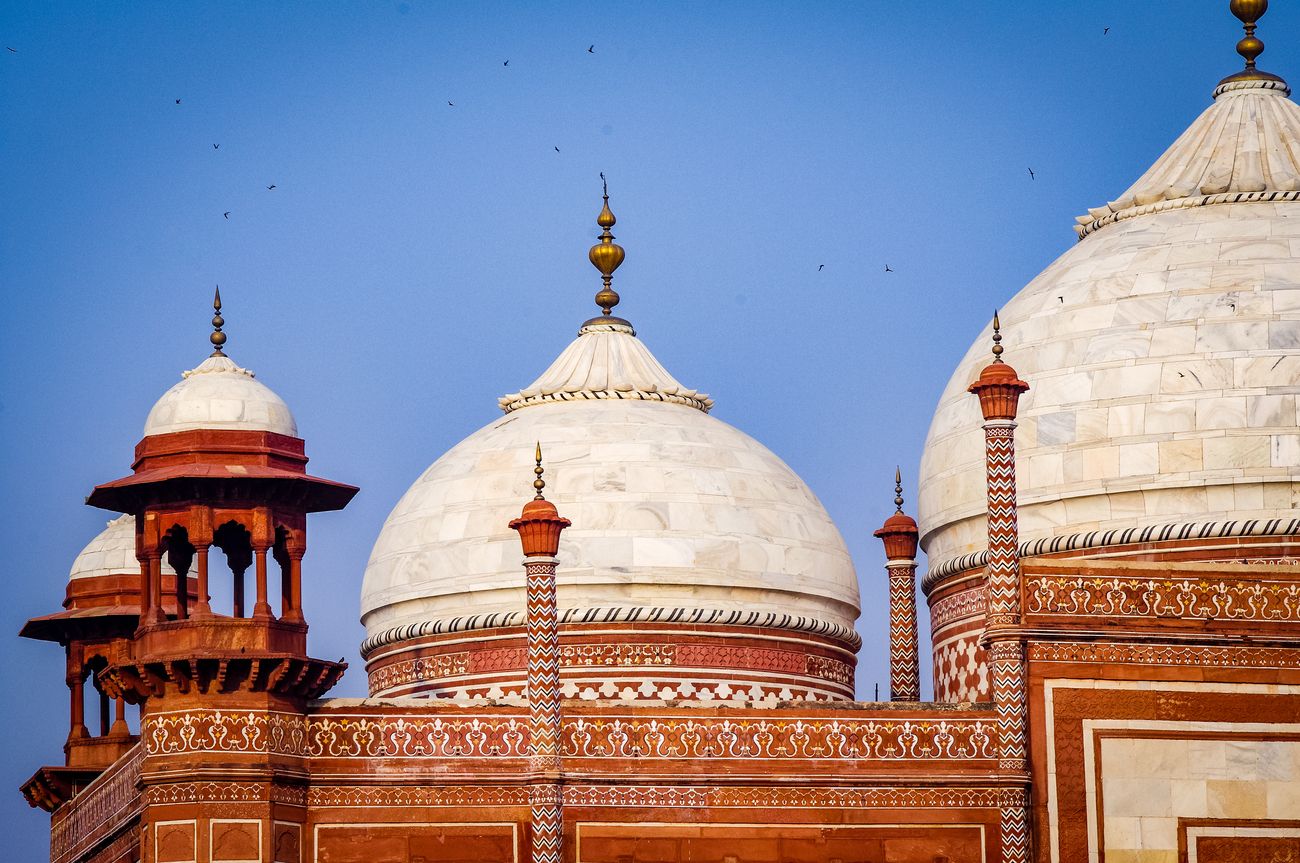
White marble and red sandstone blend seamlessly in the mosque’s architecture, making it one of the most visually striking elements of the Taj Mahal complex. © Craig Hastings
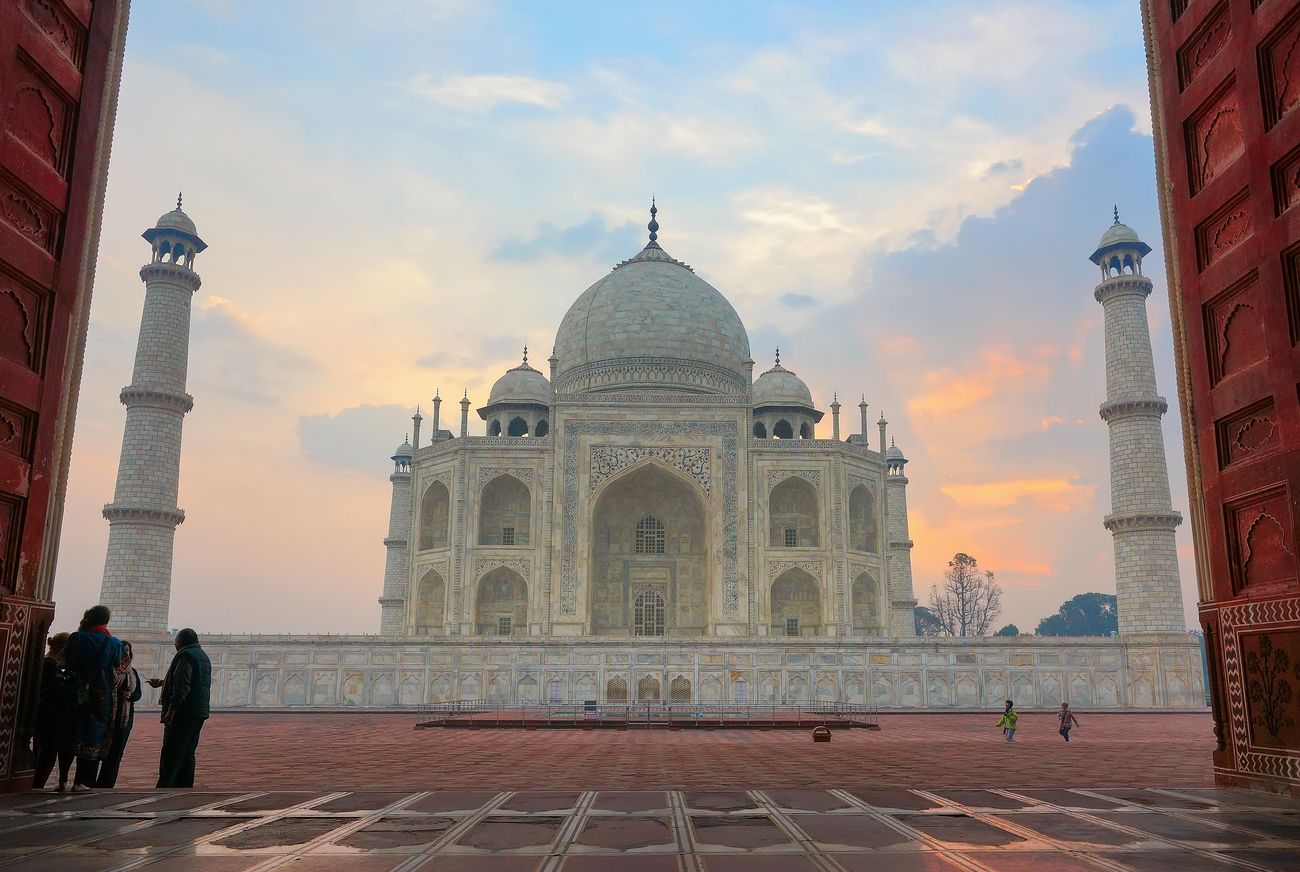
From inside the mosque, the Taj Mahal appears like a framed love poem—Shah Jahan’s marble tribute glowing softly in the distance. © MOROZ NATALIYA
The Mehman Khana (Guest House)
On the right side of the Taj Mahal stands the Mehman Khana, also known as the jawab, meaning “the response.” Its purpose is more than functional—it provides the perfect architectural balance to the mosque (Masjid) on the opposite side, completing the symmetry that defines the entire complex.
Historically, this elegant structure is believed to have accommodated guests during Mumtaz Mahal’s urs, her death anniversary observances. To maintain visual harmony, the Mehman Khana also faces a water feature, mirroring the pool and ablution tank found near the mosque.
Inside, however, the differences become clear. Unlike the Masjid, the Mehman Khana’s floors do not feature the black marble outlines of prayer mats, and there is no mihrab, confirming that it was never intended for worship.
With its serene presence and carefully balanced design, the Mehman Khana stands as a reminder that at the Taj Mahal, every building—functional or symbolic—plays a role in creating perfect symmetry.
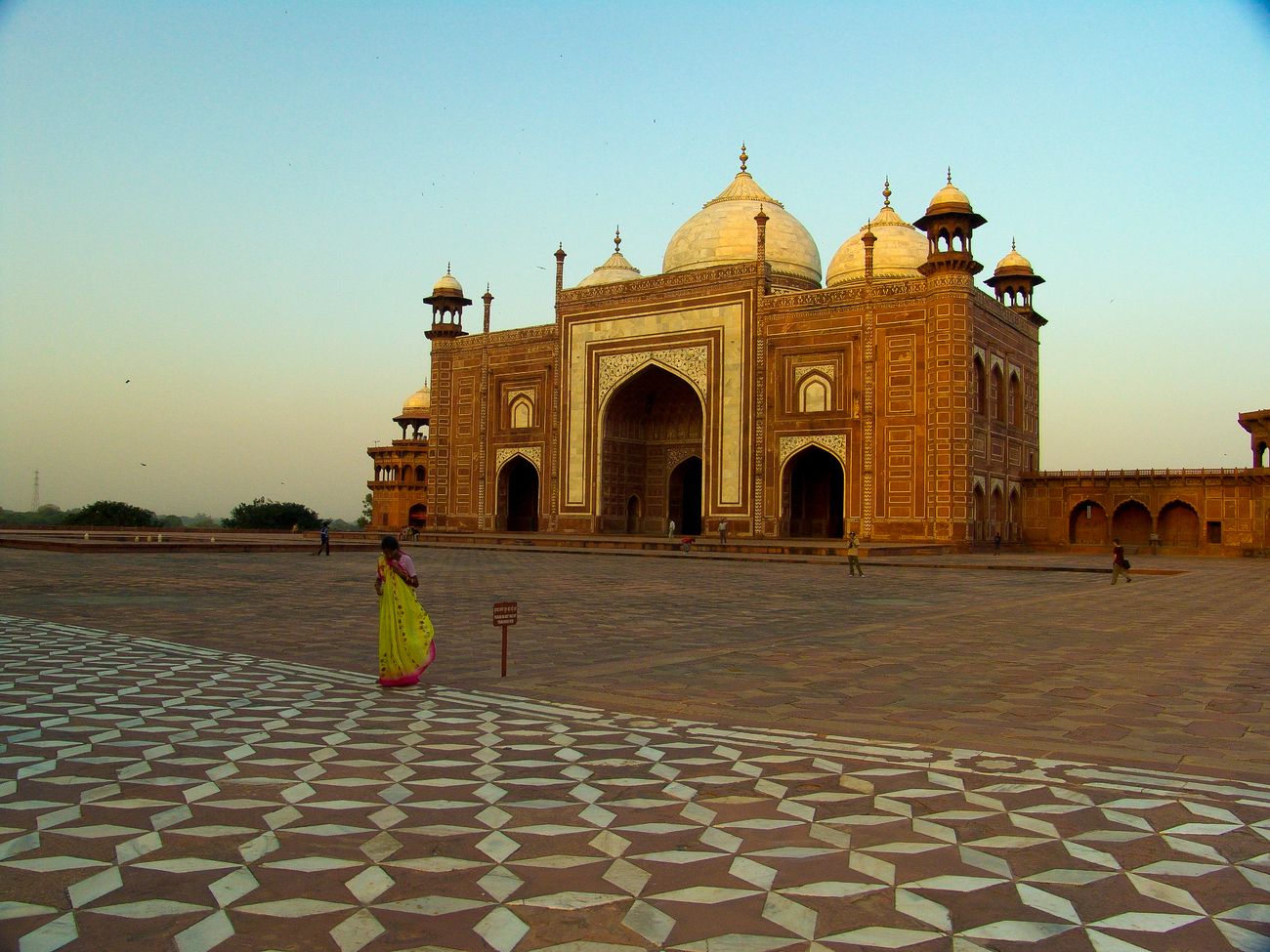
The Mehman Khana (Guest House) and its tranquil pool form a harmonious counterpart to the mosque on the opposite side of the Taj. © Hugo Zavala
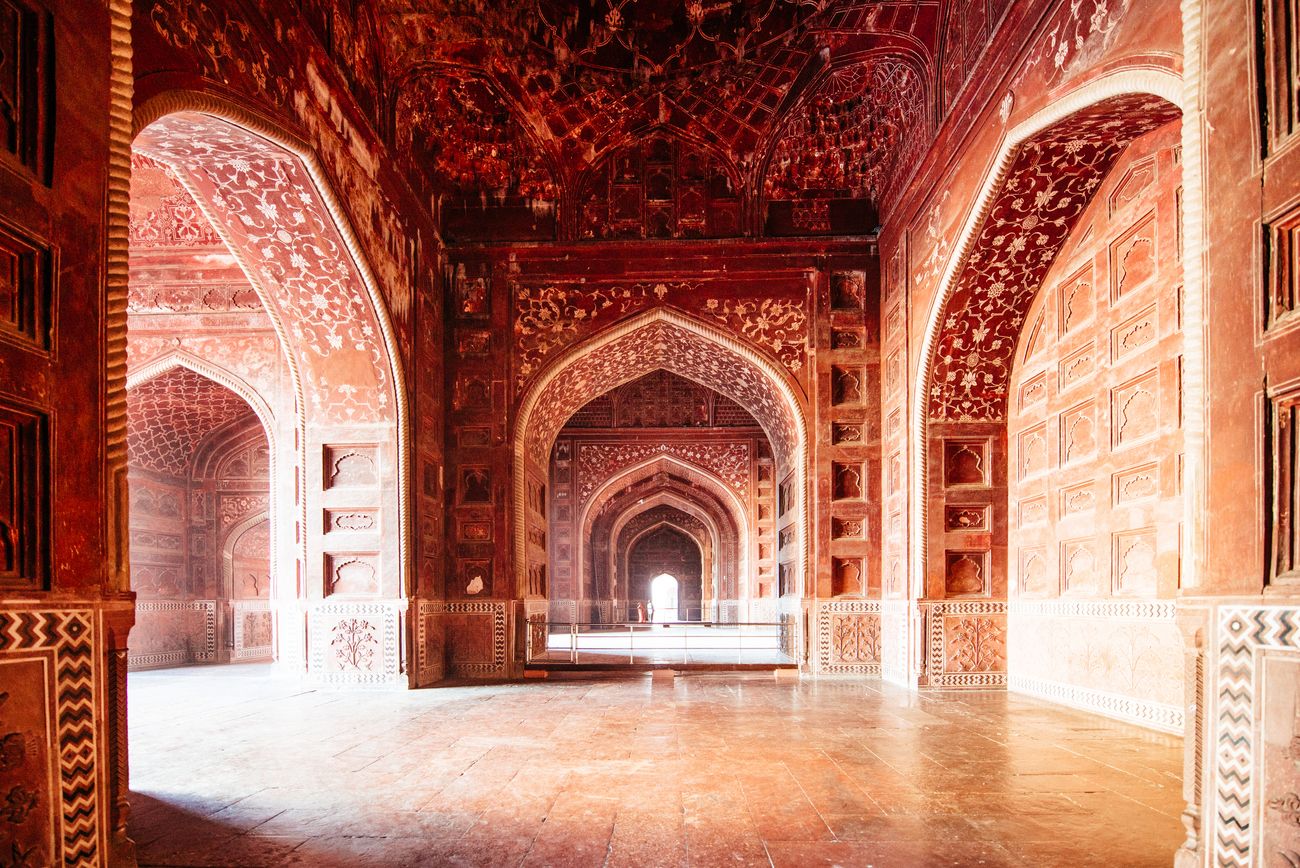
The guest house features beautiful archways that cast elegant shadows—a calming retreat mirroring the grandeur of the main mausoleum. © ferrantraite
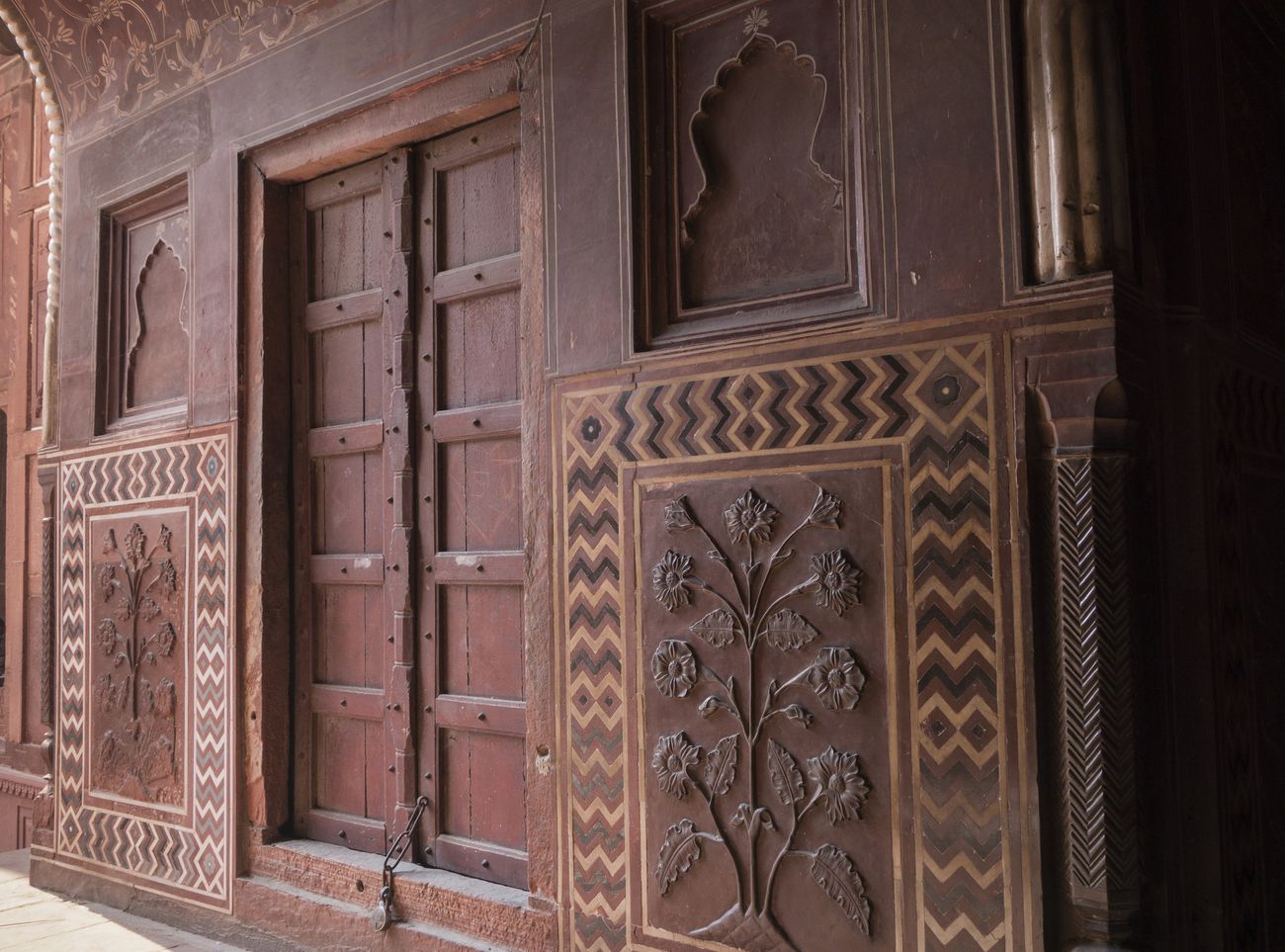
Decorative panels in the guest house echo the motifs of the Taj Mahal, though rendered in warm red sandstone instead of white marble. © jstephenlee
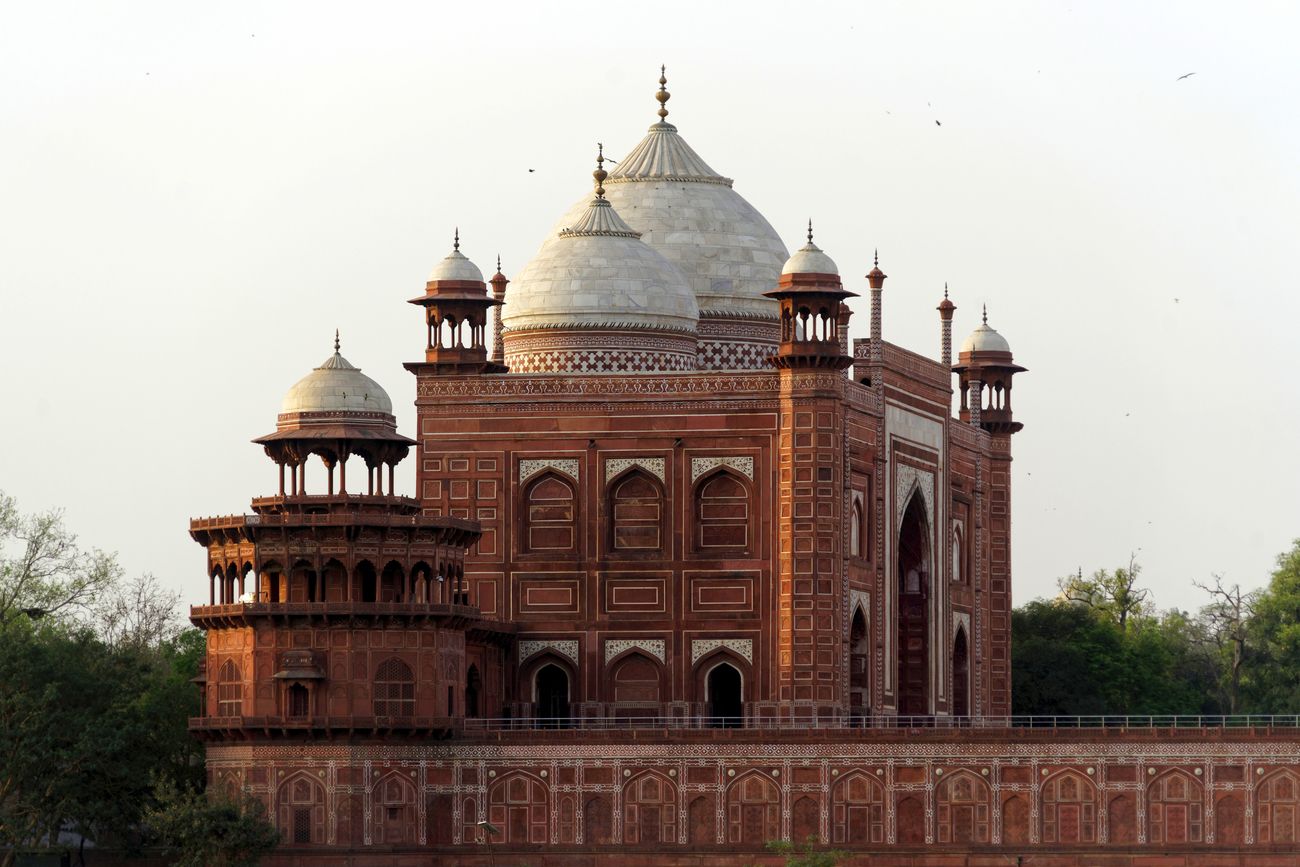
The guest house on the eastern side stands like a silent guardian of the Taj Mahal, seen here from across the Yamuna River. © The Perfect
The Outline of the Finial
Just beside the entrance to the Mehman Khana stands a fascinating replica of the Taj Mahal’s brass finial—the crown-like ornament that tops the main dome. Stretching an impressive 31 feet in length, this model allows visitors to appreciate the scale and craftsmanship of the original up close. Its finely engraved details are carved into black stone, offering a striking contrast and giving viewers a rare glimpse into the monument’s architectural artistry.
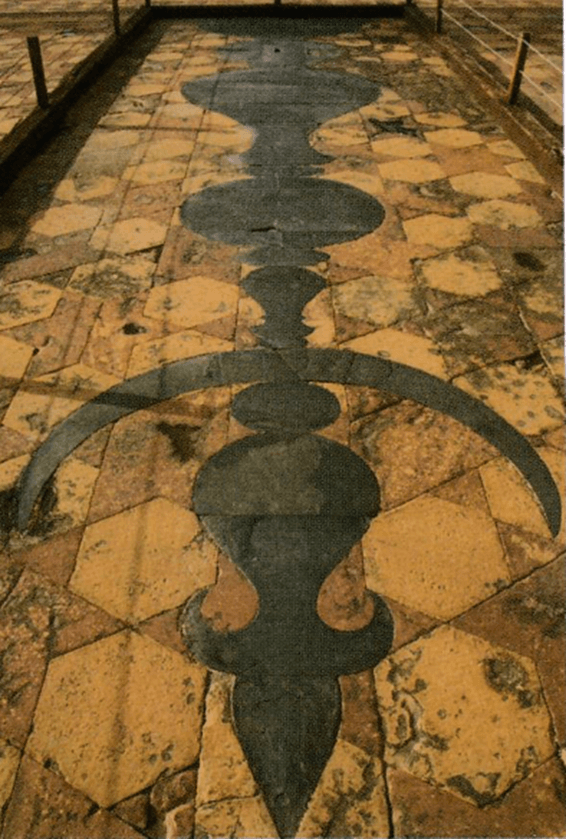
A detailed black stone replica of the Taj Mahal’s finial showcases the craftsmanship behind this iconic architectural element.
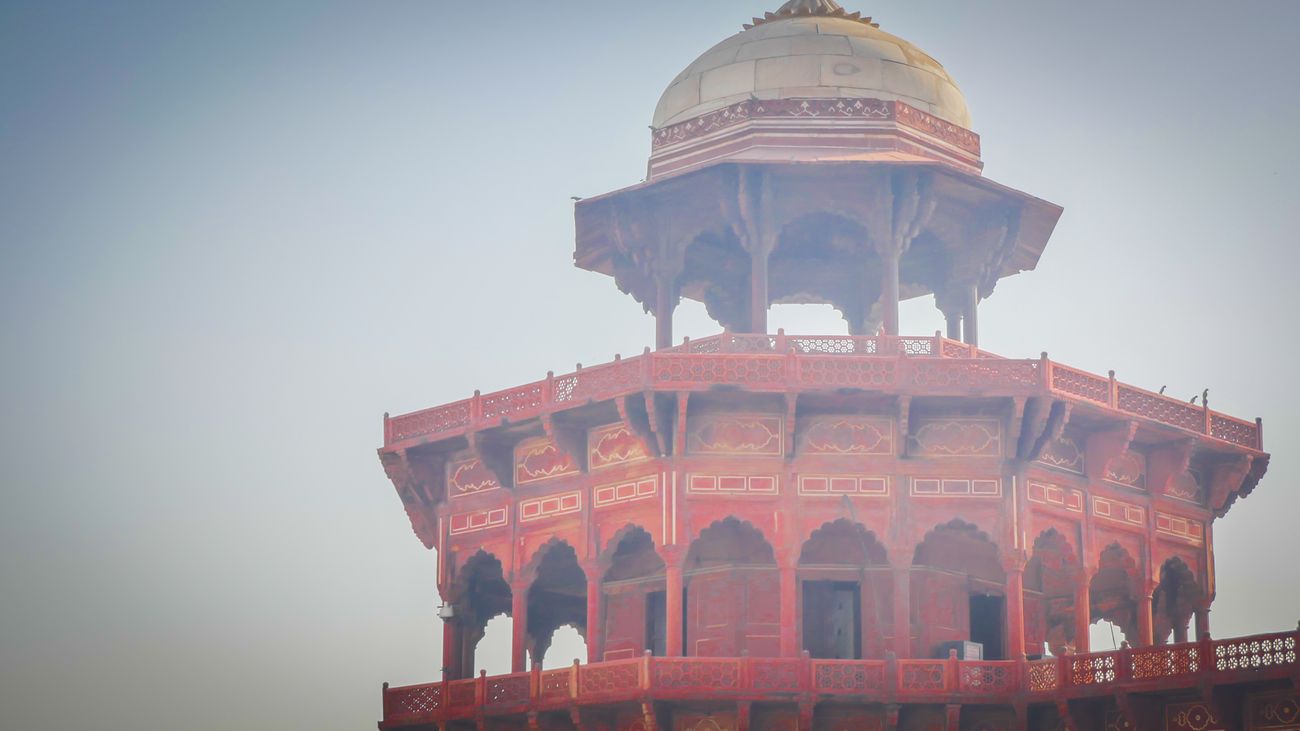
Each corner of the Taj Mahal’s massive base features an octagonal tower pavilion, adding symmetry and depth to the complex. © Vivvi Smak
⭐ Tourist Information: Visiting the Taj Mahal
✈ Travel by Air
International travelers usually fly into New Delhi, the closest major airport to Agra.
Agra also has its own airport, offering direct flights from Bangalore, Mumbai, and Varanasi, making travel convenient for domestic visitors.
🚆 Travel by Rail
Agra is well-connected by train to most major cities in India. Popular daily trains between New Delhi and Agra include:
• Shatabdi Express
• Gatiman Express
• Taj Express
These fast, comfortable options make Agra an easy day trip or weekend getaway.
🚗 Travel by Road
You can also reach Agra by car:
• From Delhi – 140 miles
• From Jaipur – 165 miles
Modern highways make the journey smooth and scenic.
🕌 Travel Within Agra
To reach the Taj Mahal, hire an auto-rickshaw, taxi, or take a local bus. All are easily available throughout the city.
🎟 Entry Fees & Visitor Information
• Opening Hours: Sunrise to sunset (closed on Fridays).
• Best Time to Visit: October to March, when the weather is pleasant.
• Entry Fees:
-
-
Indian & SAARC citizens: ₹40
-
Foreign visitors: ₹1300
-
Children below 15 years: Free
-
🌕 Night Viewing
A magical experience!
Night visits are allowed on:
• Full moon night
• Two nights before and two nights after the full moon
(Except during the month of Ramzan)
🧭 Recommended Taj Mahal Tours
Enhance your journey with curated experiences:
• Golden Triangle Tour – India
• Cultural Heritage Tour of North India
🎒 What to Bring
✔ Sunblock
✔ Drinking water
✔ Torch/flashlight
✔ Guidebooks / maps
✔ Mosquito repellent
✔ Loose change
Clothing Tips:
• Wear light cottons in summer.
• Switch to warm woolens in winter.
• Don’t forget a hat, umbrella/raincoat, and easy-to-remove footwear—especially useful for entering certain monuments.
Some Useful Information about Visiting the Taj Mahal Illustrated Through Images
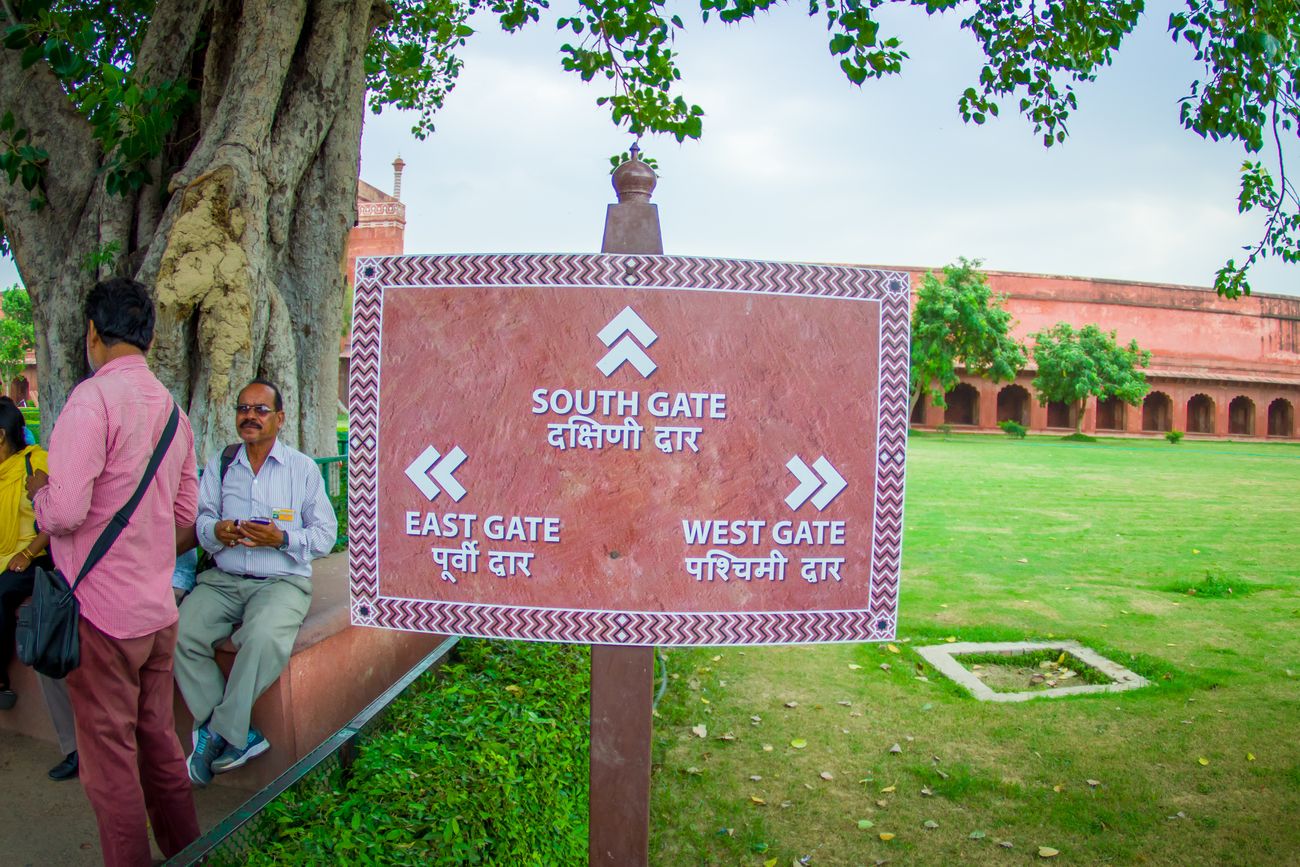
Informational signage near the Darwaza-i-Rauza helps visitors understand the garden’s layout and history. © Pablo Hidalgo
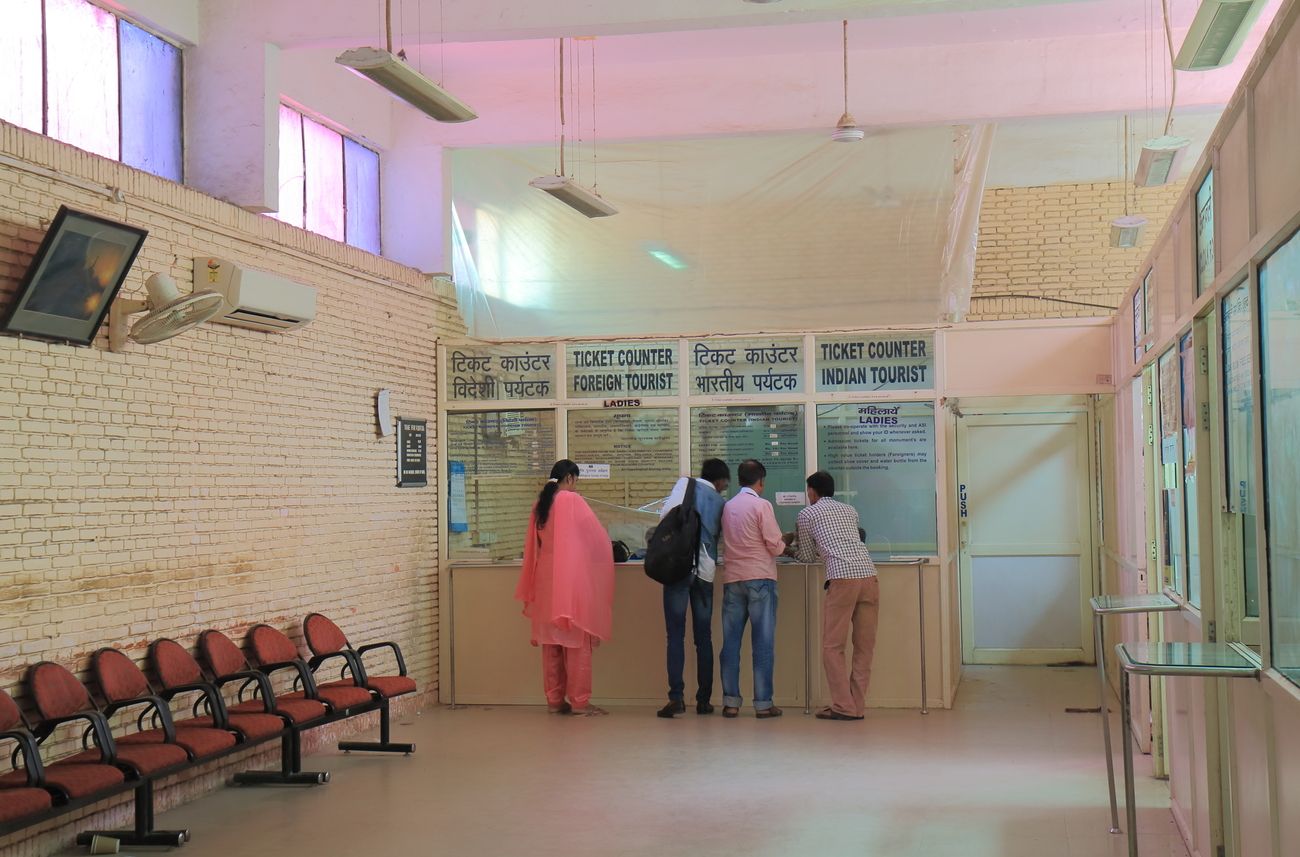
The East Gate ticket counter serves both local and foreign visitors, conveniently located near the main parking area. © TK Kurikawa
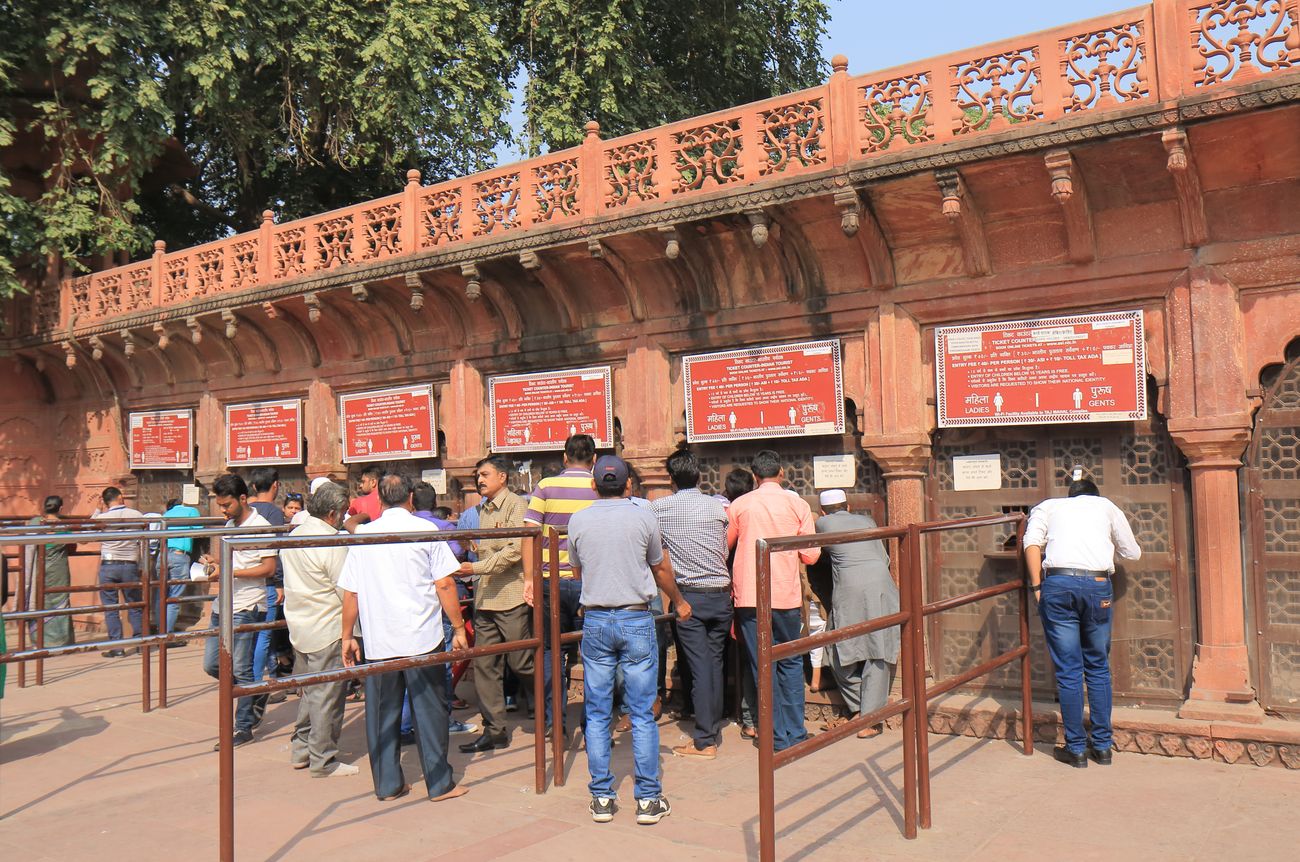
Multiple ticket counters line the West Gate, though visitors can now also book Taj Mahal tickets online. © TK Kurikawa

A clear signboard lists items prohibited inside the Taj Mahal complex. Mobile phones are allowed free of charge, though video cameras require a ticket. © TK Kurikawa

Eco-Friendly Rickshaws Near the Taj Mahal: Battery-driven rickshaws line up near the Taj Mahal’s parking area, ready to ferry visitors to the monument in quiet, pollution-free comfort. Because no diesel or petrol vehicles are allowed within 1 km (0.6 miles) of the Taj, the parking zone sits a kilometer away from the entry gate. From here, visitors can hop onto free government-run golf carts or enjoy a short, pleasant walk to the world-famous mausoleum. © Agus.d.wahyudi
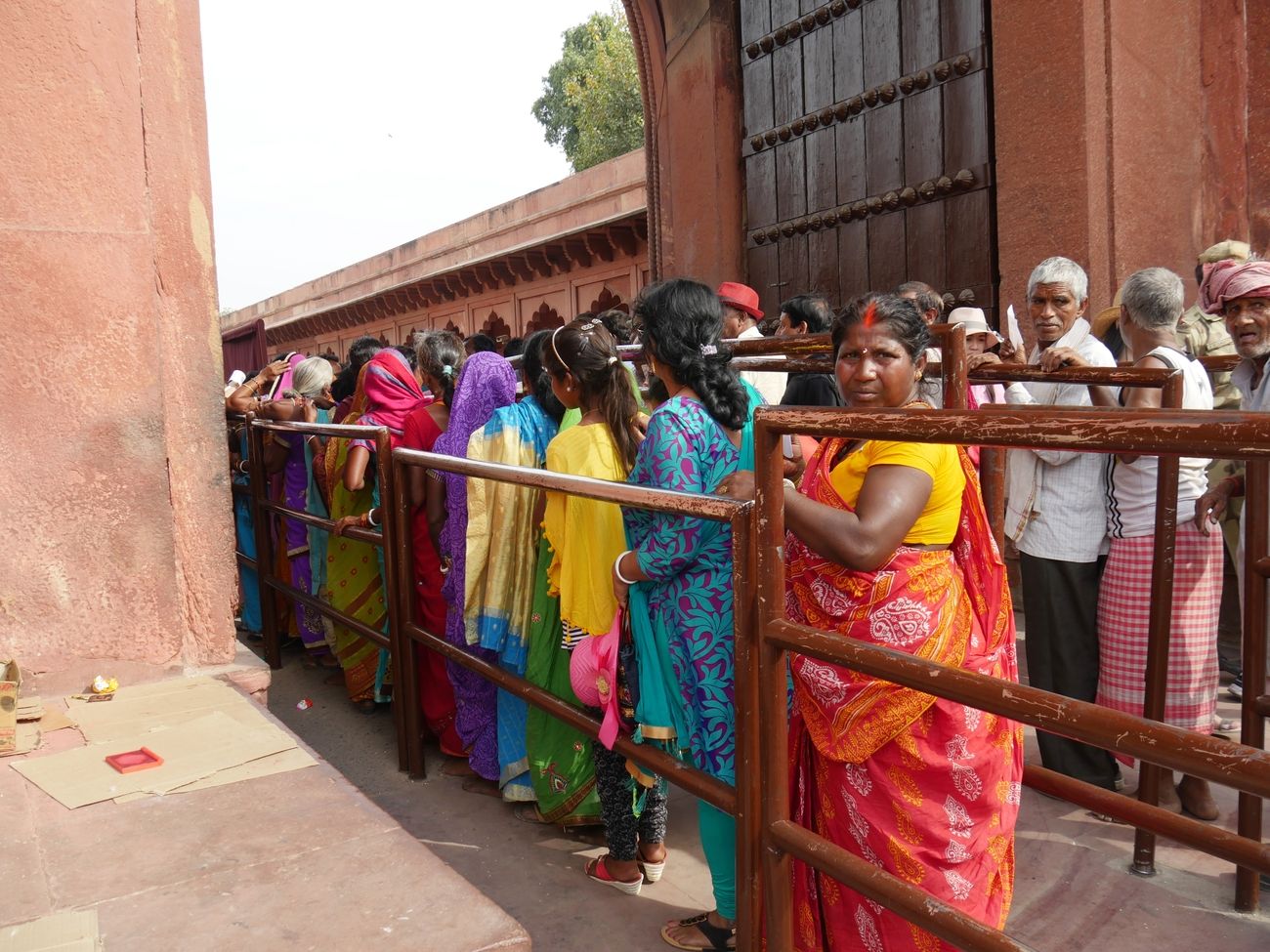
Long lines of visitors often form at the entrance, with separate—and usually shorter—queues reserved for foreign tourists. © RaksyBH

Foreign visitors receive free disposable shoe covers with their ticket—perfect for entering the mausoleum without removing footwear. © Neja Hrovat
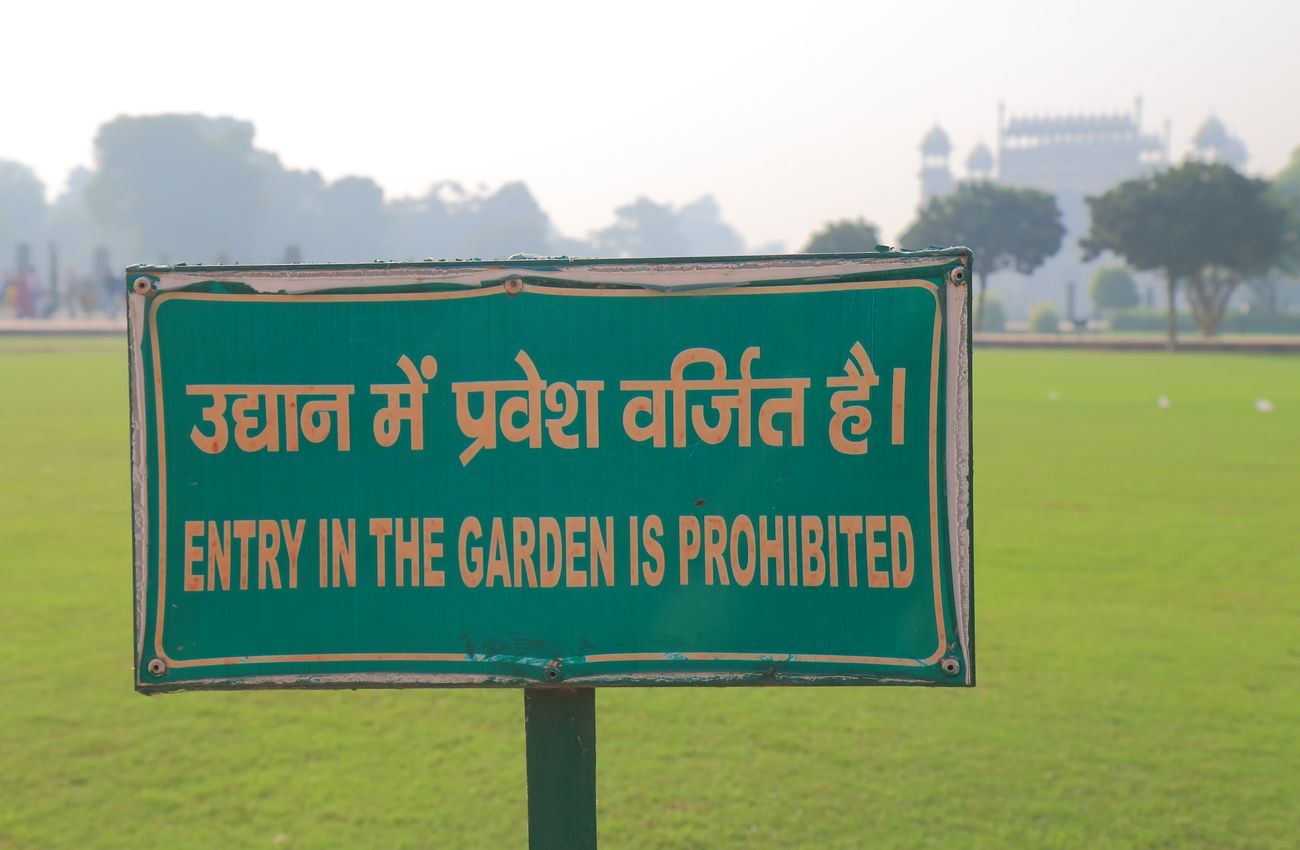
A sign marks restricted-access garden areas within the Taj Mahal complex, helping protect the delicate landscaping. © TK Kurikawa
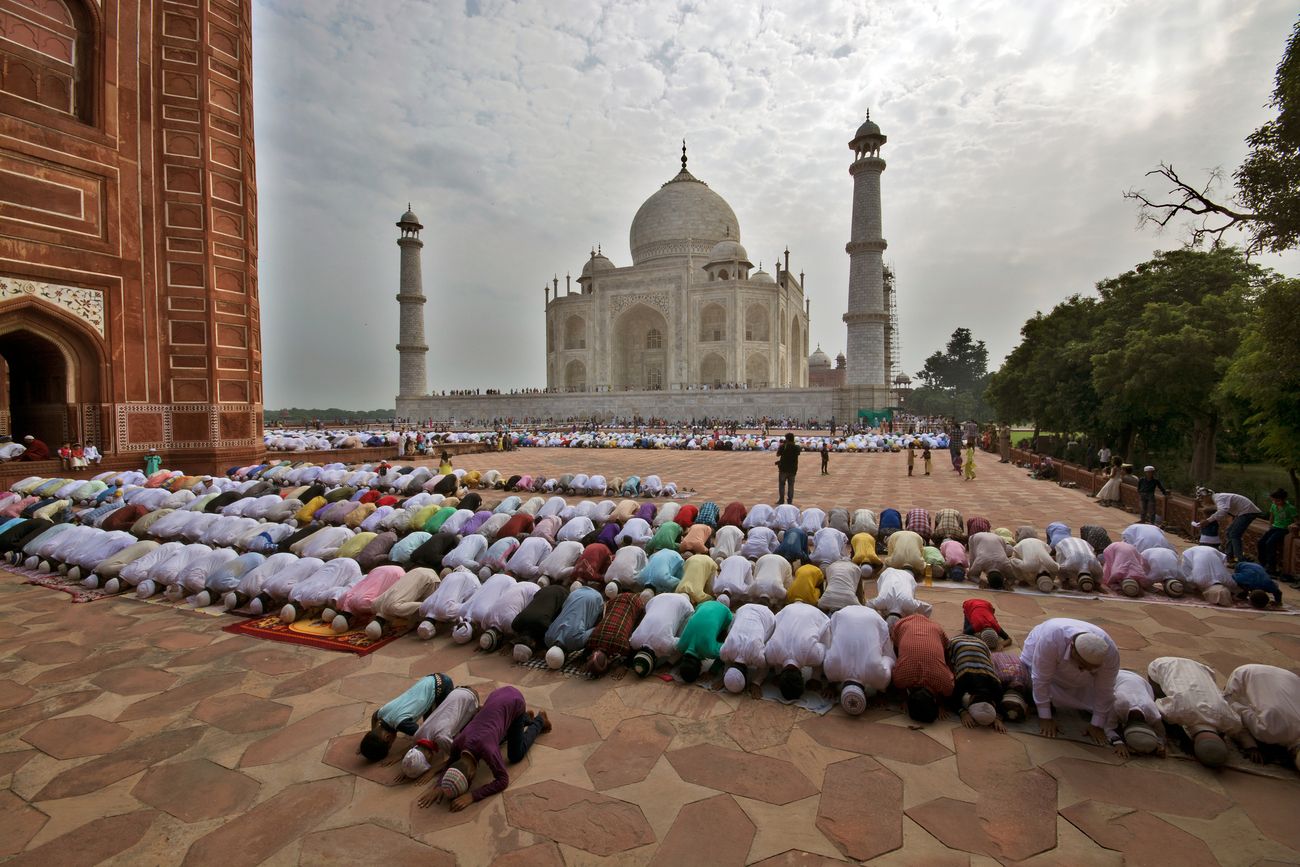
On Fridays, the Taj Mahal closes to tourists as local Muslims gather for prayers in the mosque. Devotees fill the complex during the holy Eid festival. © Somnath Chatterjee
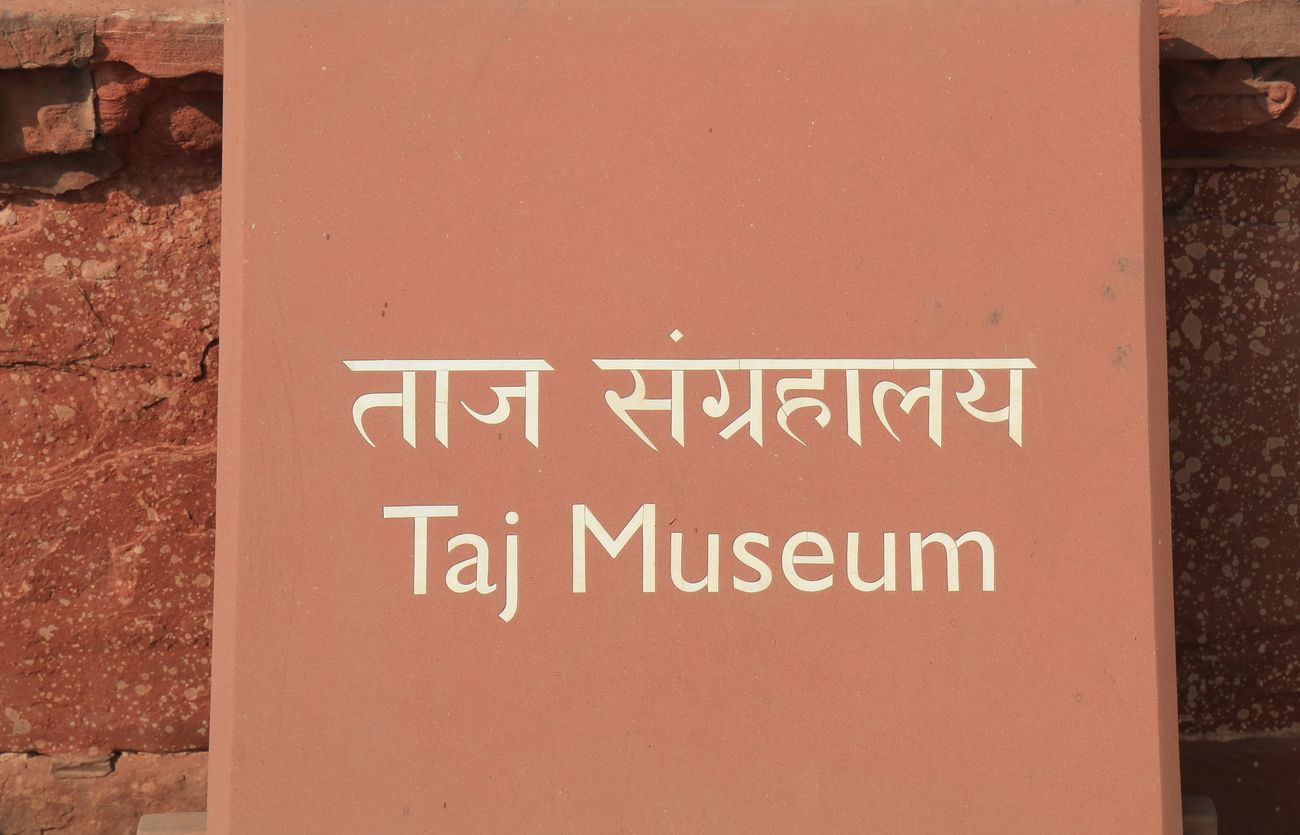
A sign marks the Taj Museum—often overlooked, yet home to rare Mughal manuscripts, miniatures, weapons, and royal decrees. © TK Kurikawa
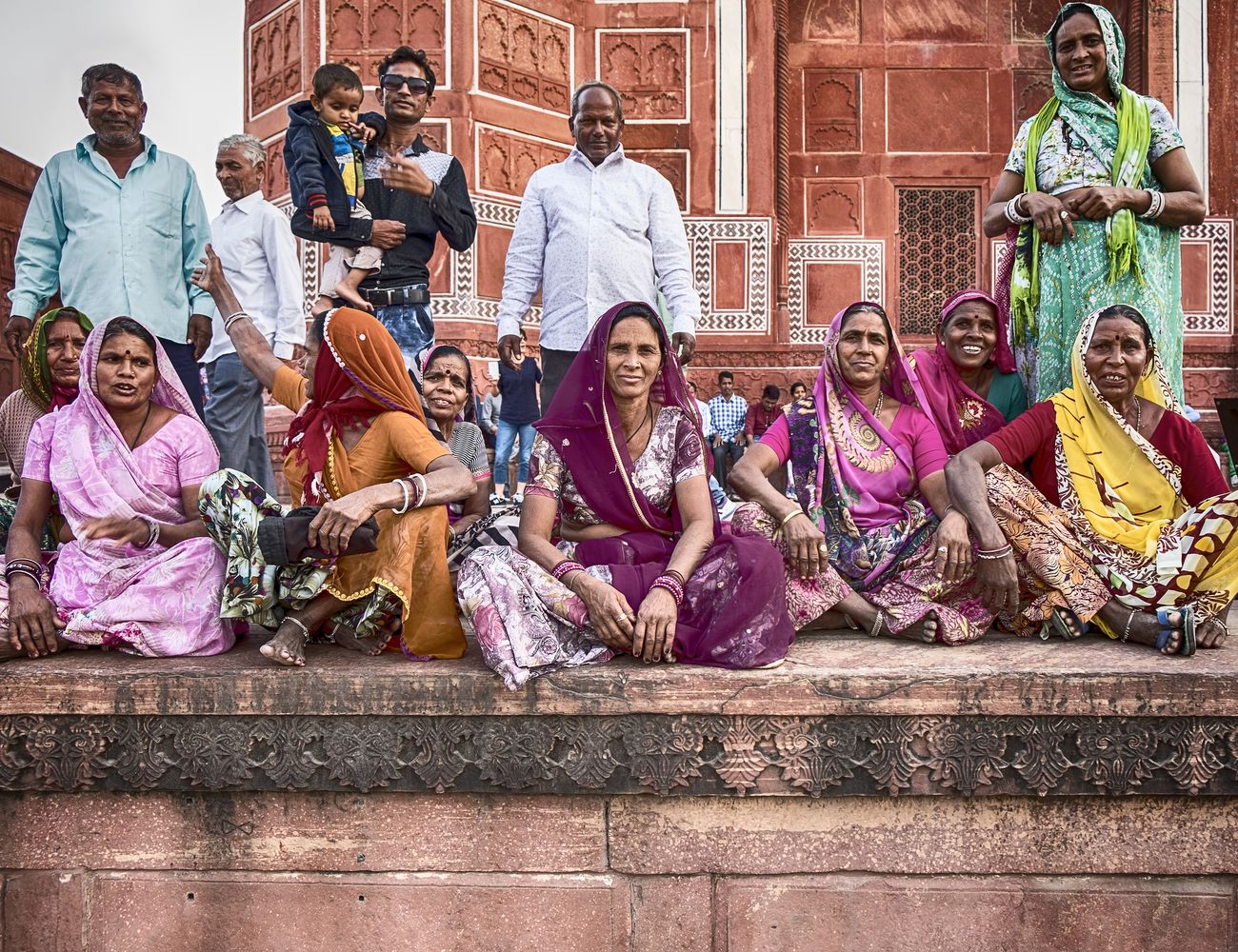
A cheerful group of local visitors poses with a foreign tourist at the Grand Gate—proof that the Taj inspires joy and connection across cultures. © Matt Ragen

A foreign tourist proudly shares her Taj Mahal photos with an Indian family, creating a heartwarming moment of cultural exchange. © Travelview
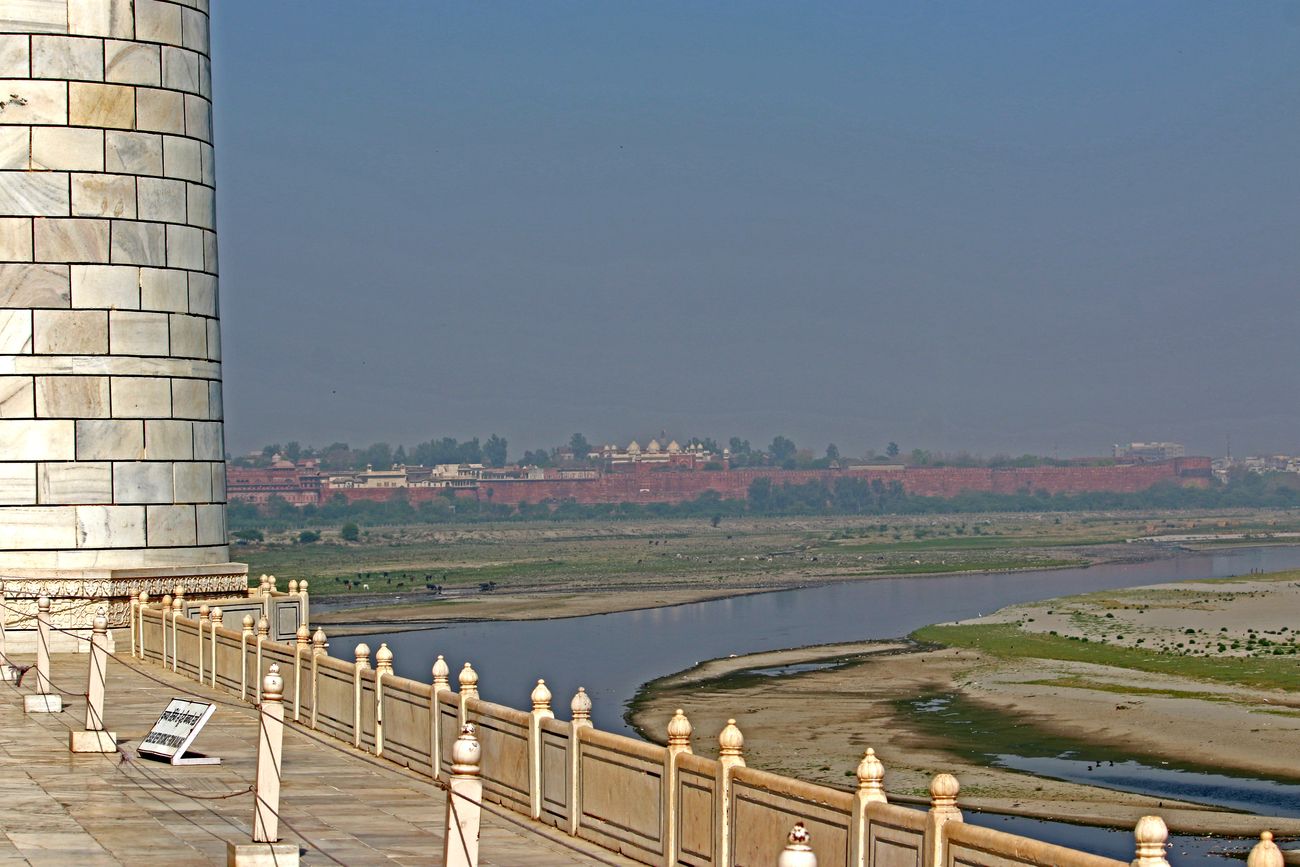
From the Taj’s platform, visitors enjoy a sweeping view of the Red Fort and the flowing Yamuna River—two silent witnesses of Mughal history. © SARIN KUNTHONG
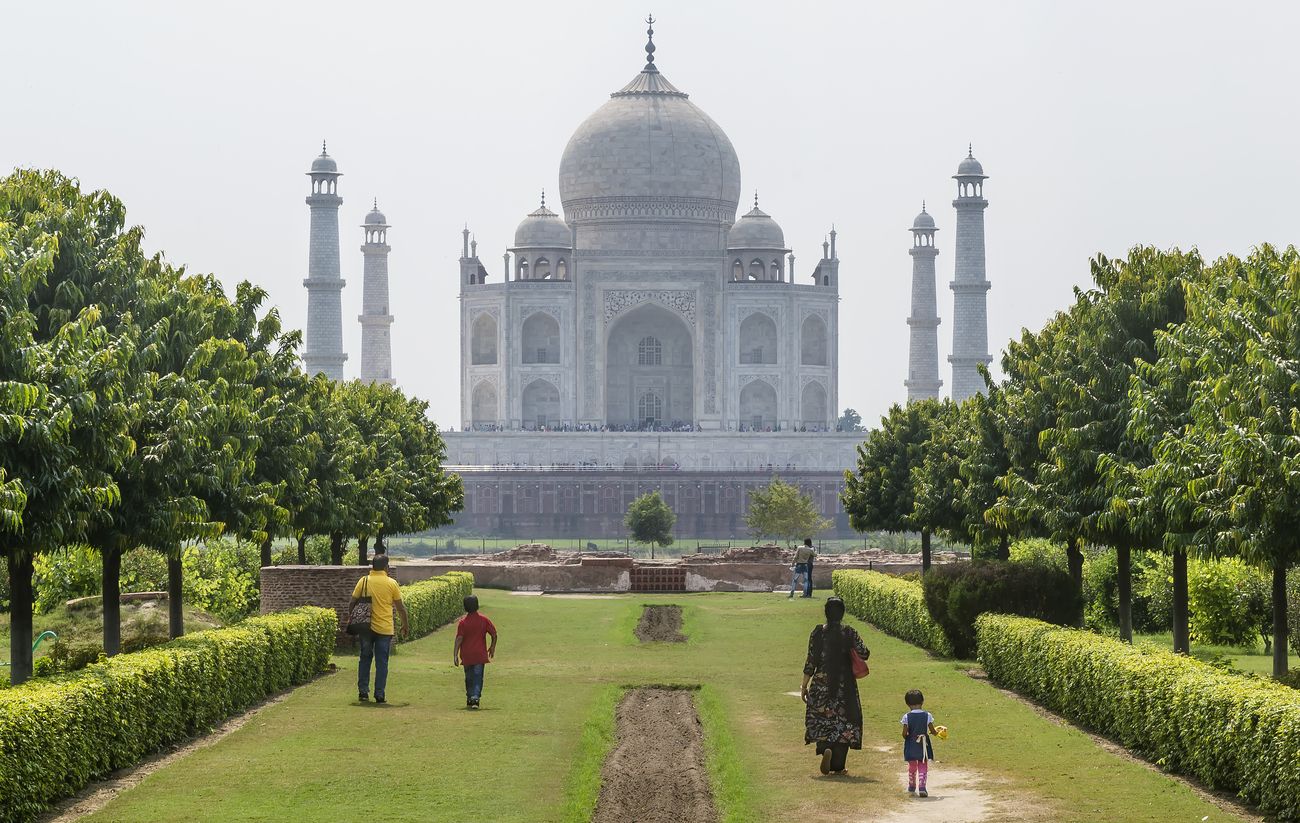
Sunset Views from Mehtab Bagh Across the Yamuna: Some of the most breathtaking views of the Taj Mahal come from across the Yamuna River at Mehtab Bagh, a serene 25-acre Mughal garden perfectly aligned with the Taj’s own Charbagh layout. Especially at sunset, the monument glows in soft gold, mirrored beautifully in this riverside garden. Entry costs 250 rupees for foreigners and 20 rupees for locals, and the garden remains open until sunset—an unforgettable vantage point for photographers and romantics alike.
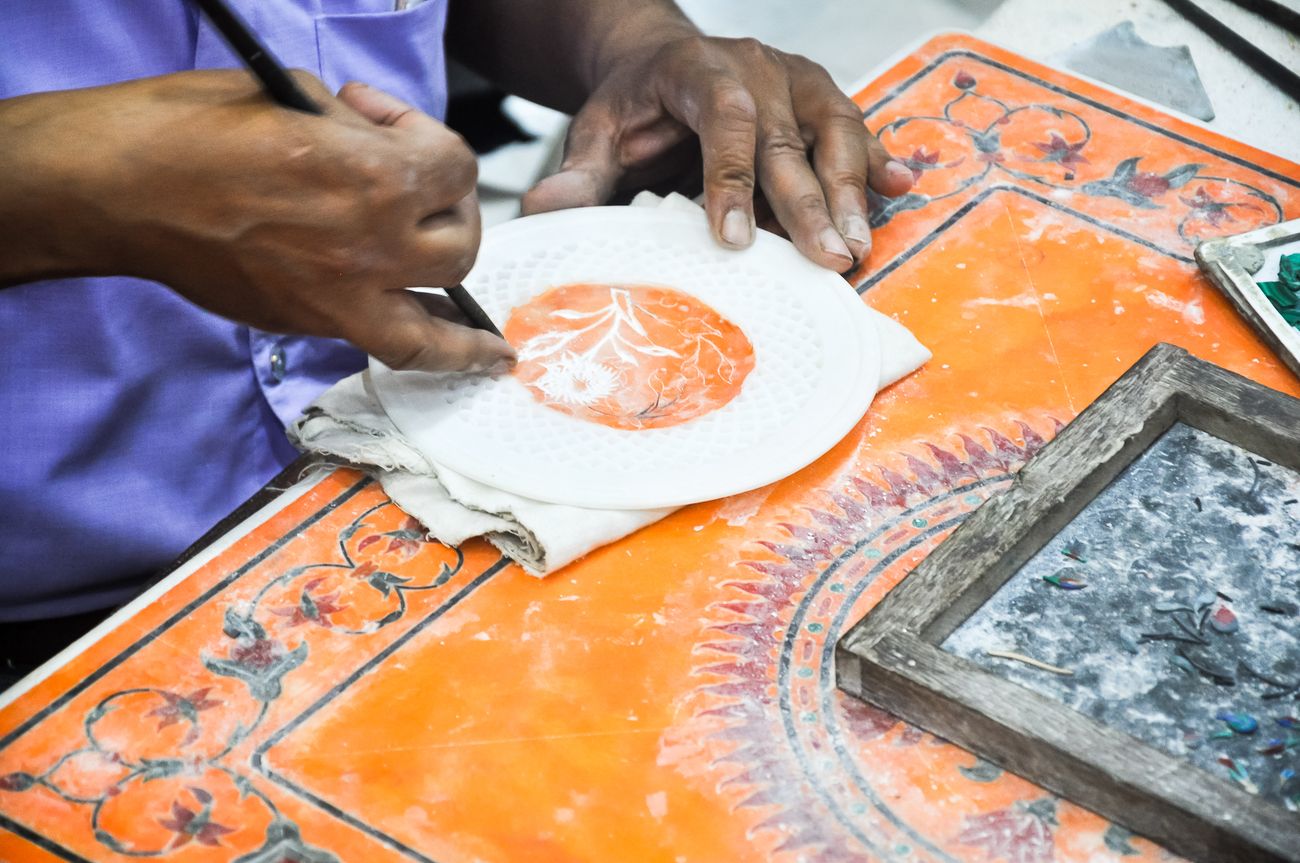
Master Craftsman Working on Marble Inlay: A skilled stonemason in Agra leans carefully over a delicate piece of marble inlay, practicing an art that dates back to the Taj Mahal’s original construction. This centuries-old craft—pietra dura—has been handed down through generations, transforming marble into stunning works of art. Today, the same meticulous technique is used to create marble coasters, tabletops, vases, elephants, and other souvenirs cherished by visitors from around the world. © Mateusz Sommer
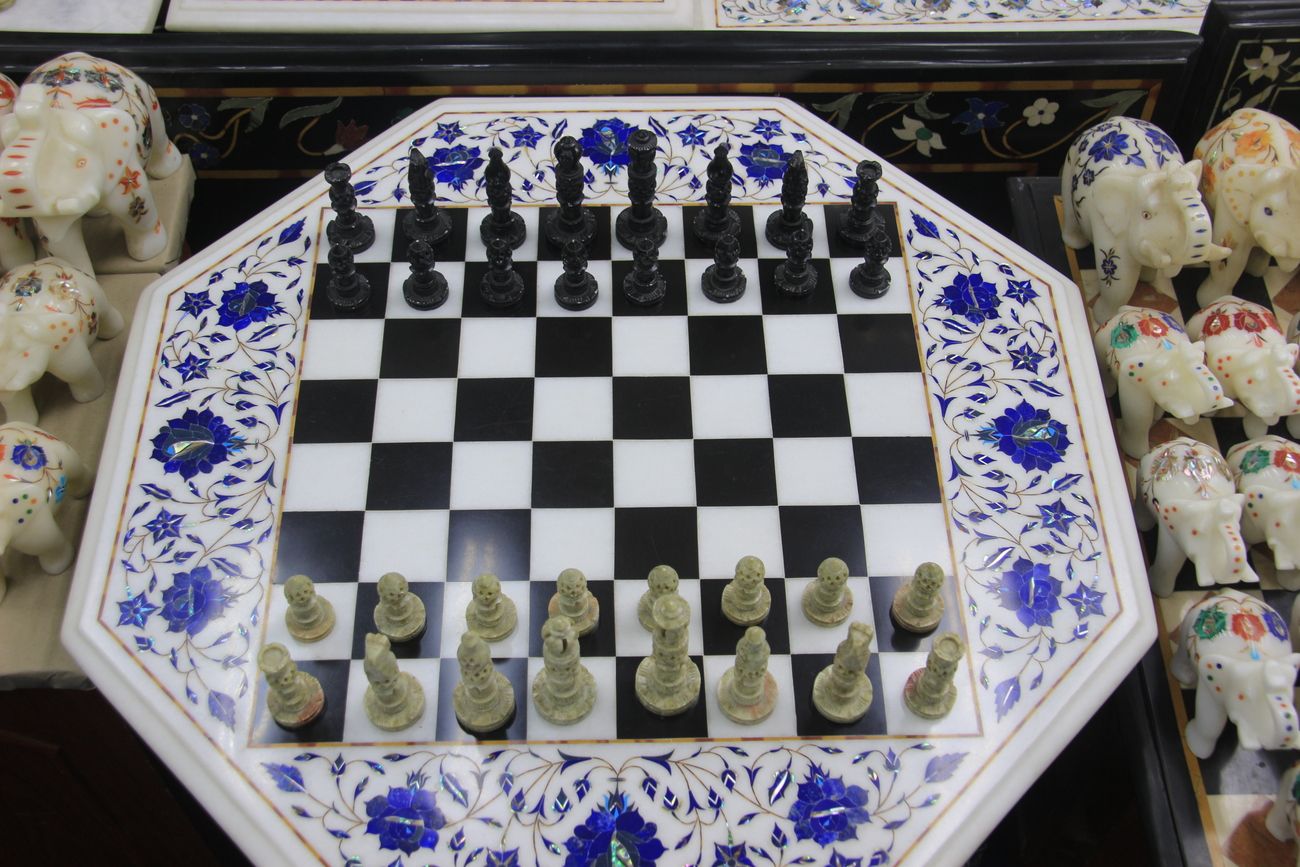
Marble tabletops, coasters, elephants, and chess sets adorned with semi-precious stones gleam in shops near the Taj Mahal—modern echoes of ancient artistry. © YUSHI
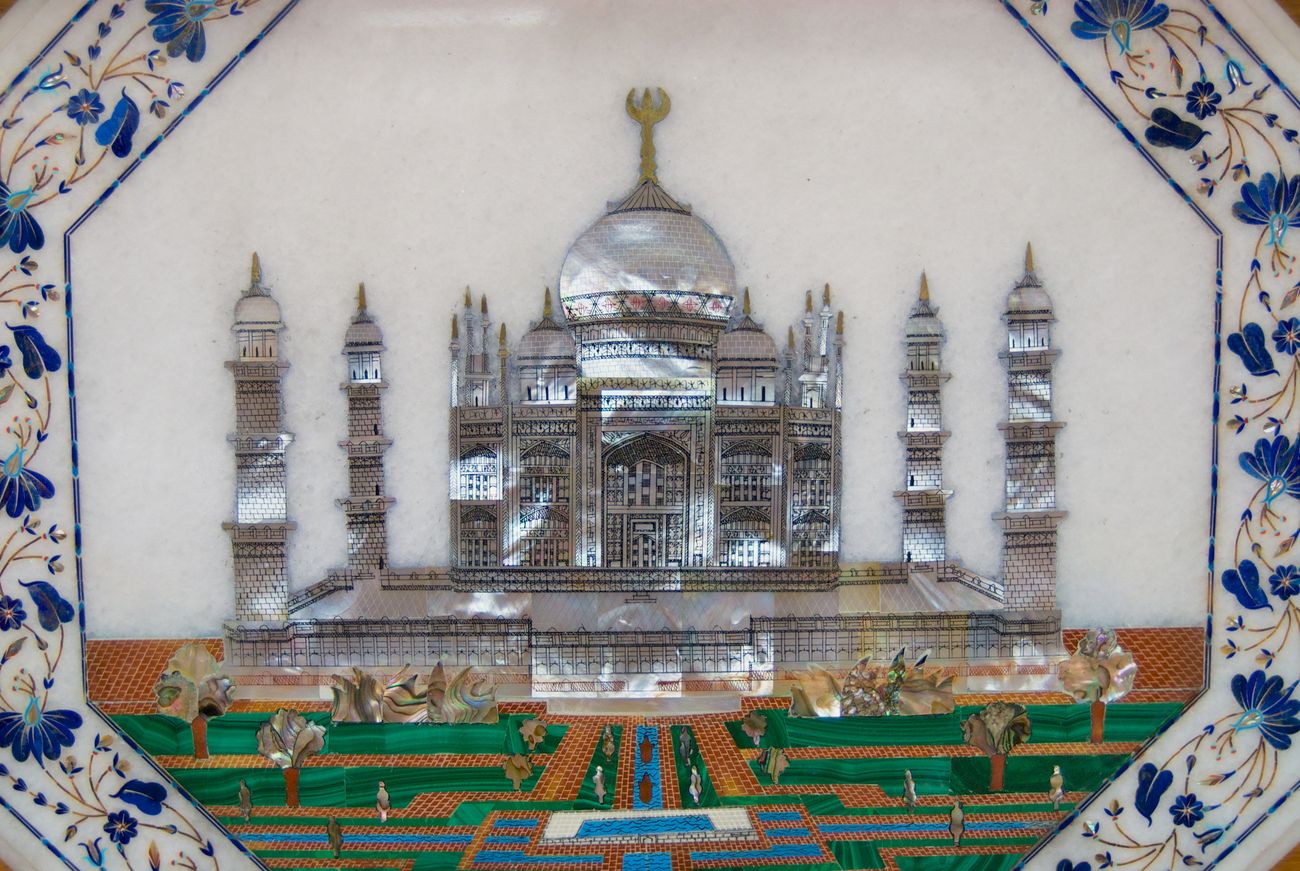
A stunning marble tabletop glitters with mother-of-pearl, malachite, and lapis lazuli—each stone carefully inlaid following age-old Mughal techniques. ©YUSHI
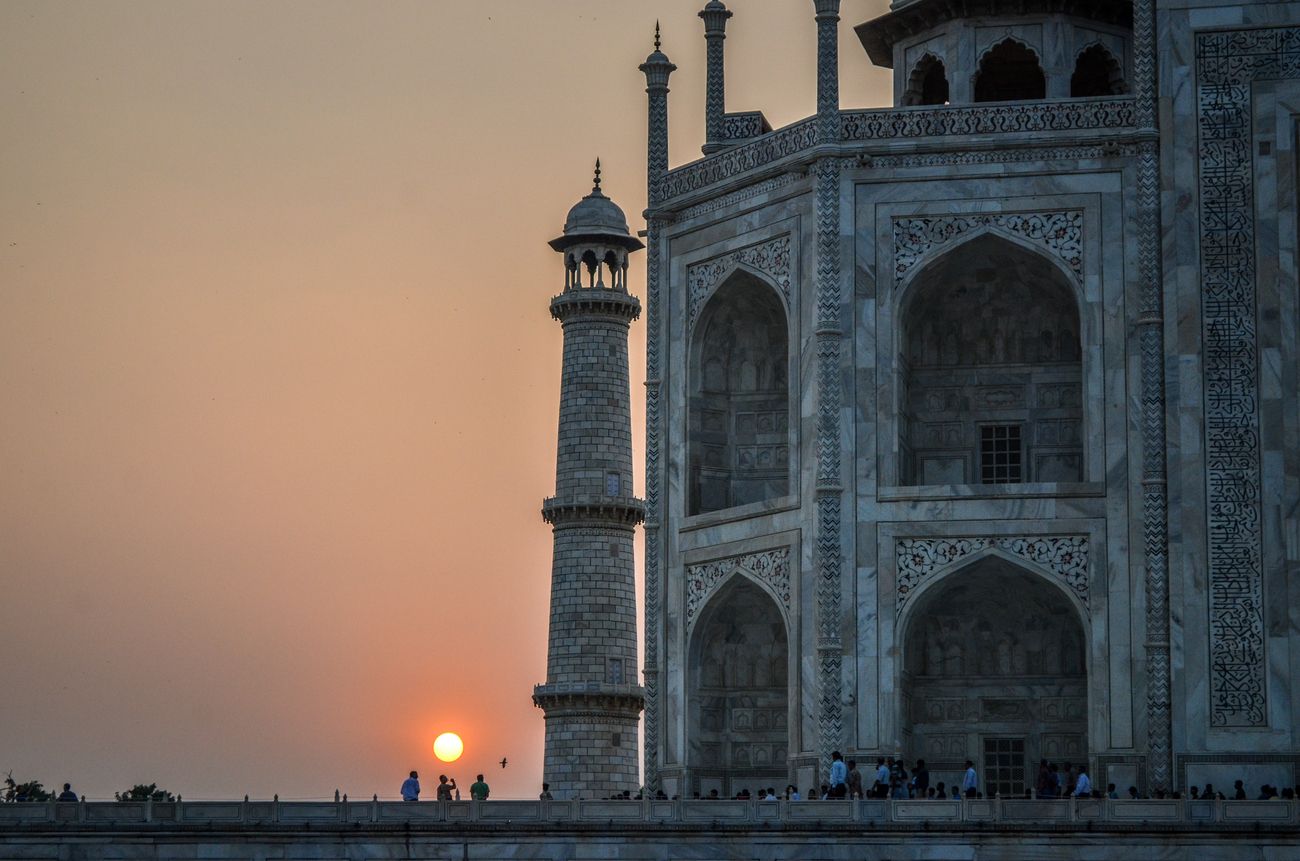
At sunset, the Taj Mahal glows with warm golden light. The complex remains open from dawn to dusk, inviting visitors to witness its shifting beauty. © 33 Degrees Photography

Military police stand watch near the Yamuna River behind the Taj Mahal, guarding the monument day and night. © Paop
Where to Stay in Agra to visit Taj Mahal
Agra has any array of hotels from budget to luxury including the flagship Oberoi Amar Vilas Hotel. Many hotels offer clear views of Taj Mahal.

A traveler relaxes by the poolside of a nearby hotel, savoring an unforgettable view of the Taj Mahal rising in the distance. © Adrian Agylar
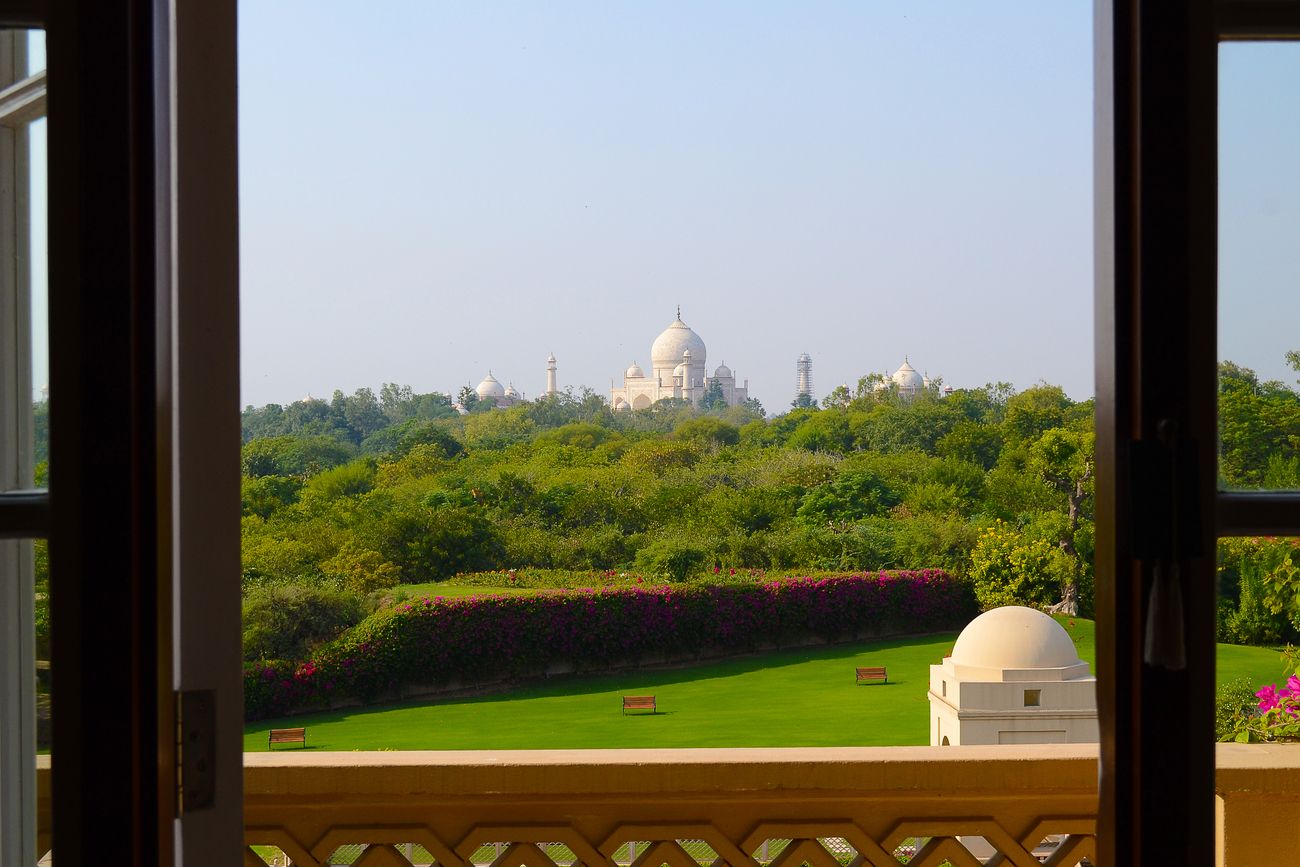
Taj Mahal View From Amar Vilas Resort & Spa: From the luxurious Amar Vilas Resort & Spa—just 600 meters from the Taj Mahal—every room opens to an uninterrupted view of the shimmering marble monument. This Oberoi property blends opulence with the romance of Agra, allowing guests to watch the Taj shift colors from dawn to dusk without ever leaving their balcony. © LunaseeStudios
Cleaning and Restoration of the Taj Mahal
Over time, as pollution increased and the monsoon rains could no longer cope with the yellowish stain on the white marble of the Taj Mahal, it became necessary for a thorough cleansing, the first in 350 years. To restore it to its former brilliance, a special cleaning process was started in 2018 and up till now the mausoleum has undergone five clay pack treatments on its outer walls. The dome will be next in line
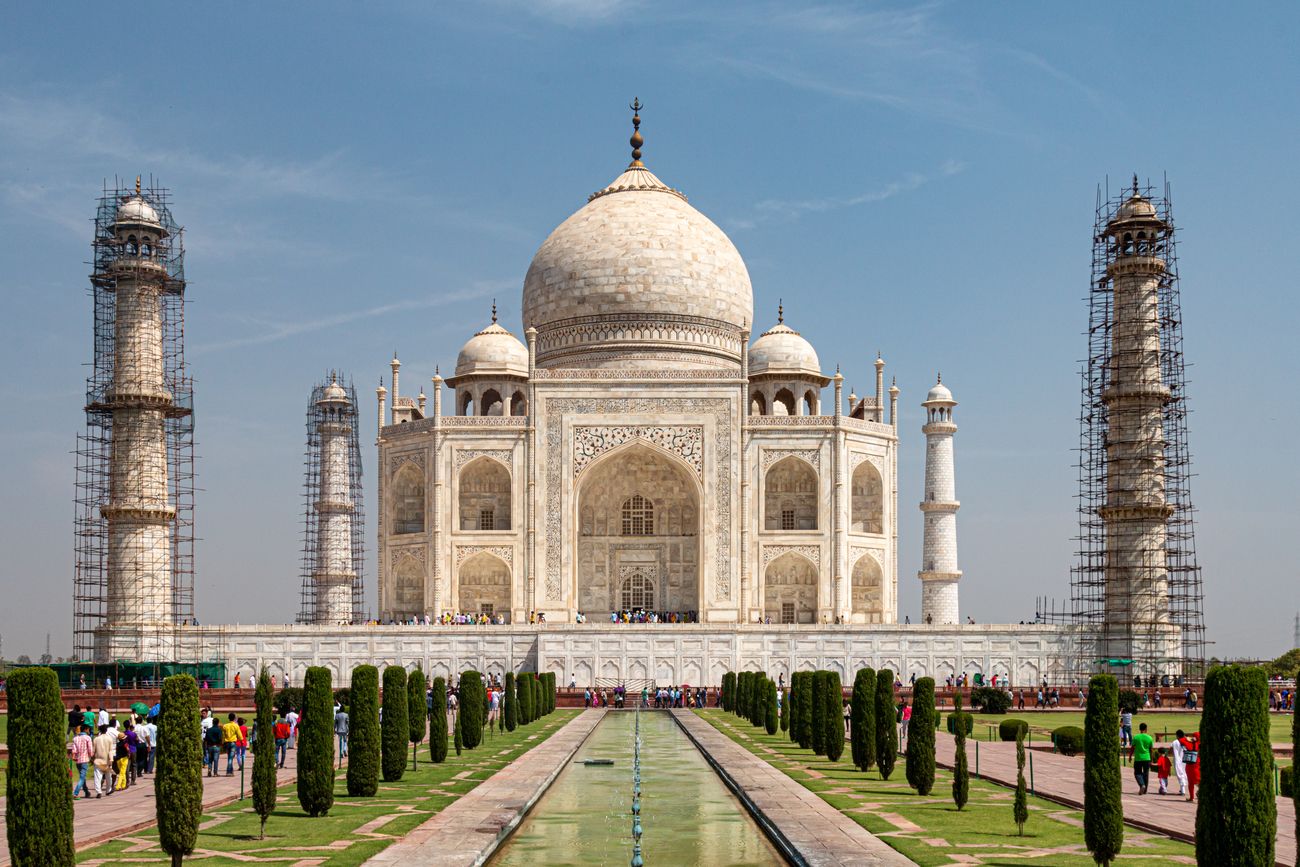
Minaret Restoration in Progress: Scaffolding climbs three of the Taj Mahal’s minarets, clear proof of ongoing restoration work. Since 2018, layers of dust and grime have been gently removed, revealing once again the radiant glow of the 17th-century masterpiece Shah Jahan built for Mumtaz Mahal. Workers apply special clay packs—similar to those used in ancient skincare rituals—to the marble, drawing out impurities. The enormous central dome still awaits its turn, and its cleaning will likely be the most challenging task of all. © Lakshmi Kanth Raju
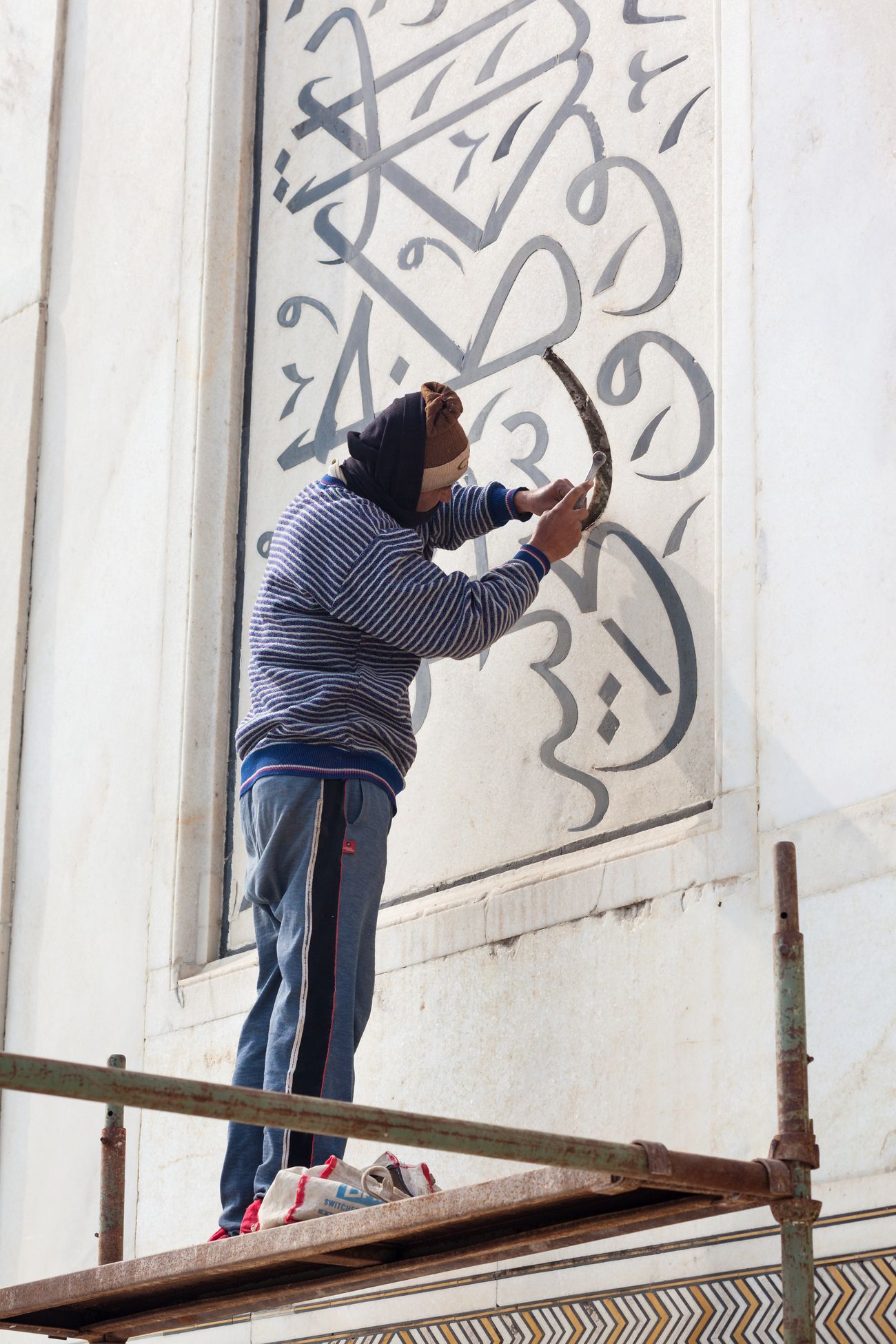
Restoring the Quranic Inscriptions: Perched high on scaffolding, an artisan meticulously restores the bold black Quranic inscriptions adorning the east gate of the Taj Mahal. Each stroke revives the precision and devotion with which Mughal calligraphers once carved these sacred verses into pristine white marble. © antb
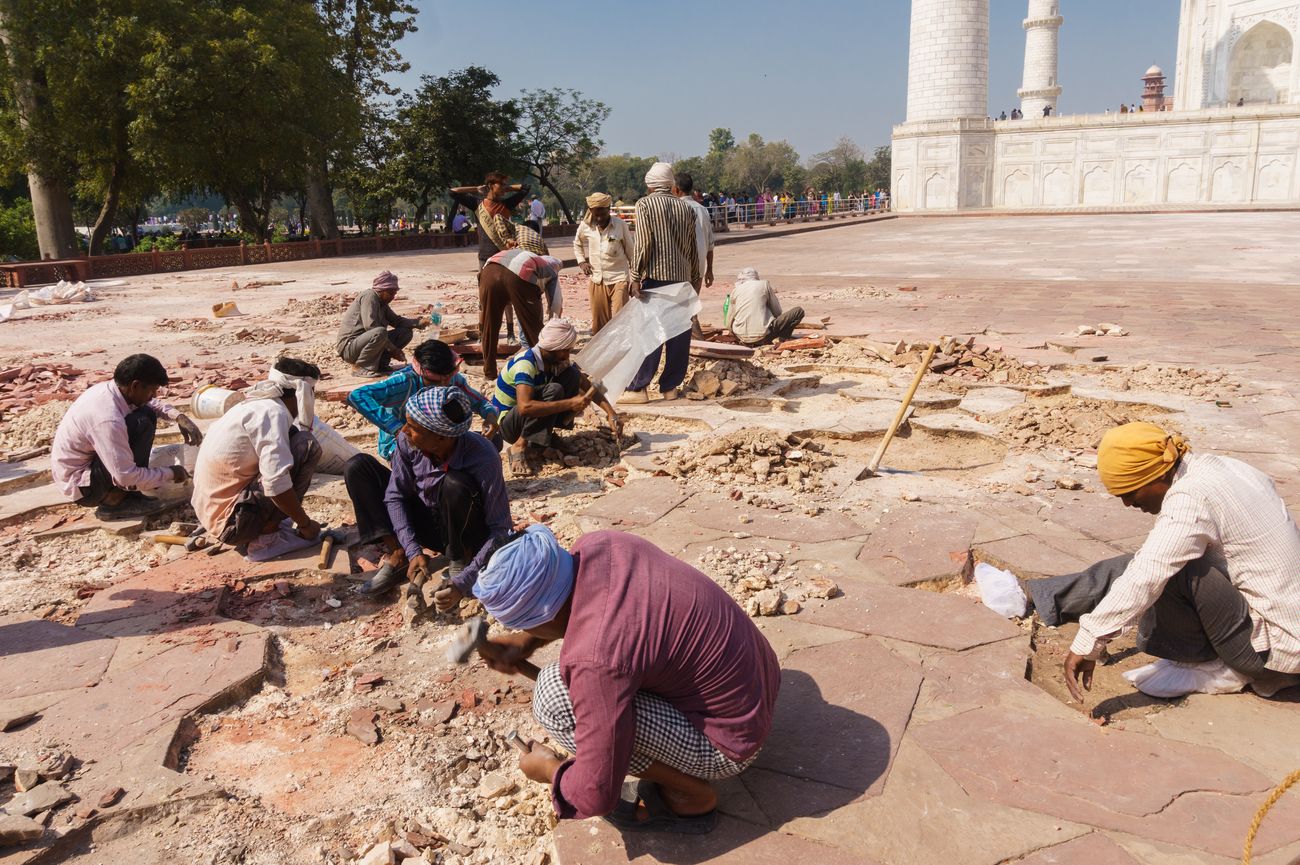
Laborers repair the red sandstone paving around the Taj, ensuring the monument’s surroundings stay as immaculate as the mausoleum itself. © Artaporn Puthikampol
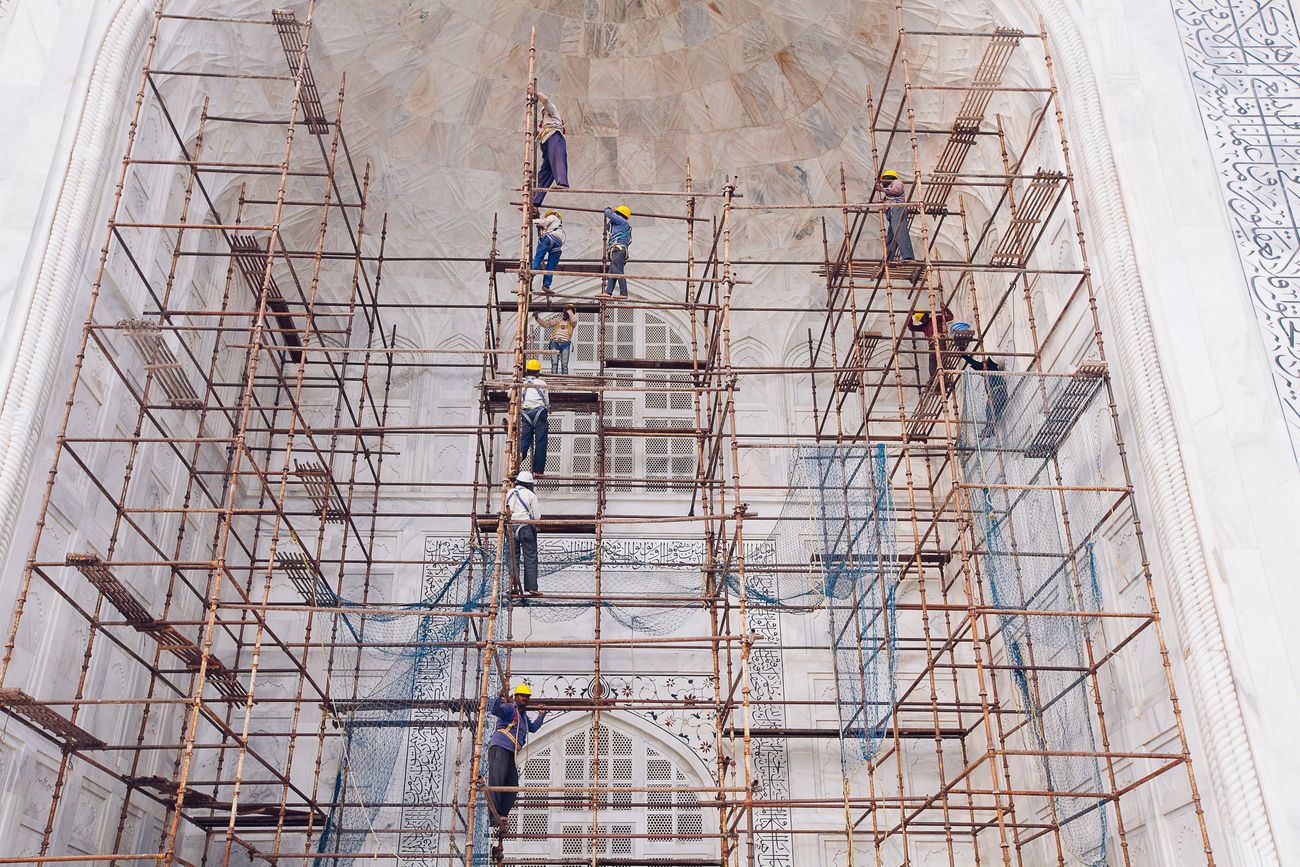
Deep Cleaning With Fuller’s Earth: Restoring the Taj Mahal is a painstaking labor of love. Workers coat the monument with Fuller’s earth, a natural clay rich in aluminum magnesium silicate, which absorbs years of accumulated grime. Once the clay is washed off, the marble emerges sparkling clean—just as it did centuries ago. This ancient technique, once used to purify skin, now keeps India’s greatest architectural jewel glowing. © Tepikina Nastya
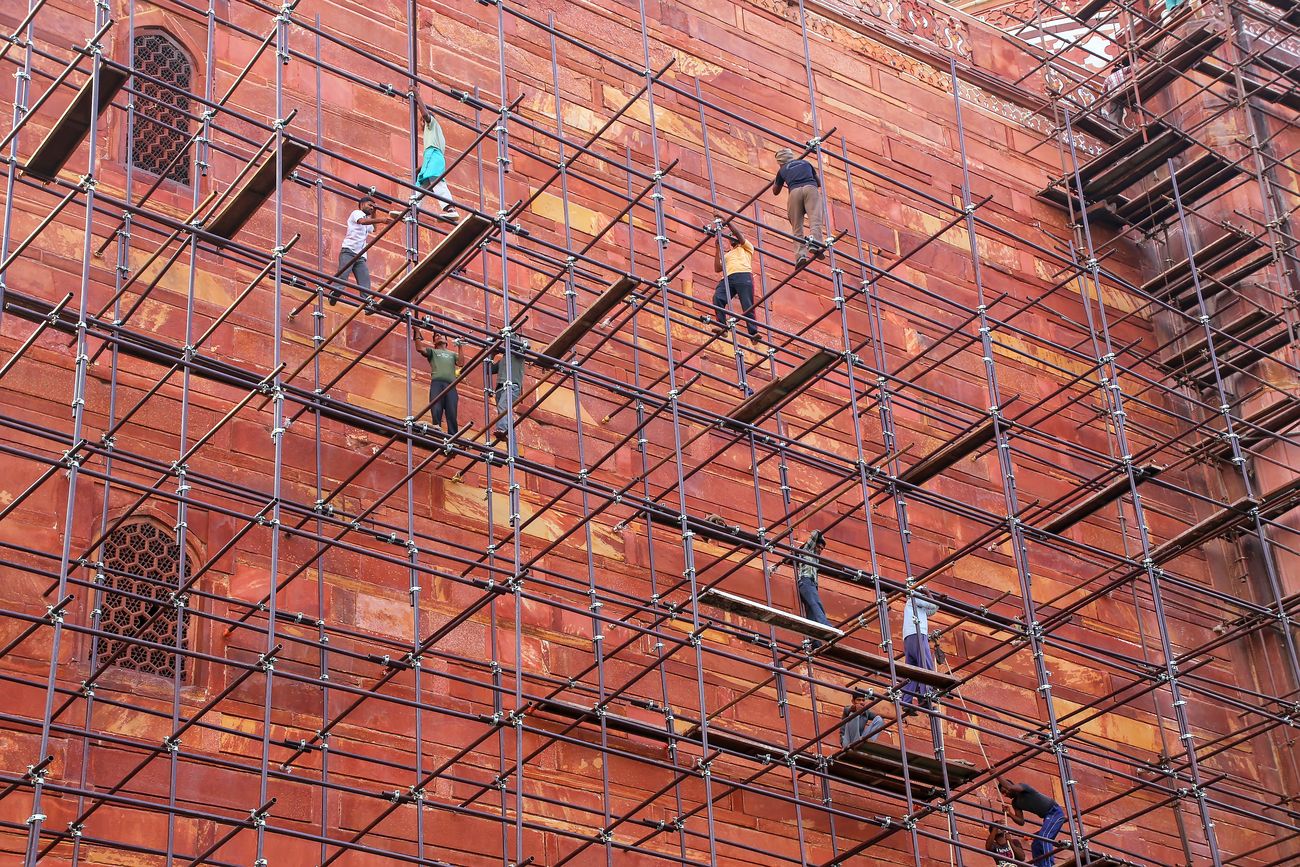
Scaffolding rises around the Taj Mahal’s mosque, preparing it for careful cleaning and restoration. © Don Mammoser
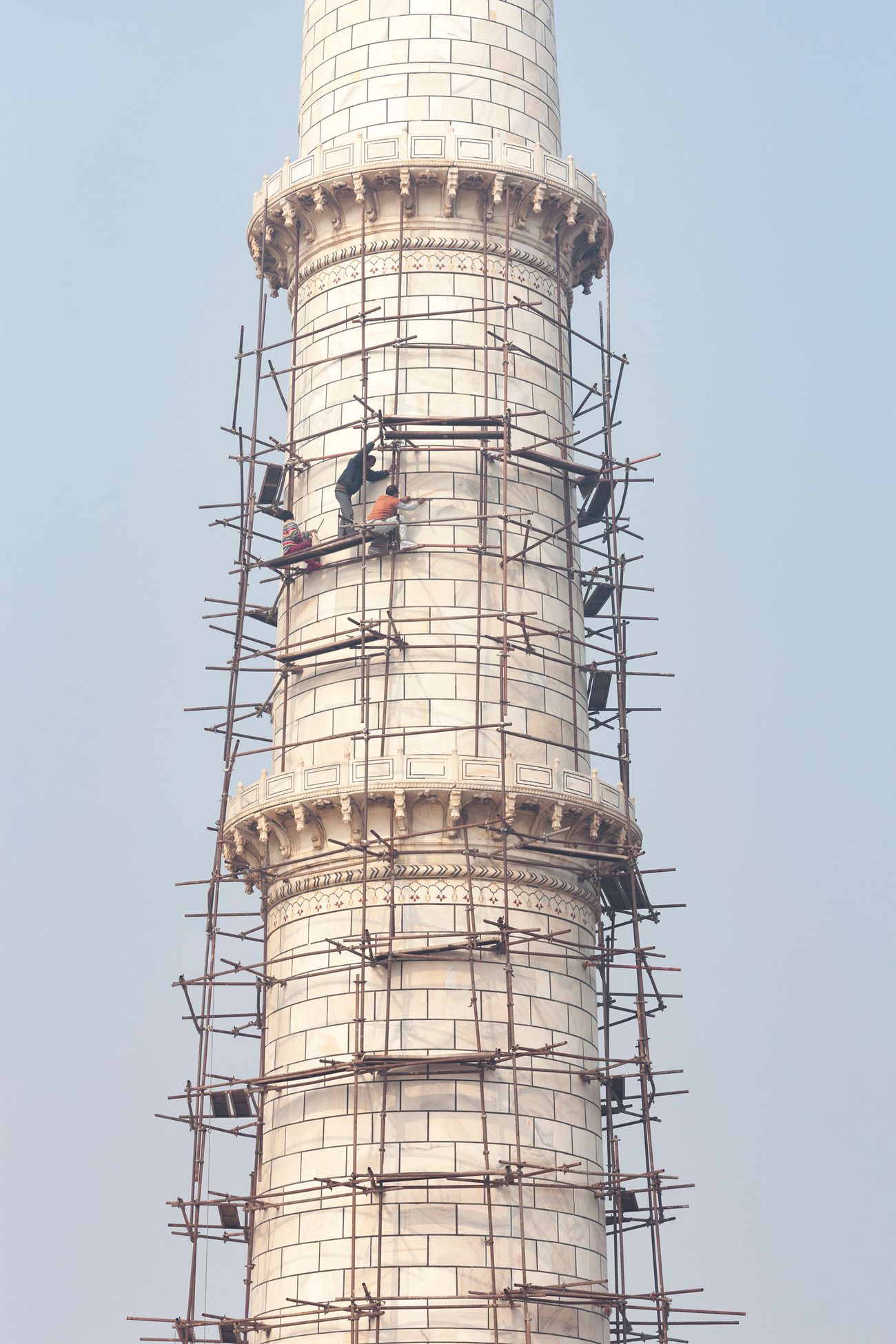
Multistage Cleaning of the Minarets: Because millions of tourists visit the Taj Mahal each year, the restoration must be done in carefully planned stages. Here, three workers stand high on scaffolding to clean and repair the northeast minaret, ensuring the monument remains pristine while keeping visitor access uninterrupted. © antb
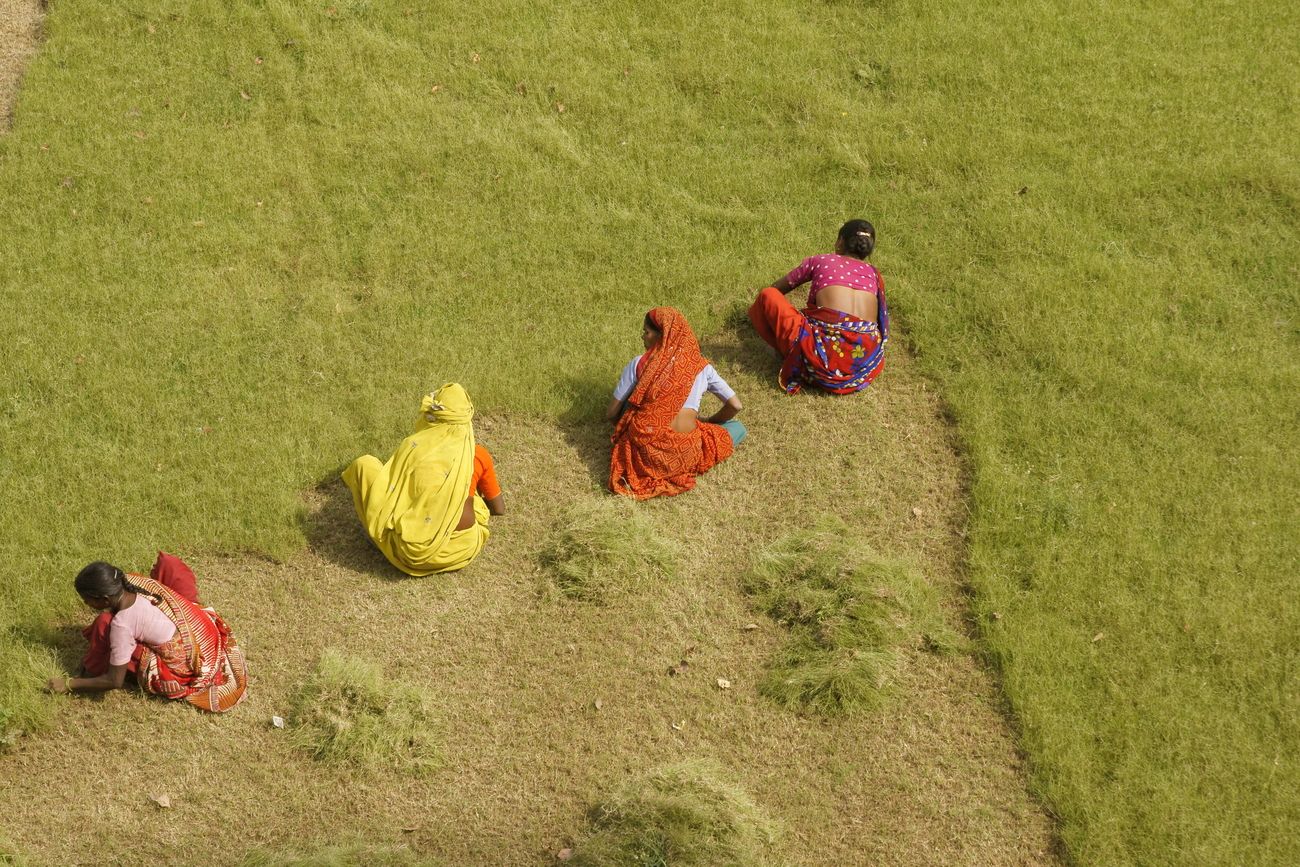
An Indian woman cuts grass by hand near the Taj Mahal, maintaining the gardens in a traditional way that preserves their historic charm. © JeremyRichards
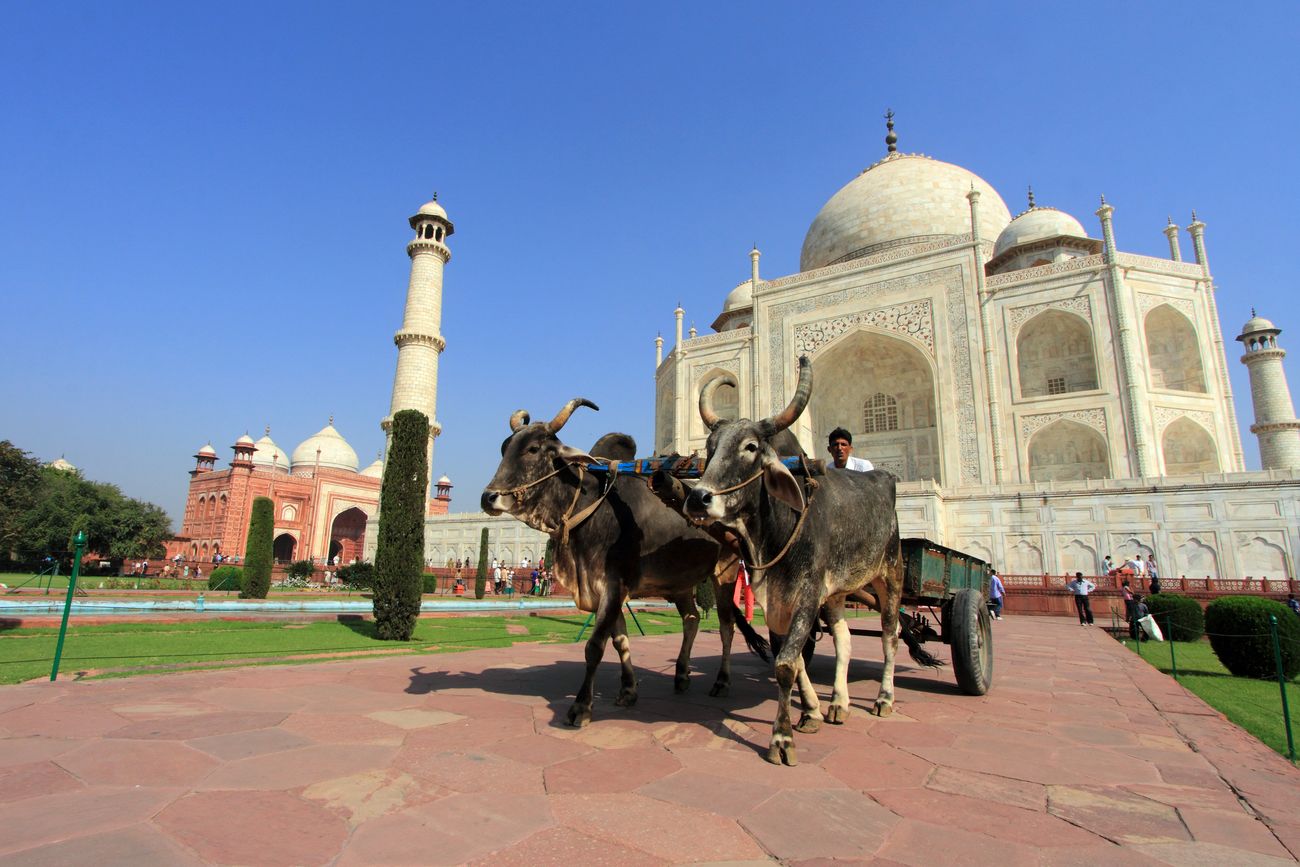
Bullock Carts Carry Restoration Materials: With no petrol or diesel vehicles allowed within a kilometer of the Taj Mahal, even construction materials must travel the eco-friendly way—by traditional bullock cart. These slow, steady carriers transport everything needed for restoration work, preserving both the monument’s purity and the environment around it. © AJP Shutterstock



































![Golden Triangle Tour with Goa [Culture + Beach Vacation] (12 days)](https://www.vacationindia.com/wp-content/uploads/2022/06/golden-triangle-tour-with-beach-vacation-270x160.jpg "Golden Triangle Tour with Goa [Culture + Beach Vacation] (12 days)")











Discover the timeless beauty of the Taj Mahal with a Taj Mahal Tour Package from Delhi. Enjoy a smooth journey to Agra, explore its iconic monuments, and create unforgettable memories with TajWithGuide.
Book Your Tour: http://www.tajwithguide.com
Explore the breathtaking Taj Mahal, discover Agra’s historic treasures, and enjoy a comfortable, hassle-free sightseeing experience.
Book Your Tour: http://www.tajwithguide.com